
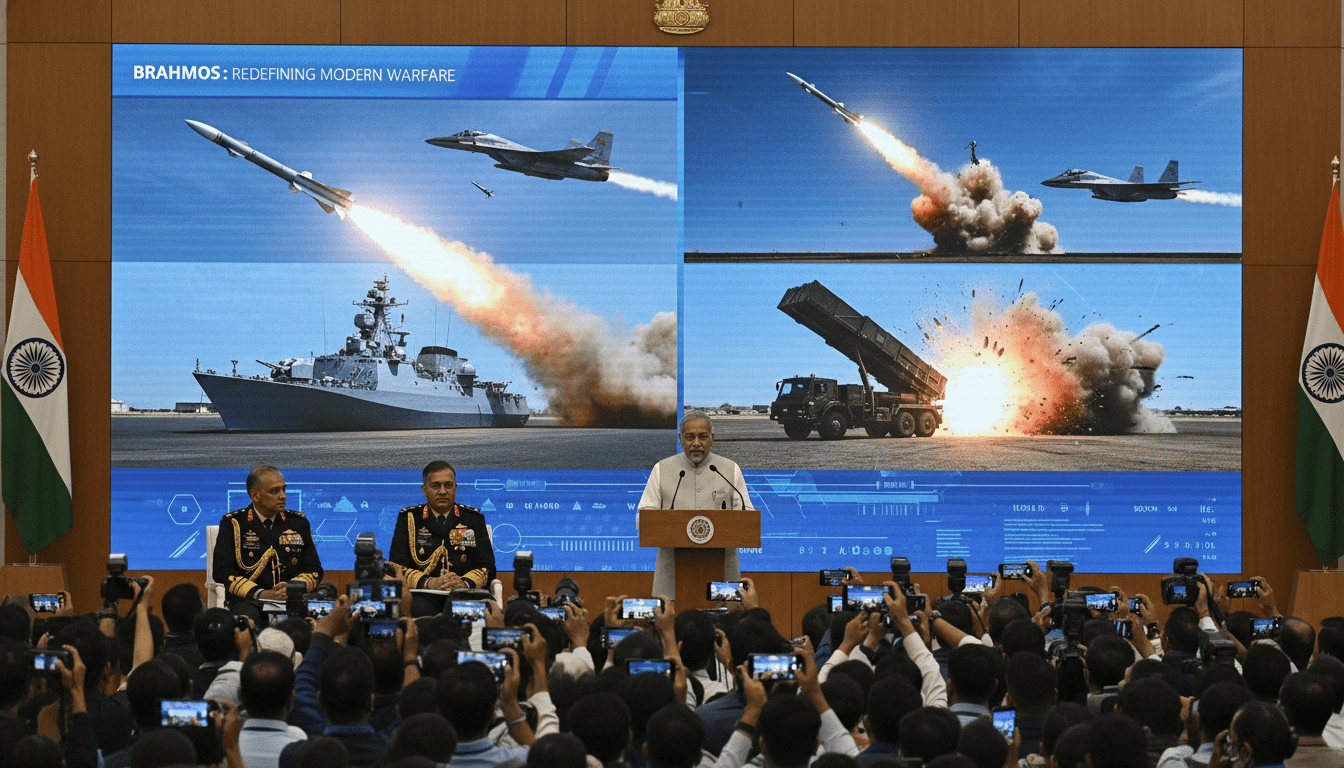
India markets BrahMos missile as export flagship amid strategic debate
India markets the BrahMos missile as a premier export, stressing supersonic precision and multi-platform launch capability while buyers weigh strategic risks.
India’s defence establishment has publicly elevated the BrahMos missile to the center of its arms-export push, presenting the supersonic cruise missile as a transformative capability and a commercial success story. The BrahMos missile, developed since the late 1990s, is being promoted in official material for its speed, accuracy and ability to launch from land, sea, air and submarines. New promotional videos and statements from the Indian Ministry of Defence have framed the system as both a technological showcase and a revenue generator for the domestic defence industry.
India Presents BrahMos as a Sales Success
India’s recent communications portray the BrahMos missile in unequivocal terms, calling it a redefinition of modern warfare and a decisive tool against maritime and land targets. Government-produced clips emphasize the missile’s claimed ability to strike with “highest precision” at supersonic speeds, language designed to attract buyers looking for reliable, fast-strike options. The marketing tone mirrors a broader strategy to deepen defence-industrial ties with foreign partners and to convert prestige technology into export contracts.
India’s export narrative also signals an intent to normalize larger-scale sales of advanced missiles, moving beyond occasional bilateral transfers toward regular commercial practice. Officials frame exports as part of an industrial policy to sustain domestic manufacturing, enhance technological partnerships and expand geopolitical influence through defence ties. The sales pitch blends technical claims with diplomatic messaging aimed at countries seeking to bolster deterrence and coastal defence.
Versatility: Multiple Launch Platforms Highlighted
Promotional materials and technical briefs stress the BrahMos missile’s flexibility, noting that variants can be launched from road-mobile launchers, aircraft, surface ships and submarines. This multi-domain capability is emphasized as a selling point for states with diverse defence needs, from littoral security to island defence and strike operations. The breadth of launch options allows suppliers to offer tailored configurations—naval, land-based or air-launched—depending on a buyer’s force structure.
Buyers attracted to platform versatility cite operational advantages such as deployment flexibility, redundancy and integration with existing command-and-control systems. For nations with limited budgets, the ability to field a missile across platforms can provide a cost-effective path to improving deterrence without procuring multiple, niche systems.
Technical Claims and Strategic Messaging
India’s promotional rhetoric centers on speed, precision and lethality—attributes that the Ministry of Defence highlights to differentiate the BrahMos missile from rival systems. Supersonic cruise flight and a compact, adaptable design are presented as proof points for both tactical effectiveness and survivability against defences. The narrative links performance claims to psychological impact, asserting that the missile’s characteristics will have deterrent value against potential adversaries.
Independent analysts, while acknowledging the platform’s capabilities, caution that marketing materials often condense technical nuance into simple messages. Range, guidance accuracy, warhead options and integration challenges are complex variables that affect operational performance. Potential buyers typically require detailed operational testing, certifications and intelligence assurances before committing to high-value missile acquisitions.
Export Strategy and Potential Markets
India’s export drive comes at a time when several nations are diversifying procurement away from traditional suppliers, creating openings for new entrants. The BrahMos missile is being positioned for states seeking to enhance coastal defence, protect maritime trade routes or deter regional adversaries. Procurement interest is likely strongest among countries with strategic openings for closer military cooperation with India and the logistical capacity to maintain advanced systems.
Beyond direct sales, New Delhi appears to be using potential export deals as leverage for broader defence partnerships, including technology transfers and joint production. Such arrangements can appeal to customers wishing to build local industrial capability rather than merely import finished systems. However, the high cost of advanced missiles and political hesitation in some buyer states remain obstacles to rapid market penetration.
Strategic Concerns and Regional Reactions
The push to export a high-performance missile raises geopolitical and non-proliferation questions among regional observers and security experts. Neighbouring states and rival powers may view wider distribution of supersonic strike systems as a destabilizing factor that could prompt arms races or recalibrations of military doctrine. There are also concerns about the proliferation risk if end-use safeguards and controls are not rigorous and transparent.
Diplomats and analysts stress that export approvals will need to balance commercial interests with commitments under international regimes and bilateral relations. For some recipient countries, acquiring advanced strike capability can alter regional balances in ways that complicate crisis management and maritime security cooperation.
India markets the BrahMos missile as a symbol of its growing defence-industrial confidence, but turning promotional rhetoric into enduring export success will require credible operational data, clear safeguards and careful diplomatic handling. The coming months will test whether marketing narratives translate into signed contracts and sustained industrial ties, and whether buyers and regional actors are willing to accept the strategic shifts such sales could entail.
