
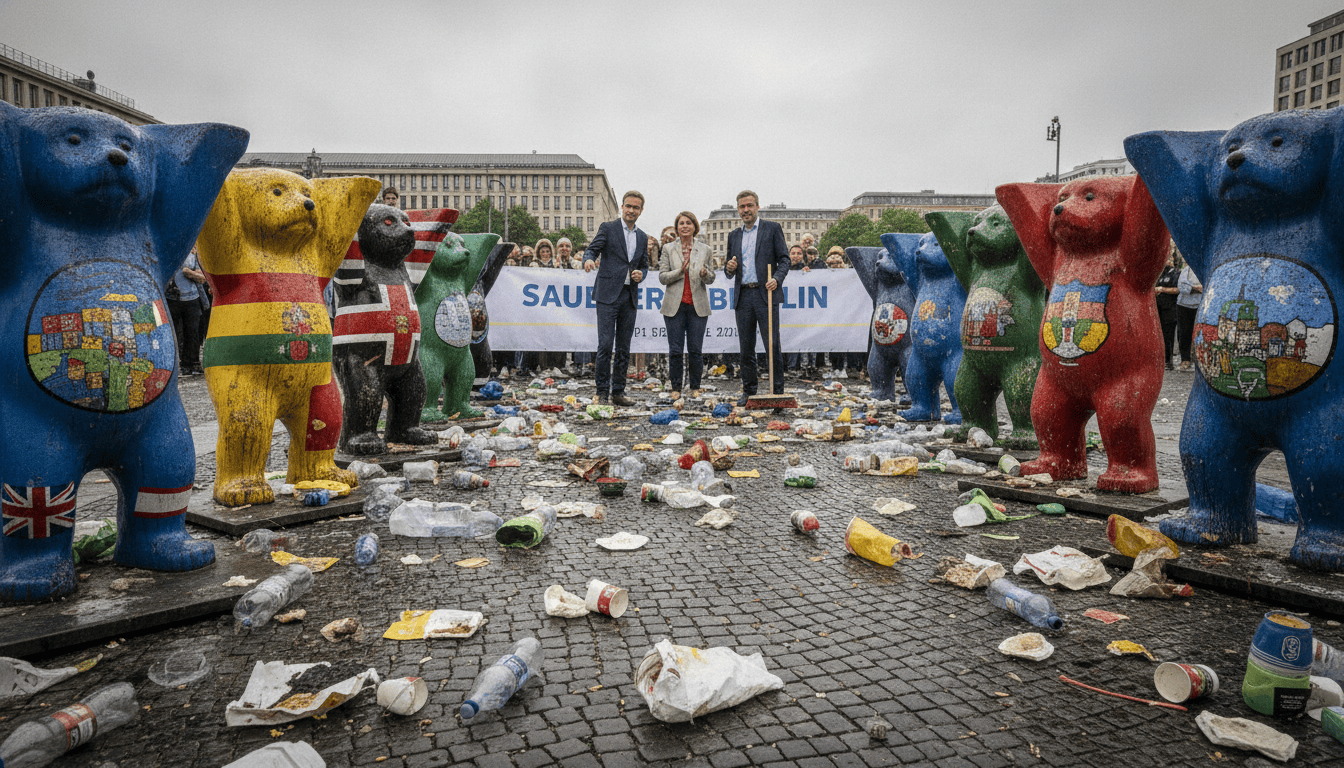
Berlin bears in crates and on podiums: sculptures spotlight a wider debate on the city’s upkeep
A crated bear at Dreilinden has become a vivid symbol as Berlin bears and their varied sculptures prompt fresh debate over public cleanliness, civic pride and election pledges.
Crated bear at Dreilinden draws attention
A sculpted bear at the former Dreilinden border crossing has been placed in a crate for months, its head the only visible part, drawing motorists’ eyes on the A115. The sight has unsettled locals and visitors and reignited discussion about the condition of public art and the city’s visible upkeep. That solitary, partially hidden emblem has become a shorthand for how residents perceive municipal care and cultural stewardship.
From heraldic emblem to everyday mascot
The bear has long served as Berlin’s heraldic animal, a city symbol reproduced on official seals and in public sculpture for generations. Renée Sintenis’s compact bear design is one of the best-known modern incarnations, appearing on the city’s letterheads and roadways, while statues by August Gaul and Hugo Lederer recall earlier eras of civic pride. Over time the animal shifted in character from martial herald to a more amiable, sometimes comic figure in the urban landscape.
Sculptures mirror Berlin’s moods
Across neighborhoods, bear sculptures register different attitudes toward the city: Stephan Horota’s slumped sandstone figure in Prenzlauer Berg reads as weary resignation, while the Buddy Bears scattered around town profess a message of multicultural openness. Some works evoke grandeur of a bygone capital; others reflect postwar improvisation and contemporary ambivalence. The variety of forms and conditions makes Berlin’s bears into a visual diary of civic sentiment.
Election campaigns put cleanliness on the agenda
Municipal politics has folded the issue of public space into campaign platforms ahead of local elections. Steffen Krach of the SPD has prioritized street cleanliness in a “hundred-day” plan that includes free bulky-waste pickups as one early measure. The CDU candidate Stefan Evers proposed obliging certain welfare recipients to help collect litter, framing enforcement and personal responsibility as tools for restoring order. Both initiatives signal that cleanliness has become a political test this season.
Enforcement and public behaviour under scrutiny
There are rules on the books — including fines for littering introduced in recent years — but critics argue enforcement is inconsistent and public compliance unreliable. Prominent political figures have pointed to visible decay in high-profile sites to underscore broader dysfunction; some officials have even linked infrastructure failings to a perception that the capital is poorly maintained. That mix of policy proposals and pointed rhetoric has sharpened public discussion about who should care for shared spaces.
Quality of public space vs. fear of overcontrol
Comparisons with other cities highlight a tension at the heart of the debate: well-policed, well-kept streets can look pristine, yet that order can feel enforced and sterile to some Berliners. Many residents embrace a degree of looseness as part of the city’s identity, valuing tolerance over uniform presentation. At the same time, long stretches of grey façades, neglected storefronts and obvious trash have prompted calls for a civic revival that would not erase Berlin’s characteristic rough edges.
Cultural touchstones and local resilience
Despite criticism, pockets of cultivated beauty endure: museum precincts, redesigned squares, parks, lakes and the former Reichssportfeld still attract everyday life and quiet admiration. Municipal services have shown incremental improvements in some areas, from more responsive citizen offices to municipal reuse markets and expanded childcare offerings. Those small advances suggest that change is often incremental rather than transformative.
The crated bear at Dreilinden, the Buddy Bears outside city halls and the battered fountains of central boulevards together tell a story about Berlin’s current moment: a capital negotiating its image, its infrastructure and the expectations placed on public space. The city’s bears—wounded, jaunty or contemplative—remain public mirrors, reflecting debates about responsibility, aesthetics and what it means to belong in a metropolis that has always been a work in progress.
