
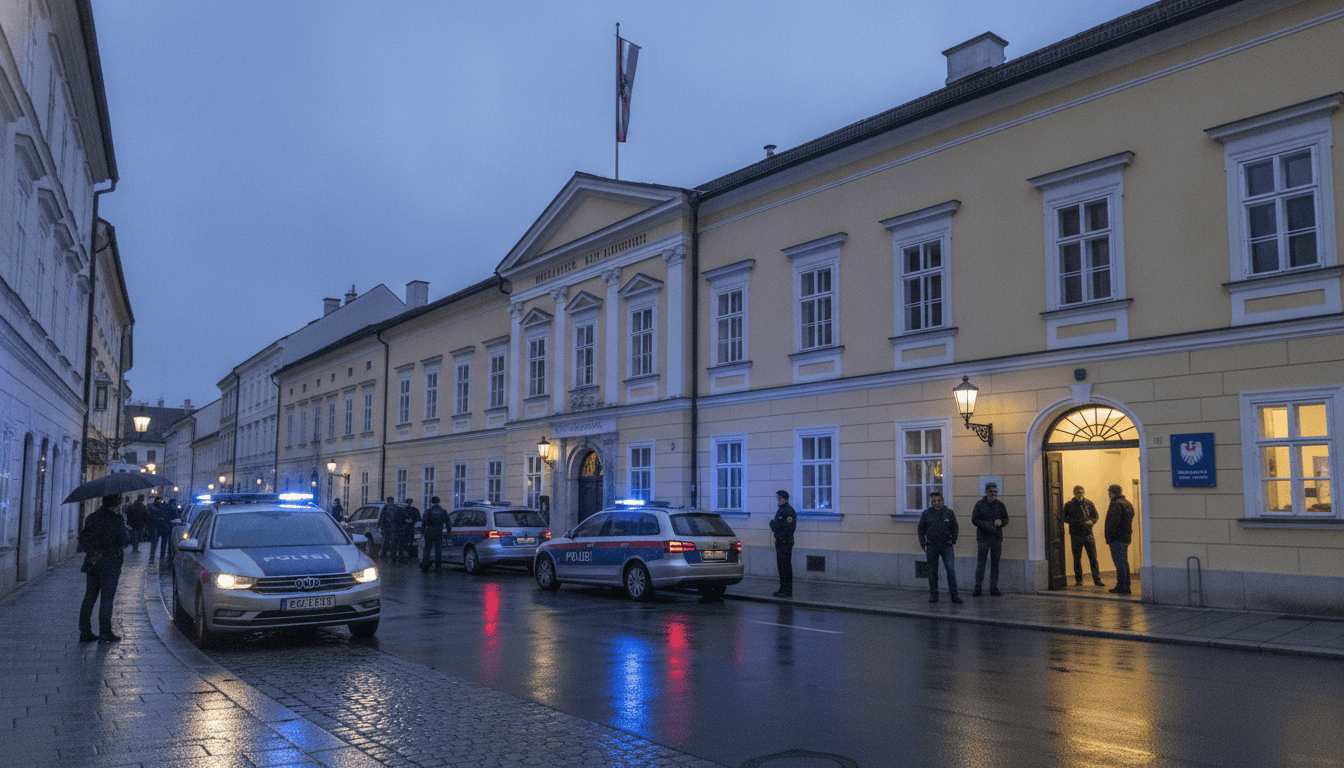
Police move into Hitler’s Braunau birthplace as Austria repurposes contested site
Interior Minister Gerhard Karner will oversee police moving into Hitler’s Braunau birthplace; a roundup of Zambada’s pending sentence, Fields Medal announcements, UNESCO bids and Nestlé’s half-year outlook.
Police to occupy Hitler’s Braunau birthplace
Austria will station police inside Hitler’s Braunau birthplace this week, a move Interior Minister Gerhard Karner will oversee in a formal handover on Wednesday. The decision ends years of debate over the fate of the house in the Upper Austrian border town, which has been the subject of contested uses and legal interventions.
The building hosted a care facility until 2011 and was expropriated by the state in 2016 as authorities sought options to prevent the site becoming a shrine. Officials say the police presence is intended to neutralize the site’s symbolic appeal and give the state direct control over its use and maintenance.
Local officials and historians have argued for a permanent, non-propagandistic purpose for the property while some residents view any attention as unwanted. The move is notable for its explicit aim to remove the house from public mythmaking, and authorities stress the occupation will be administrative and security-focused.
US court to hand down sentence in Ismael Zambada case
A federal court in the United States is set to impose a sentence on Ismael Zambada, the 76-year-old Sinaloa cartel figure known as El Mayo, after his 2024 transfer to US custody. Zambada pleaded guilty to charges tied to drug trafficking and leading a criminal enterprise, and prosecutors have sought a substantial term following his admission of guilt.
Different accounts have circulated about the circumstances of his transfer to US authorities, but court filings indicate Zambada accepted responsibility through counsel and acknowledged harm caused by the trafficking networks he helped run. Sentencing guidelines and the scale of allegations suggest a lengthy prison term, with prosecutors and defense lawyers presenting contrasting portraits of his role and culpability.
Observers say the case underscores the ongoing international cooperation against organized drug trafficking and the challenges of adjudicating transnational criminal leadership. Legal analysts will monitor whether the sentence reflects the seriousness of the offenses and the practical limits of securing convictions against cartel chiefs.
Fields Medal winners to be announced at ICM in Philadelphia
The International Congress of Mathematicians in Philadelphia will reveal the next cohort of Fields Medal recipients on Thursday, continuing a four-year tradition that honors outstanding achievement in mathematics. The prize, instituted by John Charles Fields, occupies a stature in the mathematical community comparable to other global awards for scientific accomplishment.
Past laureates, including Maryna Viazovska in 2022 for her breakthrough on sphere packing in eight dimensions, illustrate the medal’s emphasis on deep theoretical advances. The ICM announcement is closely watched by academic institutions and funding bodies as a barometer of emerging directions in pure and applied mathematics.
Mathematicians and science policymakers often use the occasion to highlight the field’s societal relevance as well as to advocate for sustained research support. Recipients typically receive enhanced visibility, invitations to lecture, and renewed funding for their programs.
UNESCO committee may inscribe Bruno Taut’s Zehlendorf settlement
The UNESCO World Heritage Committee meeting in South Korea this week will consider a slate of nominations that likely includes the Bruno Taut–designed Waldsiedlung in Berlin-Zehlendorf. If inscribed, the settlement would join a global list of cultural and natural sites that totals more than a thousand entries and carries both protections and obligations.
Supporters argue World Heritage status would recognize the settlement’s architectural and social-housing significance and help preserve its distinctive modernist aesthetic. However, local residents and housing advocates have raised concerns that recognition could drive tourism and speculative investment, potentially raising rents and altering the area’s social composition.
Authorities and heritage bodies must balance preservation goals with housing affordability and the settlement’s founding intent as a community for workers and middle-class families. Decisions on inscription often prompt follow-up measures from municipal governments to manage visitor impact and protect vulnerable residents.
Nestlé CEO Philipp Navratil to address investors with half-year figures
Nestlé will publish half-year results on Thursday as CEO Philipp Navratil, in office since September, presents an update on the group’s performance and strategic priorities. The Swiss food giant has faced a string of operational and reputational challenges in recent months, from product recalls to softer profitability, prompting investor scrutiny of management plans.
Navratil has signaled a streamlining agenda and a strategic shift toward higher-growth categories, notably pet care, where the company sees rising consumer spending on premium food and services. Analysts will watch revenue trends across key markets and the outcomes of cost and portfolio adjustments announced earlier this year.
The quarterly report will also be read for clues about how Nestlé intends to address regulatory and quality-control pressures and whether the leadership changes will produce a sustainable recovery in margins and investor confidence.
Austria’s decision on the Braunau property, the pending US sentence for a cartel leader, major academic awards in mathematics, heritage deliberations in Seoul, and corporate strategy at Nestlé illustrate a week of consequential choices across public policy, law, culture and business. Each development carries implications for communities, institutions and international cooperation as officials and organizations seek to reconcile history, accountability and future priorities.
