
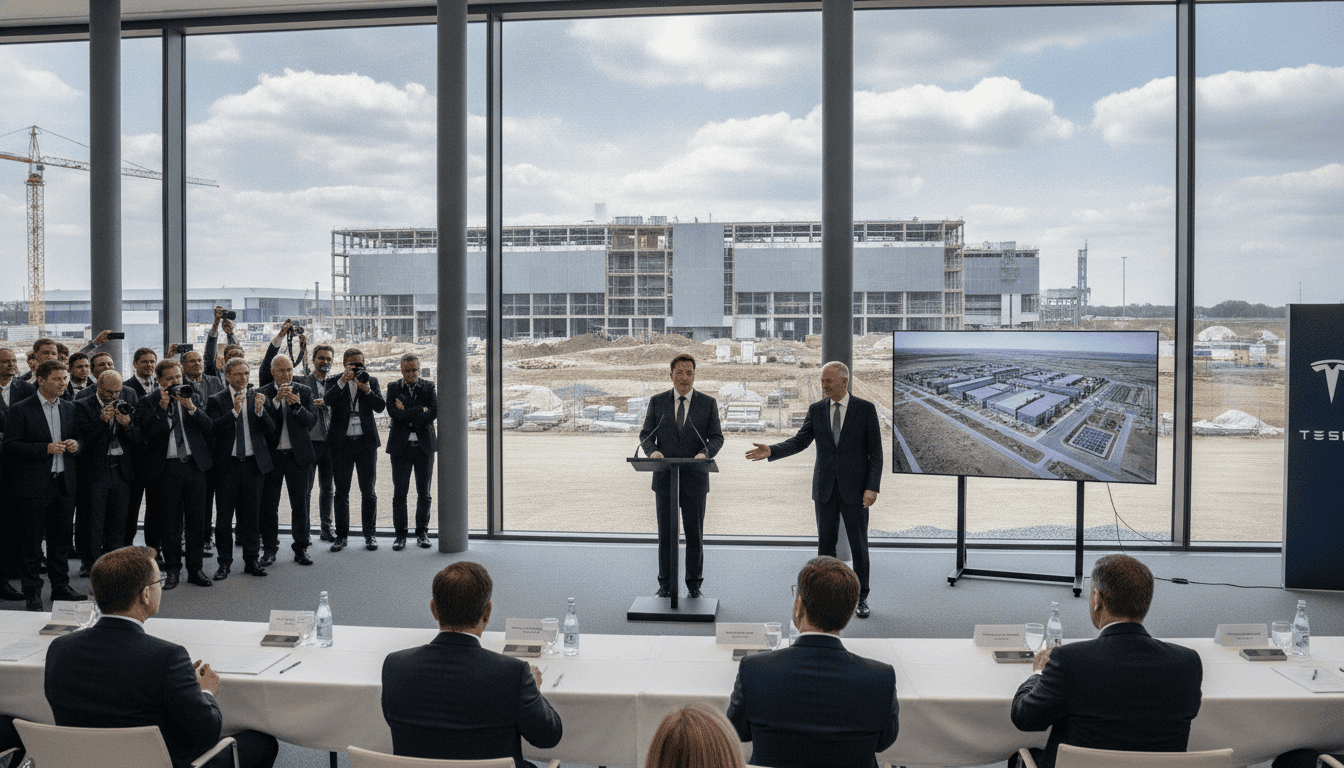
Tesla Grünheide production to expand with battery-cell plans and 3,500 new jobs
Tesla Grünheide production poised for significant growth in 2026, with plans to add battery-cell manufacturing, expand market reach and create 3,500 jobs.
Tesla’s Grünheide factory near Berlin is set to increase output in 2026, the company’s 2025 report indicates, signaling a renewed push to expand both vehicle and battery-cell manufacturing at the site. The report forecasts a “markedly higher” production volume for the 2026 financial year and notes additional state support and rising capacity utilisation as central to the plan. Company officials say the plant will continue to supply more than 30 markets from Germany while seeking to open new ones.
Projected production increase for 2026
The Tesla Manufacturing Brandenburg SE annual report for 2025 projects a significant uptick in production for the 2026 year, driven by model transitions and capacity expansion. Management highlighted government subsidies as a factor that will support higher utilisation of plant capacity. The report frames the planned scale-up as essential to meeting demand across existing and new European markets.
Target output and employment growth
Tesla has announced an ambition to scale production in Grünheide to as many as 7,500 vehicles per week — roughly 375,000 cars annually — a ramp-up that would accompany the creation of about 3,500 new jobs. Company communications describe a strategy to capture more of the vehicle and battery value chain on a single campus, which executives argue will improve efficiency and shorten supply lines. The job increase would reinforce Grünheide’s position as one of Brandenburg’s largest industrial employers.
Battery-cell production and supply-chain caveats
A central element of the expansion is the intended development of battery-cell manufacturing at Grünheide, aiming to consolidate the supply chain from cell to finished vehicle at one location. Tesla’s report acknowledges that establishing cell production in Europe faces “substantial challenges,” noting dependence on economic conditions and secure supply chains. The company stressed that the timing and extent of cell production growth will remain tied to those commercial and logistical realities.
Financial results for 2025
Despite a challenging market backdrop, Tesla’s German subsidiary posted a higher annual surplus for 2025, closing the year with a net profit of €77.1 million — roughly €20 million more than in 2024. At the same time, revenue declined from €7.7 billion in 2024 to €7.1 billion in 2025, a shift the company attributes primarily to lower production costs and the financial effects of model transitions. Management presented the mix as indicative of a stable underlying production base amid a period of product and variant integration.
Production volumes and capacity utilisation
In 2025 the Grünheide plant produced approximately 202,000 vehicles, down by about 9,000 units from the previous year, according to the report. Capacity utilisation at the facility stood at 54 percent for 2025, slightly below the 56 percent recorded in 2024, but the company expects utilisation to rise as new lines and cell production come online. Current assembly at the site focuses on the Model Y, and the planned throughput increase is aimed at addressing variant rollouts and accelerating output.
Environmental concerns and community response
Since its opening in March 2022, the Grünheide factory has drawn scrutiny from environmental groups and local residents, particularly over its proximity to water protection zones. Activists have raised concerns that expanded operations could affect groundwater, prompting protests and legal scrutiny in previous years. Tesla has responded in its filings by stating that the plant does not burden groundwater, while regional authorities and campaigners continue to debate monitoring and mitigation measures tied to further expansion.
Looking ahead, the planned expansion at Tesla’s Grünheide site represents a strategic bet on consolidating European manufacturing of electric vehicles and battery cells at a single campus, while balancing financial performance, workforce growth and environmental scrutiny. The coming year will test how quickly the company can raise production towards its 7,500‑vehicles‑per‑week target, whether cell manufacturing can be economically scaled in Europe, and how regulators and communities respond as the site increases output.
