
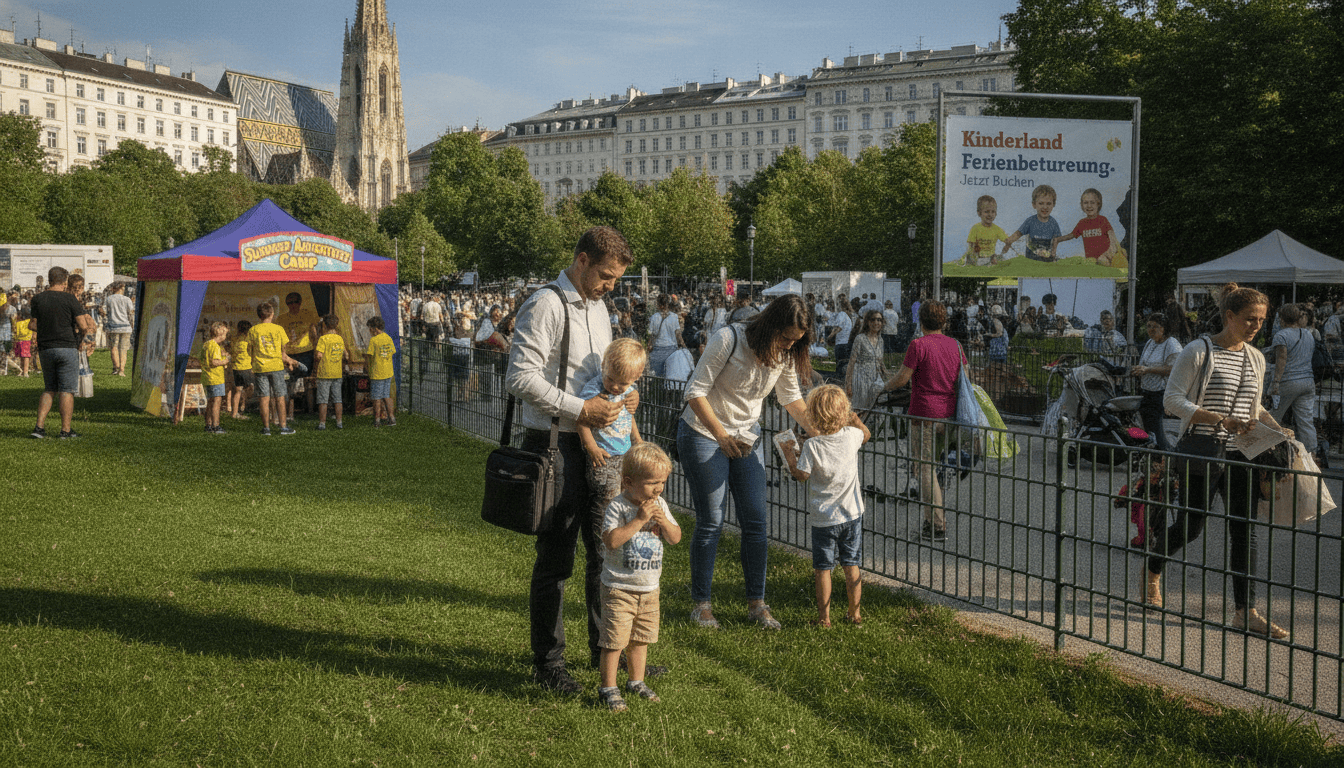
Austria summer holidays leave working parents juggling care and costs
Austria summer holidays strain working parents: study shows nine-week break fuels a booming camp industry, adds costs for families and widens social gaps.
Austria summer holidays have become a logistical and financial strain for many working families, a new survey and market trends show. Parents report juggling calendars, holiday quotas and childcare for the nine-week break while costs for organized care and camps rise. The pressure is driving a growing private market for summer programmes even as questions of access, quality and inequality deepen.
Survey finds nine-week break hard to organise for working parents
A Marketagent survey cited by providers and family organisations found nine in ten respondents consider the long summer period difficult to manage for employed parents. The research identifies balancing work and childcare as the principal challenge and notes that roughly half of those surveyed view the holiday length as excessive. These findings underline that the core problem for many families is not the total number of weeks but the mismatch between school calendars and standard work schedules.
Organizations and parents alike say the practical consequences are immediate: rearranged shifts, split vacations, reliance on relatives and paid care. For households with multiple children the planning burden increases substantially, and many report tapping savings or cutting other spending to cover care costs.
European comparison shows Austria not the outlier, but gaps remain
On a European map of school calendars, Austria’s summer break is not the longest; some countries begin holidays earlier and several have shorter vacations. Nevertheless, the cross‑border comparison matters less to families than the local reality. What matters for Austrian households is the size of the gap between school time and working hours, and the availability of structured daytime options during the summer weeks.
Policymakers and advocates argue that calendar adjustments alone would not solve the underlying care problem, because solutions must align with employment patterns and labour market expectations. The debate is moving beyond mere length of the break to how the weeks are financed and who bears the cost.
Private market expands as camps and corporate programmes fill the gap
A fast-growing commercial sector has emerged to meet demand. Parents increasingly choose short, themed stays, day camps and corporate childcare offerings to bridge daytime coverage. Providers report a shift from three-week stays toward one- and two-week formats that better suit working schedules and budgets.
Market figures cited by operators show families using organised care spend hundreds of euros per child on average, creating a robust market for language camps, outdoor adventure, sports weeks and multimedia programmes. Companies are also investing in workplace childcare to reduce summer absenteeism and support employees, signaling that the cost of the break is being socialised in a range of private and employer-funded ways.
Established providers adapt quality and capacity to parental expectations
Longstanding providers such as Young Austria have reshaped offerings to meet changing demand, focusing on younger age groups, improved safety standards and shorter durations. Family-run organisations point to higher operating complexity and staffing needs: a core team supplemented by large numbers of seasonal supervisors and trained specialists is now commonplace.
The Austrian Alpine Club (Österreichischer Alpenverein) and other reputable organisations emphasise quality over quantity, citing the need for trained staff, safety concepts and group management expertise—especially for outdoor and adventure programmes. Providers say clear child-protection policies and favourable child-to-staff ratios are central selling points for concerned parents.
Costs and access fuel debate over social inequality
Rising prices for camps and overnight stays have sharpened concerns about social equity. A camp can provide vital respite and developmental experiences, but it can also be a significant expense that not all families can afford. Analysts warn that unequal access to summer programmes risks turning school holidays into a marker of social disadvantage.
Public discussions now include not only adjustments to the school calendar but also proposals for subsidised places, employer-supported options and community-based day programmes. Advocates argue that addressing affordability is as crucial as ensuring quality and safety.
Trends: sport, nature and a negotiated role for digital media
Sport-oriented camps, especially swimming and emerging trend sports, remain among the most booked formats, while nature and adventure programming are marketed as digital detoxes and community-building opportunities. At the same time, multimedia and technology-focused courses are growing, reflecting children’s changed media habits and parental demand for both exposure to and respite from screens.
Providers report that children today expect more regular contact with home, which shapes routines and communication policies at camps. Camps must balance supervised connectivity with planned offline activities to satisfy both children’s needs and parental expectations.
Demand continues to outpace supply in many regions, prompting calls for greater public and employer involvement in summer childcare planning. Organisers say scaling responsibly requires investment in training, facilities and oversight to maintain standards while expanding capacity.
The conversation around Austria summer holidays is evolving from a narrow education-policy question into a broader discussion about work–family compatibility, market responses and social solidarity. As private providers grow and diversify, policymakers and communities face choices about funding, regulation and how to ensure that the summer break serves all children and families, not only those who can afford it.
