
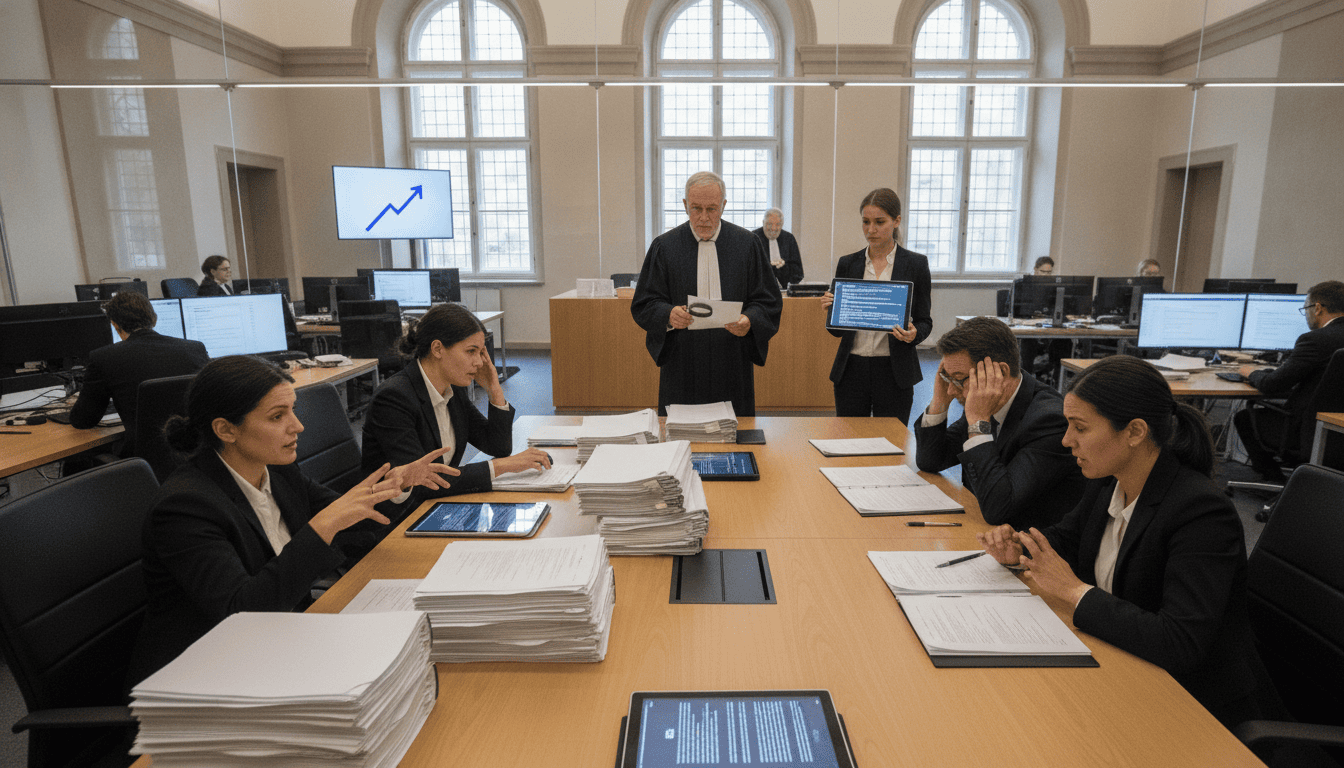
Shortage of social lawyers strains German courts as unrepresented claimants and AI filings surge
Germany’s shortage of social lawyers is squeezing access to justice, leaving many claimants unrepresented and courts burdened with AI-drafted emergency filings.
Case in Frankfurt court highlights problem
A routine hearing at the Frankfurt Social Court opened with a simple fact: a pensioner’s income was too low to cover rent and rising utility costs, and she sought municipal help to pay a 140-euro arrear. The woman, who attended without legal counsel, was confused about whether the dispute even concerned a parking space, revealing the everyday disorientation faced by self-represented litigants. Her empty chair for legal representation underlined a broader pattern in which vulnerable people must navigate complex social-law procedures alone.
Judges and court staff repeatedly said such scenes are familiar across Germany, where plaintiffs often come without counsel or with paperwork generated by automated tools. The case in Frankfurt closed quickly once the facts were clarified and the city confirmed it had already paid the sum, but the brief resolution belied the systemic strain visible in many other matters.
Federal figures show steady decline in social law specialists
Data from the Federal Bar Association indicate a sustained fall in the number of lawyers specializing in social law, dropping from 1,838 in 2020 to 1,551 at the start of this year. The decline has prompted concern from the Federal Social Court, whose president described the trend as “alarming,” noting a rise in proceedings where claimants arrive without counsel. Courts report increasing difficulty finding counsel even where process-fee assistance is granted, and higher courts must sometimes solicit representation on behalf of unrepresented parties.
The shortage is not evenly felt everywhere, but in regions with heavy caseloads the impact is tangible: hearings become longer, judges must explain legal concepts in lay terms, and the capacity for in-depth case management is reduced. Legal aid mechanisms exist, yet they are under pressure as more people apply because they cannot find a willing attorney.
Practitioners cite complexity and poor remuneration
Experienced social-law practitioners point to two central causes: the technical complexity of the field and inadequate financial compensation. Social law covers an extensive range of issues — from unemployment and pension disputes to long-term care and pandemic-related claims such as Long Covid — and statutes change frequently, obliging lawyers to invest substantial time in continuing education. At the same time, statutory fee structures under the Lawyers’ Remuneration Act often yield sums that do not reflect the work involved.
One practitioner described a typical disability-pension case in which months of document collection and written submissions culminate in a fee settlement of only a few hundred euros from a legal expenses insurer. For lawyers managing overheads and staff costs, such cases can be loss-making, prompting many to decline work funded solely by legal aid or insurance at standard rates. The result is fewer attorneys accepting routine social-law matters, especially for low-income clients.
Courts struggle with AI-drafted emergency filings
Judges and court presidents also report a new complication: an influx of emergency applications written with the assistance of general-purpose AI. In one large federal state, social courts registered 3,583 urgent filings in the first quarter of 2026 — a 162 percent increase from 1,367 a year earlier — a surge largely attributed to claimants using AI to prepare submissions. Those filings are often lengthy, unfocused and contain multiple, sometimes conflicting requests that judges and clerks must untangle.
Court officials say AI-generated documents frequently omit essential factual detail or attach excessive, irrelevant material, increasing workload rather than easing it. Where an attorney would frame a concise legal claim and attach key evidence, many AI-drafted pleadings require additional clarification and procedural steering, prolonging pre-trial processing and delaying resolution.
Calls grow for political and systemic response
Judges, court presidents and practitioners agree that remedies will require political action as well as professional adaptation. Proposals include revising fee schedules to better reflect the work involved in social-law cases, expanding legal education on social law, and investing in court-based or publicly funded legal advice services for vulnerable litigants. Stakeholders also advocate for developing AI tools tailored to social-law procedures that can assist citizens without substituting qualified legal advice.
Social welfare organizations and some courts have tried to fill gaps through counseling and pro bono projects, but those efforts fall short of meeting demand. Legal professionals caution that any AI solution must be calibrated to legal standards and supervised by experts; otherwise it risks propagating poorly structured claims that further burden courts.
For now, the snapshot offered by the Frankfurt hearing — an elderly claimant, no lawyer at her side and a short, ambiguous proceeding — is emblematic of a system under pressure. Courts say access to justice remains a cornerstone of the social state, but securing that access may require clearer funding, updated professional incentives and technological tools designed specifically for social-law needs.
