
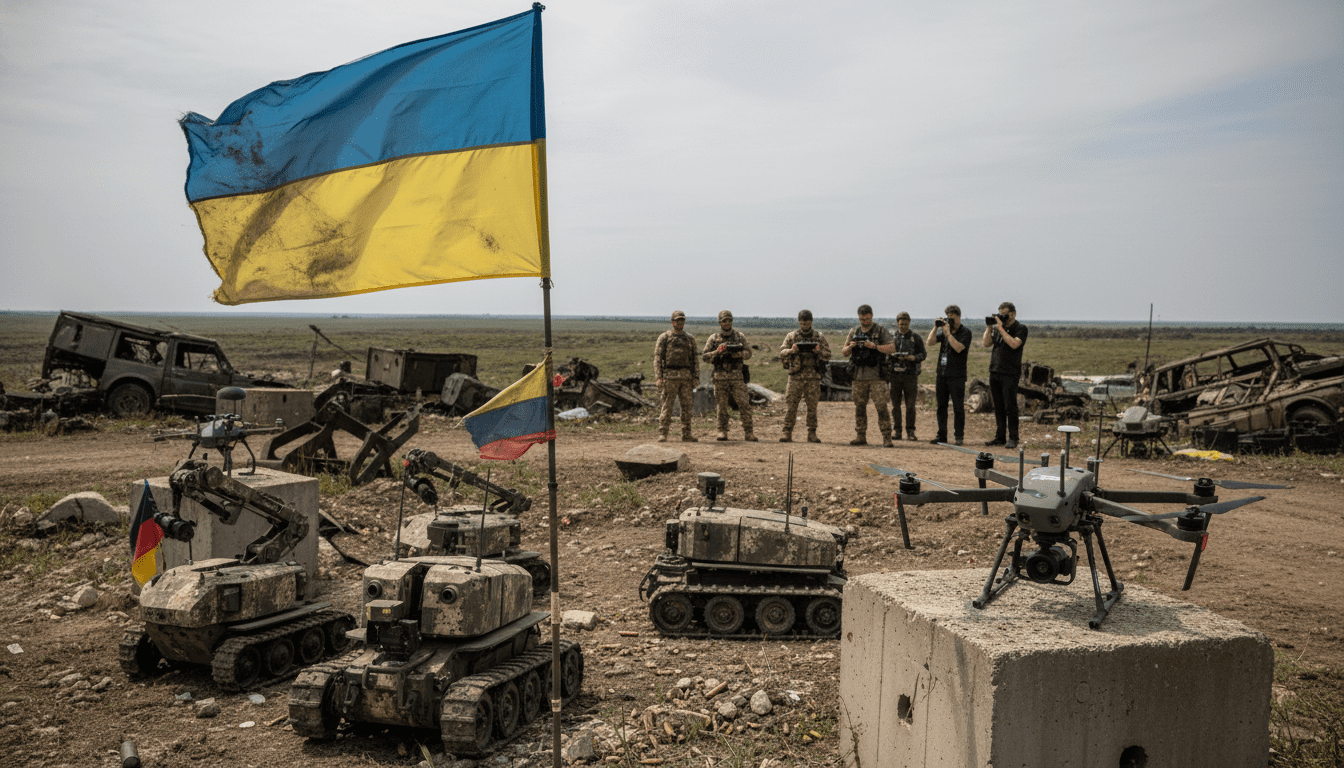
Ukraine Says Unmanned Systems Seized Position, Renewing Autonomous Weapons Debate
Ukraine’s announcement that it captured an enemy position using only unmanned systems has reignited global debate over autonomous weapons, legal oversight and battlefield risk.
Ukraine’s president said forces used ground robots and aerial drones alongside other unmanned weaponry to occupy a contested position, marking what he described as a tactical first in the conflict. The claim places autonomous weapons at the center of a renewed conversation about military innovation, ethical limits and the future of warfare.
Official claim and battlefield details
Ukrainian authorities reported the operation as a coordinated employment of ground robots and armed drones that allowed troops to take a position without direct human presence on the assaulting front. Officials framed the action as a demonstration of tactical ingenuity and an evolution in force multiplication under high-threat conditions.
Independent verification of the precise role of autonomous decision-making in the operation remains limited, and military analysts cautioned that “unmanned” can describe a wide range of systems from remotely piloted vehicles to algorithms that make targeting recommendations. That nuance matters when assessing whether weapons acted autonomously or under human command.
Reactions split between praise and concern
The announcement drew immediate praise from supporters who see unmanned systems as force multipliers that reduce soldier exposure and increase operational tempo. Proponents emphasize that integrating robotics and drones can lower casualties and offer asymmetric advantages against conventional forces.
At the same time, human-rights groups and some legal scholars warned that greater reliance on autonomous weapons risks eroding accountability and normalizing the removal of humans from lethal decision loops. Critics say such shifts could lower thresholds for violence and make war more clinical but not necessarily more lawful.
Legal framework and the rules of war
International humanitarian law applies regardless of the technology used, including autonomous weapons, but translating legal principles into technical constraints proves difficult. States and experts continue to debate how to ensure distinction, proportionality and accountability when algorithms play a role in sensing and engagement decisions.
Efforts at the United Nations in Geneva to agree binding limits or definitions of “lethal autonomous weapons systems” have stalled for years, reflecting deep disagreements over terminology and scope. The result is a patchwork of national policies and emerging doctrines rather than a cohesive international regime.
Operational risks highlighted by recent incidents
Real-world conflicts have exposed operational hazards tied to imperfect data and system design, underlining that automation can amplify underlying intelligence failures. Investigations into strikes in recent years have pointed to outdated or incorrect targeting information as a factor in tragic outcomes, demonstrating how technical errors can have severe humanitarian consequences.
Experts stress that risk management requires transparent decision trails, robust verification of data inputs, and clear lines of responsibility across command chains. Those safeguards are essential whether a system simply assists human decision‑makers or acts with greater autonomy.
Why broad bans on autonomous weapons are contested
Calls for a blanket prohibition on autonomous weapons encounter practical and conceptual obstacles because automated tools exist on a spectrum of capability. A strict definition that bans any system capable of independent target engagement could inadvertently include air-defence systems and other platforms considered indispensable for national defence.
Policymakers who favor regulation argue for narrowly tailored rules focused on unacceptable effects rather than sweeping technological bans. They propose measures that distinguish between assistive automation, human-in-the-loop systems, and fully autonomous lethal decision-making, each with different legal and operational thresholds.
Strategic implications for Europe and Germany
The unfolding use of unmanned systems in Ukraine places European governments, including Germany, in a strategic dilemma between ethical caution and operational necessity. Heavy skepticism could leave European militaries without capabilities that competitors are rapidly fielding, while unchecked adoption risks legal and humanitarian blowback.
For European policymakers the choice involves balancing procurement, doctrine development and public debate. Integrating military AI in a way that preserves democratic oversight and complies with international law will be a central policy challenge in the coming years.
The episode underscores that the rise of autonomous weapons is not a hypothetical future but an active element on today’s battlefields, forcing governments to reconcile innovation with legal duties and humanitarian concerns.
