
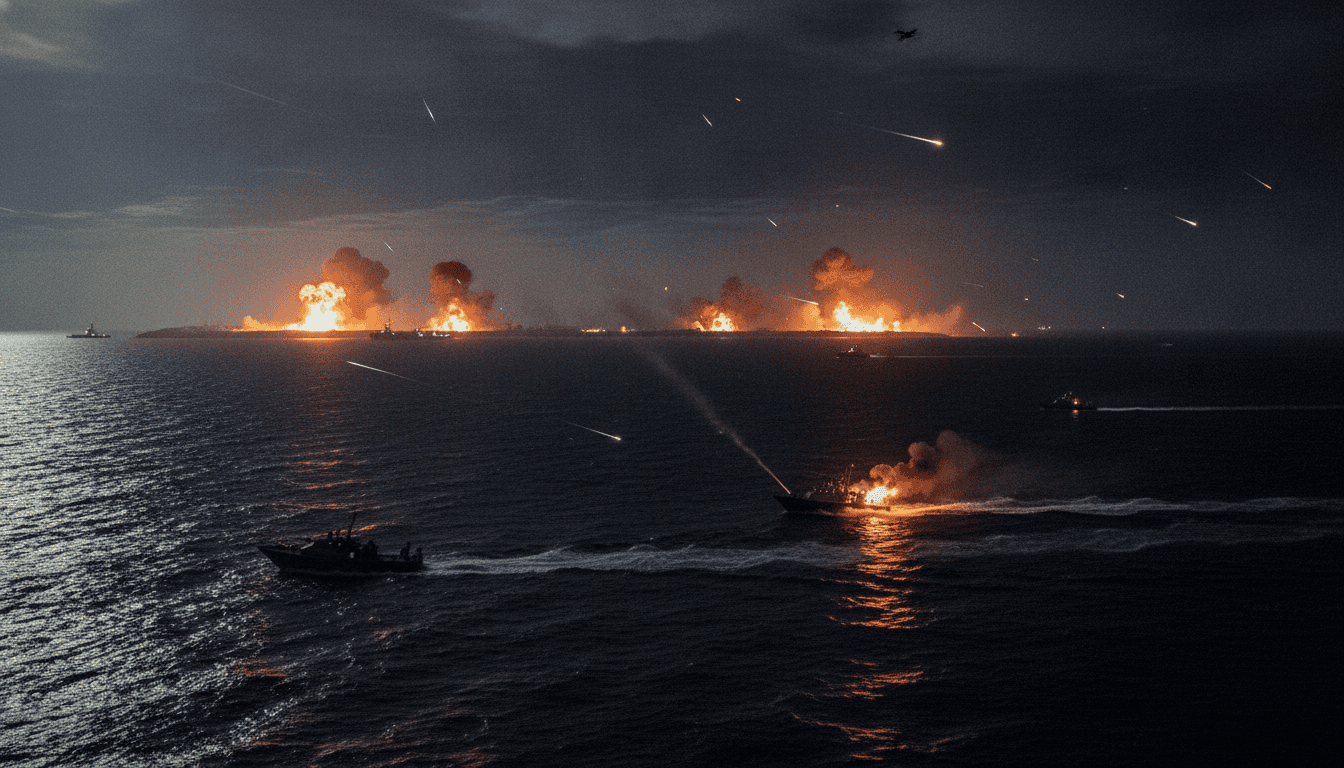
US and Iran Exchange Strikes Near Strait of Hormuz After Attacks on Merchant Ships
US strikes hit Iranian coastal defenses after Tehran was accused of attacking three commercial vessels in the Strait of Hormuz, prompting Iranian counter‑attacks and regional alarm.
Overnight U.S. Strikes on Iranian Coastal Targets
The United States military said it struck multiple Iranian air‑defense systems, coastal radars, anti‑ship missile batteries and more than 60 vessels it identified as belonging to the Islamic Revolutionary Guard Corps (IRGC). Washington described the action as retaliation after Iranian forces allegedly attacked three merchant ships in the Strait of Hormuz on Tuesday. Tehran disputed the U.S. account, characterizing many of the vessels targeted by Washington as small fishing boats rather than military craft.
The strikes mark a sharp escalation in a pattern of tit‑for‑tat operations that have repeatedly tested control over the vital shipping lane. U.S. and Iranian statements on the sequence and nature of the incidents diverge sharply, complicating efforts by outside parties to independently verify the full extent of damage or casualties.
IRGC Retaliation Strikes U.S. Positions in Region
In response to the U.S. strikes, Iran’s Revolutionary Guard reported drone and rocket attacks on American military facilities in Kuwait and Bahrain. Kuwaiti authorities confirmed that several projectiles were intercepted or impacted in the vicinity of military installations, though they provided limited detail on damage or injuries. U.S. officials acknowledged incoming fire and described the responses as part of an unfolding exchange that risks further widening.
The rapid exchange of fire between Iranian proxies and U.S. forces underscores how quickly maritime incidents can spill into attacks on land‑based assets. Regional militaries and coalition partners have strengthened patrols in the Gulf in recent weeks, but officials warn that even limited engagements carry the potential to provoke miscalculation.
June Memorandum Under Strain After U.S. Sanctions Move
A fragile memorandum agreed in June between Washington and Tehran intended to reduce immediate tensions around the Strait of Hormuz is facing renewed strain. U.S. authorities revoked a special license that had temporarily permitted certain Iranian oil sales, reinstating the broader sanctions regime governing Tehran’s energy exports. That step immediately narrowed potential buyers for Iranian crude and renewed pressure on Tehran’s economy.
Analysts note the revocation deprived Iran of a predictable flow of buyers such as South Korea, Japan and India, which had held back purchases pending clarity about the arrangement. Without the special license, Tehran has increasingly relied on smaller Chinese refiners willing to purchase oil at steep discounts, a dynamic that reduces Tehran’s negotiating leverage and heightens domestic economic pressures.
Competing Navigation Claims Raise Stakes for Shipping
Iran has interpreted the June agreement as granting it primary responsibility for restoring and securing commercial navigation through the Strait of Hormuz, a claim Washington rejects. Iranian forces have publicly described a route hugging the country’s southern coastline as the only safe passage for tankers and merchant ships. U.S. naval forces, by contrast, have guided vessels along the Omani side of the waterway and insist on international transit rights.
The opposing claims over navigation corridors translate into differing operational patterns at sea and increase the likelihood of confrontations involving escorting ships, patrol boats and maritime surveillance assets. Commercial operators report heightened uncertainty about insurance and routing, factors that can slow deliveries and raise costs for global energy markets.
Attacked Vessels and Regional Signalling
The three merchant vessels reportedly attacked by Iranian forces included a Saudi oil tanker and a Qatari liquefied natural gas carrier, according to multiple regional accounts. Military analysts argue that targeting vessels owned or operated by Gulf states sends a deliberate signal that Tehran is willing to challenge not only Western naval presence but also the interests of its regional rivals. Hamidreza Azizi of the German Stiftung Wissenschaft und Politik commented on social media that Tehran seeks to preserve leverage over the waterway even as it pursues a measured approach to wider confrontation.
Iranian commanders appear to view control of the strait as a lasting deterrent against both the United States and Israel, officials and analysts say. That strategic calculation, combined with limited diplomatic channels, reduces incentives for an immediate de‑escalation absent broader concessions on sanctions and regional policy.
Political Context and Regional Diplomatic Impact
The recent exchange comes as Tehran conducts high‑profile state events and engages in diplomatic outreach across the Gulf, complicating the political environment inside Iran. Separately, Iranian authorities have sought to maintain and expand ties with the Houthi movement in Yemen, including reported flights that transported delegations for ceremonies in Sanaa. Observers warn such links could facilitate further transfers of materiel and deepen Iran’s regional influence.
Gulf governments have voiced concern about the spike in incidents near key shipping routes and called for restraint to avoid wider conflict. International shipping companies and insurers are monitoring developments closely, and some have adjusted coverage and routing policies in response to the higher risk environment.
The immediate consequences of the strikes remain partly opaque, with no independent confirmation of the full scope of damage to vessels or bases from either side. As both Washington and Tehran frame their actions as defensive and retaliatory, diplomats say the window for a negotiated reduction of hostilities narrows unless external mediators secure rapid, verifiable commitments to step back from direct military measures.
Tensions around the Strait of Hormuz are likely to remain a central flashpoint for regional security and global energy markets until a durable political accommodation emerges.
