
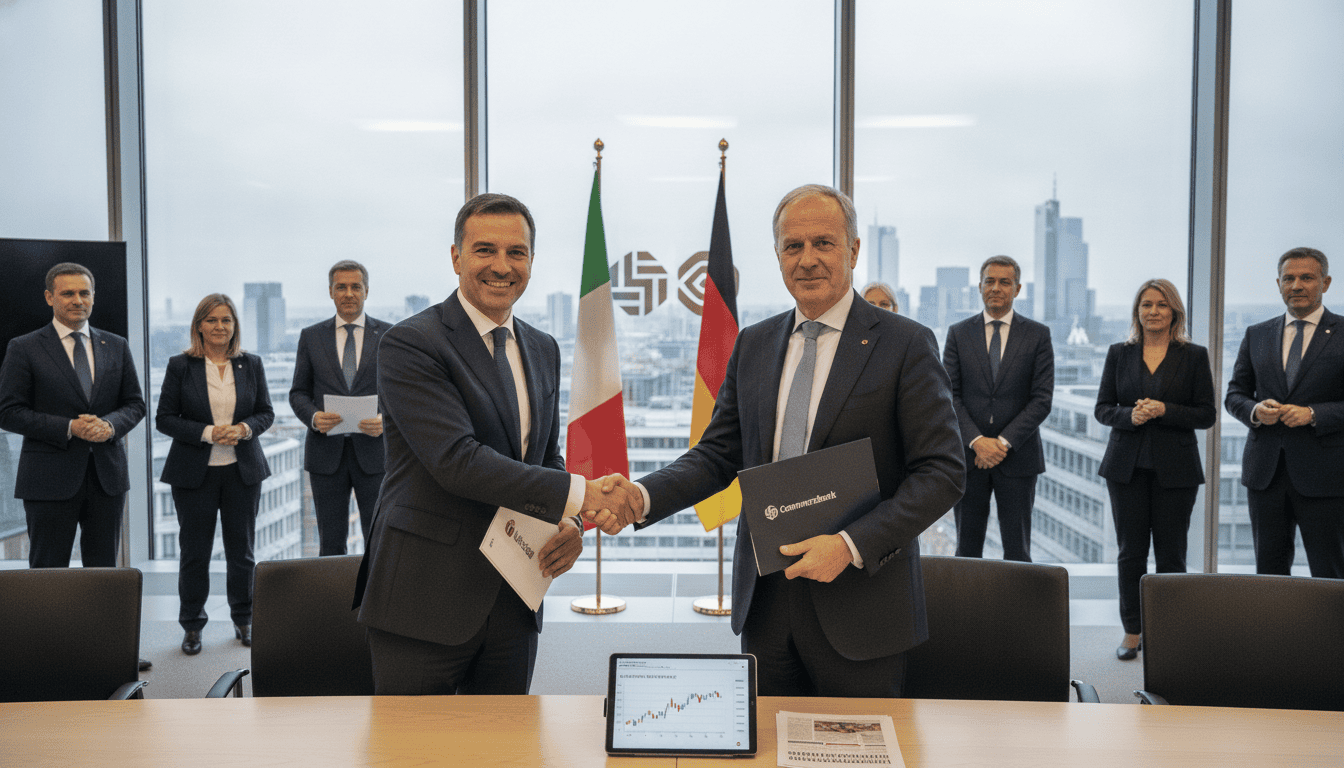
UniCredit Stake in Commerzbank Reaches 49.65% of Voting Rights After Exchange Offer
UniCredit stake in Commerzbank rose to 49.65% of voting rights after 17.6% of shareholders accepted the exchange offer, positioning the Italian bank to shape the German lender’s governance. (UniCredit announcement) (marketscreener.com)
Acceptance figures and voting breakdown
UniCredit said that, after the expiry of the acceptance period, 17.60% of Commerzbank’s outstanding share capital had been tendered to its voluntary exchange offer. This additional tranche, combined with UniCredit’s existing direct holdings and derivative positions, results in an aggregate stake the bank reports as translating into 49.65% of Commerzbank’s voting rights. (marketscreener.com)
The Italian lender previously held roughly 26.77% of Commerzbank shares directly and disclosed derivative instruments equivalent to around 3.22% of the shares, figures that UniCredit says contribute to its total effective exposure. These numbers underpin UniCredit’s calculation of its new voting position and reflect conversions and tendered shares accepted during the extended offer window. (unicreditgroup.eu)
Terms of the exchange offer and shareholder response
The exchange offer proposed 0.485 UniCredit shares for each Commerzbank share, a ratio set out in the offer documentation and reviewed by regulators. That exchange rate initially implied only a small premium to Commerzbank’s prior closing price and at times turned into an implied discount as Commerzbank shares outperformed UniCredit’s stock during the offer period. (unicreditgroup.eu)
Commerzbank’s management had repeatedly argued that the offer lacked an adequate economic incentive for free-floating shareholders, noting that market prices frequently traded above the implied value of the exchange. Despite those warnings, a combination of strategic holders and shareholders with ties to UniCredit accepted the exchange, prompting the larger-than-expected acceptance level. (commerzbank.de)
Control prospects and boardroom implications
With reported voting rights above 40 percent, UniCredit is poised to exert substantial influence over Commerzbank’s supervisory board ahead of the next annual general meeting. Such a position would allow UniCredit to propose or back candidates for supervisory roles and to shape strategic decisions at the German lender. (marketscreener.com)
Market observers say the new balance of power does not guarantee an immediate management change but substantially raises the probability that UniCredit can drive governance shifts if it chooses to act on its leverage. The possibility of reshaping executive leadership or board composition is now firmly on the agenda for both banks. (marketscreener.com)
Regulatory review and clearance timeline
UniCredit and Commerzbank both note that the transaction remains subject to customary regulatory approvals, including scrutiny by the European Central Bank and other competition and financial regulators. UniCredit has signaled that final completion is expected next year, reflecting the time needed for regulatory reviews and for procedural steps such as the cancellation of treasury shares. (unicreditgroup.eu)
Regulators will assess not only competition and market-concentration issues but also financial-stability considerations and the implications for customers in Germany and across UniCredit’s pan-European footprint. Any conditions or remedies imposed by authorities could shape the operational integration that follows. (unicreditgroup.eu)
Political resistance and public-sector stakeholder stance
The German government and public-sector stakeholders have been openly critical of UniCredit’s approach, arguing that the offer does not present sufficient economic justification and stressing the importance of maintaining Commerzbank’s strategic independence. Government representatives — who hold a material stake through public funds — reiterated opposition during the offer period. (tagesschau.de)
Commerzbank’s own statements framed the acceptance behaviour as economically unusual and warned that the apparent premium created by UniCredit’s approach was not sufficient to persuade most unaffiliated shareholders. The bank has continued to urge a cautious assessment of UniCredit’s reported figures and intentions. (commerzbank.de)
Market reaction and valuation debate
Analysts noted that the acceptance level reflects a complex mix of motives: some holders reacted to short-term price movements while others accepted for strategic or relationship reasons. The exchange ratio and shifts in Implied premium were central to investor decisions as market prices evolved across the offer period. (unicreditgroup.eu)
Traders observed volatility in both UniCredit and Commerzbank shares as the market digested the higher-than-expected uptake and the potential governance consequences. Debate has intensified over whether the transaction enhances value through scale and cross-border synergies or whether integration risks and political opposition will limit potential upside. (marketscreener.com)
Looking ahead, both banks will navigate regulatory reviews and the practical steps of consolidating stakes, while shareholders and public stakeholders remain focused on the implications for strategy, management and the German banking landscape. The reported 49.65% voting position marks a pivotal shift in influence; how UniCredit chooses to exercise that influence will determine whether the deal evolves into deeper operational integration or a prolonged governance standoff.
