
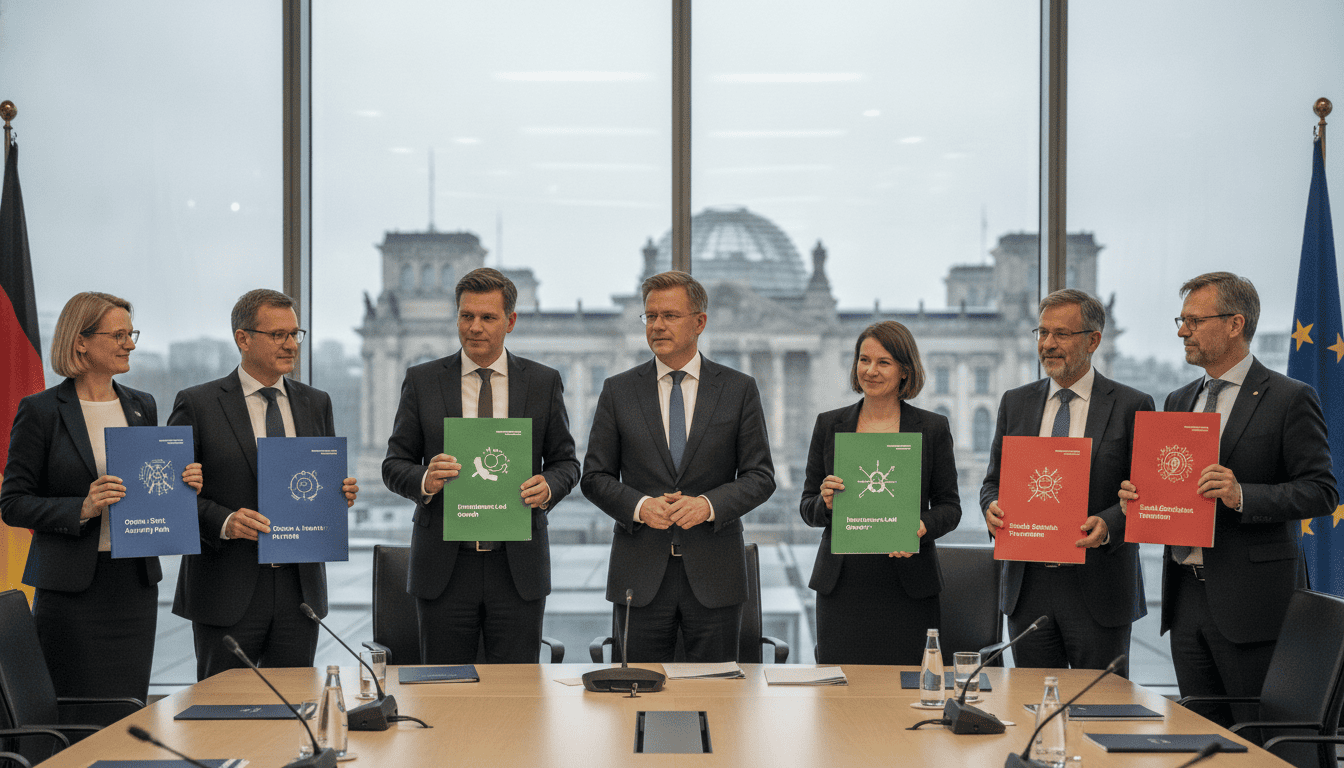
Germany to Receive Three Conflicting Plans from Commission on Debt Brake Reform
Germany’s commission on debt brake reform will present three divergent proposals to Finance Minister Lars Klingbeil next week, after a 15-member panel failed to agree on a single blueprint. The lack of consensus leaves the coalition to judge competing visions for how to balance fiscal restraint with investment needs.
Commission to present three separate recommendations
The government-appointed commission convened to redraw the constitutional debt brake met for what is expected to be its final session this Wednesday morning. Rather than producing a collective recommendation, the panel will hand Finance Minister Lars Klingbeil three distinct proposals that reflect political and technical divisions within the group.
The 15-member body was chaired by coalition representatives and included experts close to the Union and the SPD as well as two independent economists. A required two-thirds majority for a unified plan proved unattainable, prompting the split submission.
Consensus on the structural deficit rule and defense spending
Despite deep disagreement on many points, a broad majority of commissioners agreed that the structural deficit rule remains a useful tool for containing public indebtedness. The panel reaffirmed the central role of the structural deficit ceiling, currently set at 0.35 percent of gross domestic product for both federal and state budgets.
Commissioners also concurred that defense spending should be brought back into the federal core budget and subjected to the debt brake rules over time. Those shared conclusions mark the only clear common ground among the competing proposals.
Union proposal keeps 0.35% cap and phases defense funding back in by 2035
The proposal backed by Union-aligned members—labelled internally as an “atmospheric” or “breathing” debt brake—retains the 0.35 percent structural deficit cap while tying relief mechanisms to the overall debt ratio. Under this approach, the cap would continue to apply so long as the national debt level remains above 60 percent of GDP.
The Union draft envisions a phased reintegration of defense expenditures into the regular budget between 2029 and 2035. Officials estimate that returning those costs to the core budget could shave more than €100 billion a year from the federal government’s borrowing headroom, a tightening that would be difficult to absorb given roughly €400 billion in annual tax revenues.
SPD plan expands investment leeway and delays full reintegration to 2040
SPD-aligned commissioners advanced an “investment-oriented” debt brake that aims to protect major public projects while keeping long-term fiscal discipline. Their plan would extend the transition period for moving defense spending back into the core budget to 2040 and would carve out extra annual borrowing capacity specifically for investments.
Under the SPD framework, the existing 0.35 percent structural limit would be supplemented by a 0.8 percent GDP allowance for prioritized investments in rail, bridges, digitalization, education and other future-oriented projects. Combined with the structural margin, that would raise the total permissible annual deficit to 1.5 percent of GDP for the federal-state system.
Proponents argue the extra room would mirror current outflows from the special Infrastructure and Climate Neutrality Fund and prevent a disruptive funding cliff when that vehicle expires. Critics caution the approach would slow the pace at which the debt ratio returns toward the EU benchmark of 60 percent, although supporters note stronger investment-backed growth could accelerate the ratio’s decline.
Two economists recommend focusing on spending paths and employment
A third recommendation, produced by the two independent economists on the panel, shifts the debate away from the debt-to-GDP ratio and toward multi-year expenditure trajectories. Their advice prioritizes compliance with EU fiscal rules without creating stricter national constraints that would lock policymakers into rigid priorities.
They argue against constitutionally privileging investment spending over other public expenditures, saying the practice could unduly constrain elected governments. The economists also propose elevating full employment to a constitutional objective alongside debt limits, broadening the mandate for fiscal policy beyond balance-sheet targets.
Next steps and political implications
With three divergent blueprints on the table, the coalition will face a politically fraught decision about whether to adopt a stricter, status-quo approach, grant targeted investment leeway, or pursue a spending-path framework that reframes fiscal priorities. The outcome will determine how urgently defense costs return to the core budget and how decisively Germany can finance long-term infrastructure and digitalization projects.
Ministers now must weigh technical trade-offs against electoral and macroeconomic consequences, balancing the aim of reducing the debt ratio with the need to sustain investment and employment. The Finance Ministry is expected to use the commission’s competing options as the basis for negotiations that could reshape Germany’s fiscal rulebook for years to come.
