
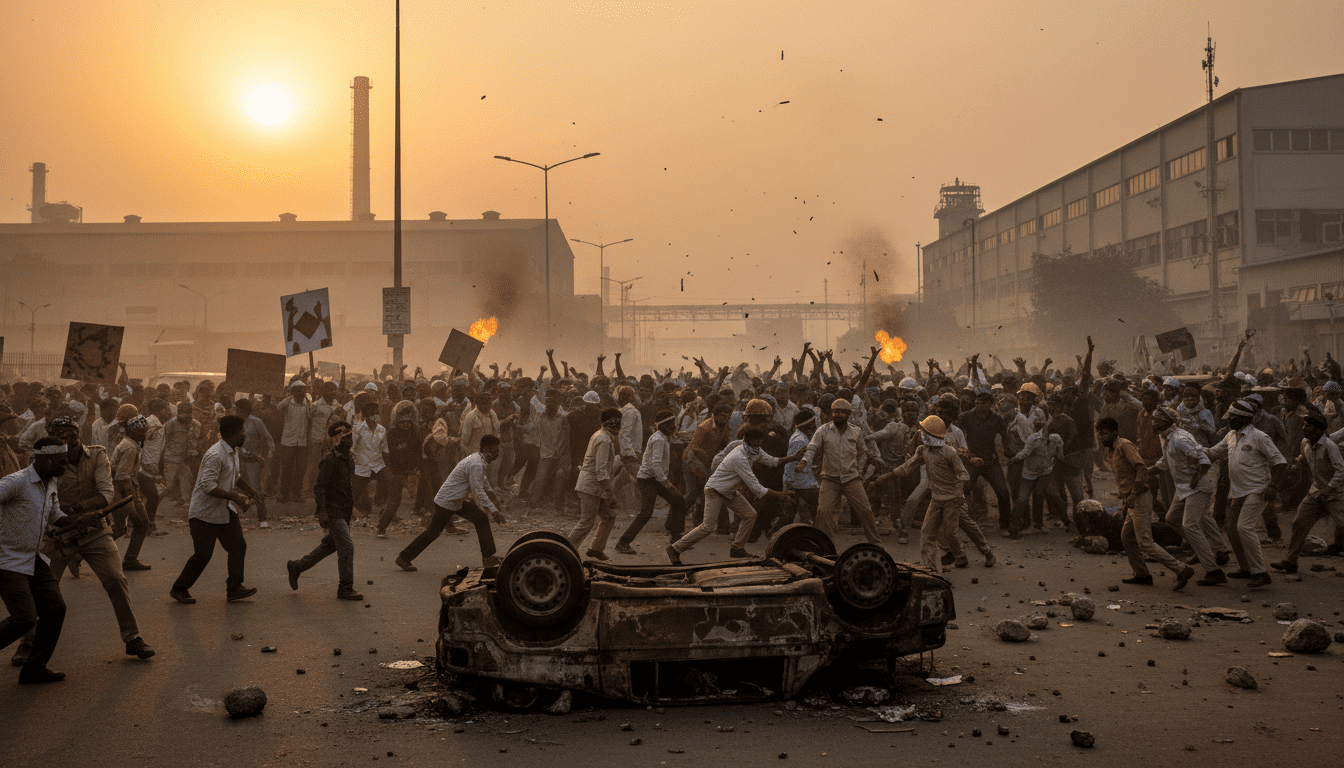
Noida factory workers protest turns violent on fourth day in major industrial township
Noida factory workers protest turns violent on its fourth day; tear gas used and vehicles torched as officials urge talks amid rising costs and wage demands.
The Noida factory workers protest, now in its fourth day, escalated into clashes on Monday with tear gas fired and several vehicles set alight across the satellite city, local authorities said. Police described their response as the use of “minimum force” to restore order as hundreds of workers confronted security personnel near industrial clusters. The unrest comes as workers press for wage, hours and overtime reforms against a backdrop of climbing living costs linked to global fuel supply disruptions.
Violence escalates on fourth day
Visuals from the scene showed groups of protesters marching through industrial roads while security forces in riot gear formed lines near barricades. In multiple locations an overturned vehicle was shown burning and stones were hurled at police as demonstrators tried to break through cordons. Gautam Budh Nagar police issued a statement saying senior officers were engaging with workers and attempting to counsel them to maintain peace.
Authorities describe measured response
Police officials defended their tactics, saying they aimed to contain violence without resorting to heavy-handed methods, and that steps were being taken to prevent further property damage. Narendra Kashyap, a lawmaker from Uttar Pradesh, appealed for calm and asked protesters to present their demands through dialogue with government authorities. Administrative sources said teams from local police and the district administration were conducting outreach at factory gates to negotiate a de-escalation.
Workers set out clear labour demands
Protesters have demanded fixed duty hours, formal payment for overtime and strict enforcement of central labour guidelines, according to accounts from participants. Vinay Mahoti, a 30-year-old hosiery worker from Bihar, said he first raised concerns inside his factory before joining colleagues from several units to march together. Workers also complained about inconsistent pay practices and said they wanted written assurances that minimum standards would be upheld.
Economic pressures feed the unrest
Organizers and analysts point to rising living costs and fuel-price pressures as drivers of worker anger, with prices squeezing household budgets and amplifying demands for higher pay. Officials and economists say disruptions to fuel supplies following intensifying conflict in the Middle East have fed inflationary pressures, increasing transport and input costs for factories and households alike. The resulting squeeze has heightened labour sensitivity to earnings and workplace conditions in Noida’s dense industrial belt.
Regional spillover prompts policy moves
Similar industrial protests in neighbouring Haryana last week prompted the state government to order a 35 percent rise in minimum wages for affected sectors, a measure that underlines how labour unrest is prompting rapid policy responses. Local trade unions are urging comparable action in Noida and across Gautam Budh Nagar district, arguing that piecemeal wage adjustments elsewhere risk creating migration of workers and production disruptions. Officials said they were monitoring developments closely to calibrate any necessary administrative or regulatory reactions.
Impact on production and supply chains
Noida, one of Asia’s largest planned industrial townships, houses thousands of manufacturing units, so disruptions there can ripple through automotive and textile supply chains. Several car manufacturers with production facilities in the region have faced work stoppages in recent days, industry representatives said, adding that sporadic shutdowns could affect component deliveries and order fulfilment. Company spokespeople, contacted by local media, described steps to secure premises and assess production backlogs while awaiting a return to normal operations.
Evidence from news agency imagery and on-the-ground reporting showed protesters chanting slogans and moving in groups across main thoroughfares, while riot police remained deployed at key industrial junctions. District authorities said road clearances were underway and that contingency plans had been activated to keep essential transport corridors open. Residents in nearby residential sectors reported anxiety and sought reassurances from local administrators about safety and emergency services.
Negotiations were described as ongoing, with officials saying they intended to offer forums for workers to present grievances and for employers to respond within a defined timeframe. District-level committees with representation from labour officials, factory management and police were reportedly being convened to examine wage claims and working-hour arrangements. Union leaders indicated they would assess any proposed measures and consider the next steps depending on the outcomes of talks.
Officials cautioned against blanket arrests and emphasized the importance of distinguishing between peaceful demonstrators and those committing acts of arson or property damage. Lawmakers and civic leaders urged both sides to avoid provocations and to prioritise dialogue to prevent further escalation. Meanwhile, hospitals and emergency services in the area reported readiness to treat any injuries resulting from clashes, and fire services remained on alert for further outbreaks of vehicle or property fires.
As the situation develops, authorities face the dual task of restoring immediate order and addressing the underlying labour and economic grievances that triggered the Noida factory workers protest. Stakeholders said any durable resolution would require enforceable commitments on wages, overtime compensation and working conditions, alongside measures to insulate households from broader inflationary shocks. The coming days will be crucial to determine whether negotiation channels can contain the unrest and prevent broader disruptions in the industrial corridor.
