
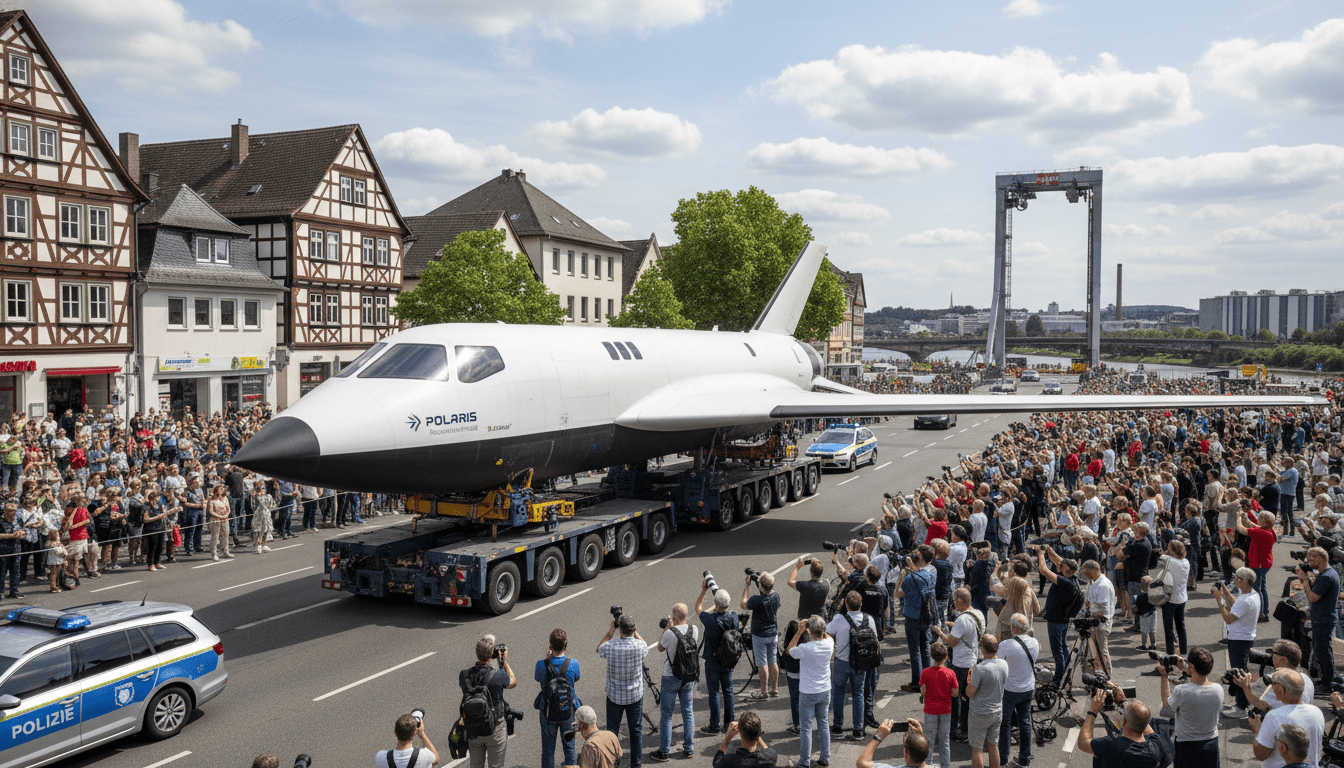
Polaris spaceplane prototype to fly in coming days, company says
German space startup Polaris will launch a larger spaceplane prototype in the coming days, founder Alexander Kopp told TECH by Handelsblatt. The Heilbronn-based company says the new vehicle features a bigger airframe and upgraded technology as it advances toward operational test flights.
Heilbronn test flight set for the immediate future
Polaris confirmed at the TECH by Handelsblatt conference that a larger prototype of its spaceplane is scheduled to fly within days. Company founder Alexander Kopp spoke directly about the timeline, framing the flight as a near-term step in a staged development program based in Heilbronn.
The announcement positions the flight as a technology demonstration rather than a commercial service debut. Polaris says the test will allow engineers to validate scaling, guidance and integration ahead of more complex trials.
Bigger airframe, incremental scaling strategy
Kopp emphasized that Polaris is scaling its models incrementally, with each prototype increasing in size and capability. The company’s approach prioritizes gradual structural and systems upgrades so engineers can monitor performance at each developmental stage.
That incremental strategy is intended to reduce risk while enabling faster learning cycles. By enlarging the airframe step by step, Polaris aims to carry more advanced avionics and flight control systems into subsequent flights.
Upgraded systems and avionics, company says
According to Polaris leadership, the latest prototype incorporates improved avionics and on-board electronics compared with earlier demonstrators. Those upgrades are intended to enhance navigation precision, telemetry and autonomous flight control during the critical phases of a spaceplane mission.
Polaris did not disclose detailed technical specifications at the conference, but Kopp indicated the modifications reflect lessons learned from prior tests. The company said engineers have integrated newer subsystems to support higher-speed flight regimes and more complex mission profiles.
Leadership outlook and corporate goals
Alexander Kopp, Polaris’s founder and chief executive, framed the upcoming flight as part of a broader push to establish a German player in reusable spaceplane technology. He said the company’s models are evolving “with ever better technology,” signalling a focus on iterative improvement rather than a single leap to full operational capability.
Polaris portrays the program as a technology-driven effort to demonstrate reusable flight elements that could later support payload delivery or other mission types. The firm’s public statements stress steady development and demonstrable milestones to attract partners and future customers.
Local manufacturing and test operations in Heilbronn
Polaris’s activities are based in Heilbronn, where the company assembles prototypes and conducts ground evaluations ahead of flight campaigns. The proximity of manufacturing and testing operations is presented as a means to shorten feedback loops between design, build and flight teams.
Ground testing and pre-flight checks will precede the scheduled launch, with engineers focusing on propulsion readiness, control logic and telemetry links. The company intends to use each test to validate component interactions under flight conditions specific to a spaceplane architecture.
Positioning within Europe’s small-launch ecosystem
Polaris is entering a competitive and rapidly evolving European space sector where multiple private ventures pursue small-launch, reusable and hybrid concepts. The company’s emphasis on a spaceplane design places it in a niche area that blends aircraft-style operations with orbital or suborbital mission goals.
Industry observers note that demonstrating reliable, repeatable flight performance will be key for any newcomer seeking government contracts or commercial launch customers. Polaris’s near-term flight therefore carries significance both for its internal roadmap and for its prospects in the broader market.
The upcoming prototype launch represents a clear engineering milestone for Polaris and a public test of the company’s incremental development strategy. With the Heilbronn flight days away, observers will watch for post-flight data and statements that clarify the vehicle’s performance and the company’s next testing steps.
