
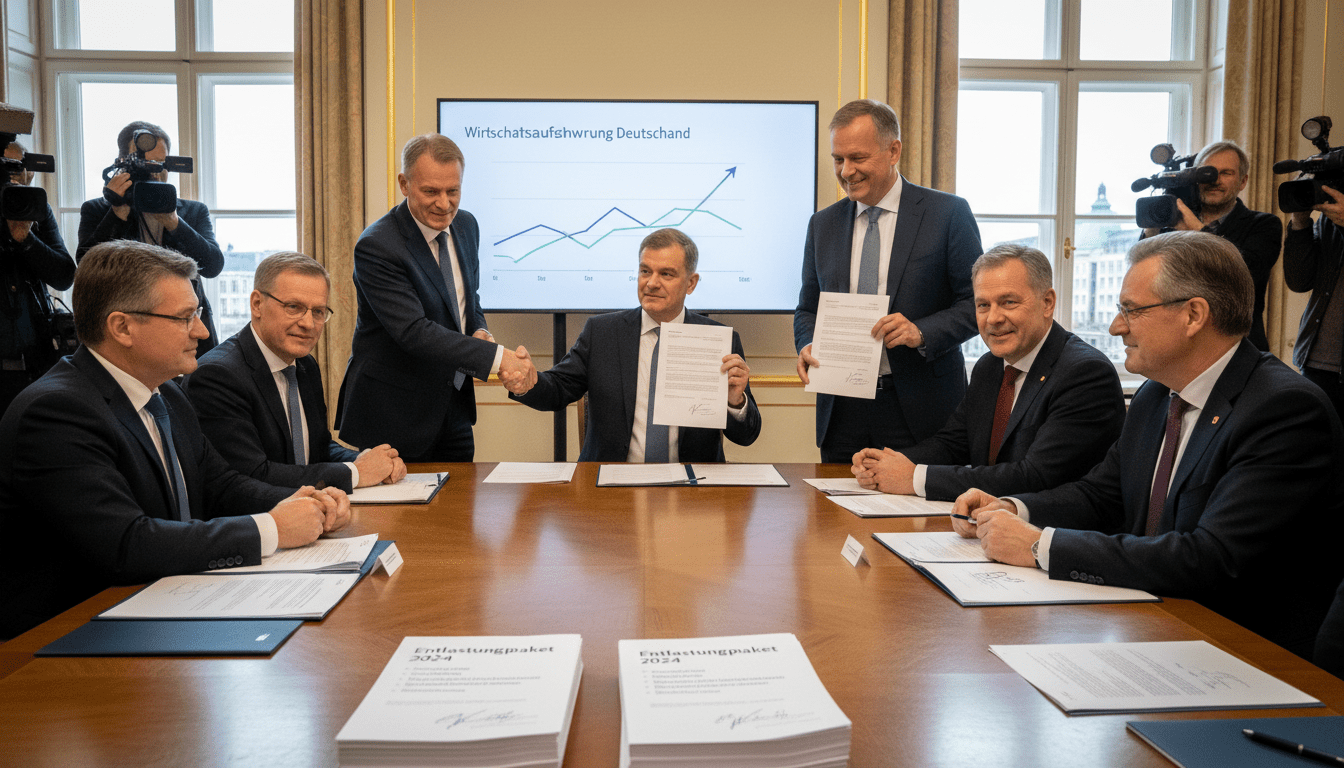
Germany unveils fuel rebate and employer inflation bonus in new relief package
Germany’s coalition unveils a fuel rebate and tax-free employer inflation bonus to ease rising energy costs, sparking debate over broad relief and fiscal risk.
A new government relief package announced by the Union and the SPD returns a fuel rebate and a tax‑free inflation bonus from employers as central measures to ease household pressure from higher petrol and diesel prices. The package mirrors elements of 2022 emergency measures while explicitly ruling out a price cap for energy, and it leaves open the possible use of a windfall tax if Brussels approves. The move has heightened debate between calls for targeted support and a politically driven, broad-based approach to relief.
Coalition agrees fuel rebate and employer inflation bonus
The coalition’s package reinstates a fuel rebate commonly known in German debate as the "tankrabatt" alongside a tax-free inflation allowance delivered through employers. Officials framed the measures as fast-acting relief meant to blunt immediate pain at the pump and supplement incomes facing higher transport and heating costs. Ministers emphasised the scheme is designed to be less costly than earlier iterations while still delivering visible benefits to motorists and workers.
Plan echoes 2022 relief but avoids market interventions
Key elements of the new plan closely resemble emergency steps taken in 2022, yet the government is avoiding direct market interventions such as price ceilings. The energy tax cut included in the package is more modest than the larger reductions enacted under the previous coalition’s crisis response, a choice the partners portray as fiscally prudent. Policymakers signalled they prefer temporary fiscal measures over structural interference in energy markets, at least for the present.
Critics warn the relief is indiscriminate and inefficient
Economists and fiscal analysts have criticised the so‑called Gießkanne, or watering‑can, approach adopted by the coalition, arguing that blanket measures benefit households that do not need assistance as much as those that do. Calls for more targeted support for low‑income households have gone unheeded in public statements from the parties, and critics say the package risks wasting public funds while producing only modest poverty relief. The debate highlights a persistent trade‑off between swift political fixes and measures that are better targeted but slower to implement.
Söder’s intervention reshapes party dynamics
Bavarian CSU leader Markus Söder’s public posture on the measures has been portrayed as a decisive influence on the coalition’s direction, sharpening internal tensions within the Union between free‑market and interventionist impulses. Observers noted that Söder’s willingness to consider a windfall tax on energy producers contrasts with other Union voices and has bolstered his negotiating leverage. The SPD’s finance chief gained leverage from that stance, while the parties conceded on issues such as a more active regulatory posture in Brussels on combustion‑engine policy.
Fiscal risks if Strait of Hormuz disruptions persist
The government warned that the fiscal cost of the relief package could rise if international supply disruptions continue, particularly through chokepoints such as the Strait of Hormuz. A prolonged slowdown or rerouting of oil and gas exports would push global energy prices higher and increase the strain on the federal budget, officials said, underlining the contingency that relief measures may need to be adjusted as global conditions evolve. The coalition’s more cautious energy tax cut reflects concern about committing to long‑term revenue losses amid volatile markets.
Calls grow for clearer tax and social reform proposals
Beyond immediate measures, commentators and some lawmakers pressed the coalition for greater clarity on structural tax and social reforms that would tackle inflationary pressures and distributional effects more sustainably. The relief package provides detail on temporary energy‑price mitigation, critics say, but falls short of presenting comprehensive plans for pension, social‑security, or tax adjustments that many experts view as more economically efficient. Lawmakers from both camps acknowledged the political necessity of compromise, but analysts warned that postponing deep reforms could amplify medium‑term fiscal and social costs.
The government framed the package as a pragmatic response to current price pressures while signalling readiness to revisit measures if international developments warrant. As debate continues in parliament and among economists, the fuel rebate and tax‑free inflation bonus will be measured both by their immediate political effects and by how policymakers manage the fiscal trade‑offs ahead.
