
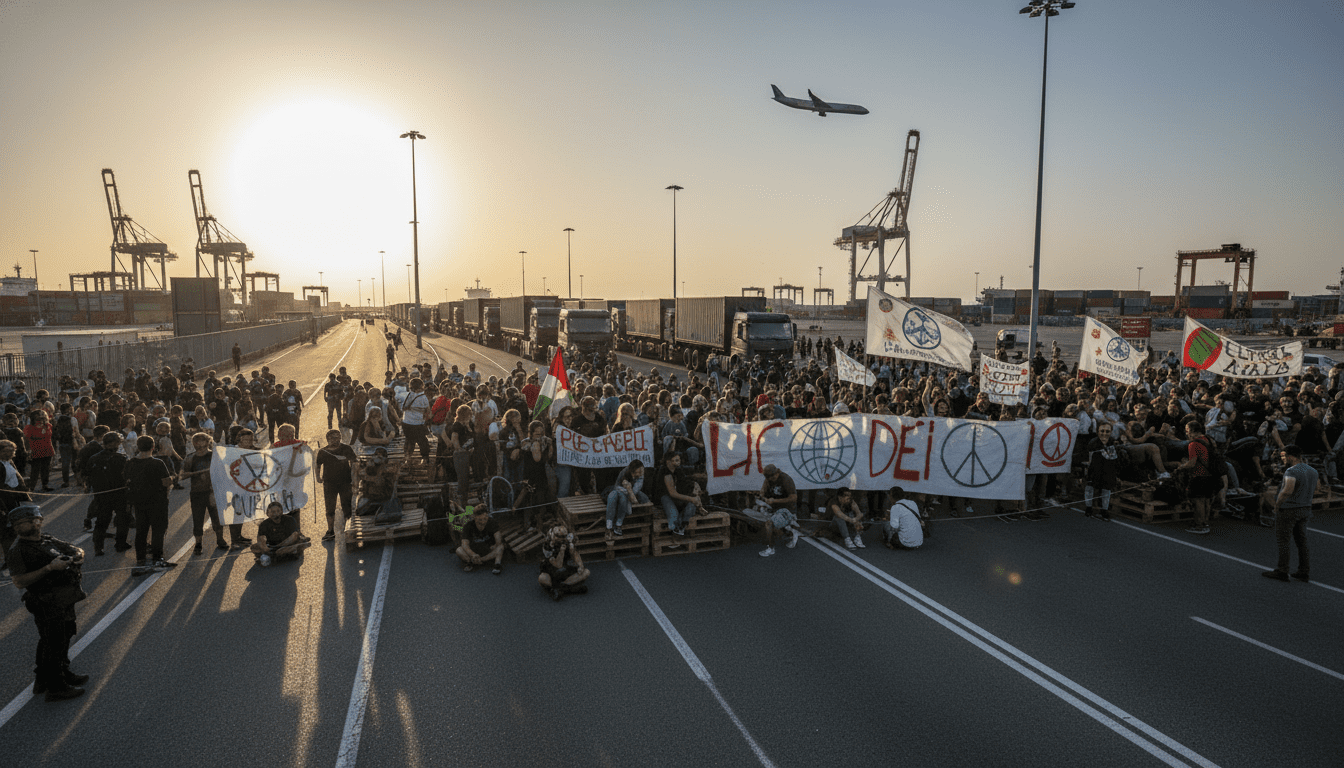
Activists Launch Global Intifada Disarm at Gioia Tauro Port to Disrupt Military Shipments
Pro-Palestinian activists launched “Global Intifada Disarm” at the Gioia Tauro port on May 29, aiming to block alleged military and dual-use shipments moving through the Calabrian hub. The mobilisation combined maritime and land protests, with organisers saying the action targeted supply chains they link to Israel and what they described as a genocide in Gaza. Demonstrators and union organisers said the campaign intends to maintain pressure on authorities and shipping companies until contested cargo is halted or publicly accounted for.
Maritime demonstration and flotilla
Five small vessels from the Thousand Madleens to Gaza initiative sailed toward Gioia Tauro after departing the nearby port of Cetraro, forming a symbolic flotilla alongside onshore demonstrations. Activists aboard the boats and participants on land called attention to the port’s role as one of the Mediterranean’s largest container hubs. Organisers said the maritime element was intended to draw public scrutiny to cargo movements that are normally handled quietly at night.
Allegations over ballistic steel containers
Campaigners and spokespeople aboard the Global Intifada vessels alleged that 16 containers of ballistic-grade steel were being held at the Gioia Tauro docks and argued the material can be used in missile production. Antonio Viteritti of La Base Cosenza, speaking from one of the boats, said activists had repeatedly flagged the shipments to authorities and received no definitive assurance they would be stopped. Protesters also pointed to previous seizures at the port, including weapons shipments that were intercepted two years ago, as part of their rationale for the action.
Shipping movements and the MSC Manasvi episode
BDS Italy told local unions and networks that the container ship MSC Manasvi was expected to call at Gioia Tauro to load eight containers that campaigners had put under scrutiny. According to activists, the vessel remained offshore for several hours and then turned back without loading the contested boxes, a development organisers cited as evidence that public attention can affect shipboard decisions. Maritime industry officials were not directly quoted by demonstrators, who nevertheless singled out Mediterranean Shipping Company (MSC) as the operator of the terminal where the contested cargo is stored.
Inspections, parliamentary questions and official probes
Italian Finance Police and the Customs Agency inspected eight containers at Gioia Tauro on March 18, initiating technical assessments to determine whether the materials were civilian, dual-use, or military in nature. The inspection followed reporting and pressure from campaigning groups and prompted a parliamentary question from Five Star Movement MP Stefania Ascari seeking government clarification on port controls. Trade union representatives said those official steps showed the protests had forced some degree of transparency, even as they called for clearer public information.
Labour, regional politics and broader grievances
Local union leaders framed the action at Gioia Tauro as both an anti-war measure and a labour issue, linking contested military logistics to wider concerns over exploitation and inequality in southern Italy. Peppe Marra, regional secretary of the USB union in Calabria, told demonstrators that media attention and public pressure prevent containers being moved “quietly” at night. Activists also highlighted regional economic grievances, arguing port accountability and workers’ rights are part of the same campaign against opaque supply chains.
Campaign aims and national mobilisation
Organisers described Global Intifada Disarm as a coordinated national effort that on May 29 extended beyond Gioia Tauro to other ports, logistics hubs and factories identified by campaigners as linked to military production. The mobilisation was called by grassroots trade unions and the Movement of Young Palestinians in Italy and sits alongside a wave of pro-Palestinian activity since last year’s Global Sumud Flotilla, organisers said. Demonstrations, university occupations and dockworkers’ interventions have, according to participants, produced growing convergence between labour struggles and solidarity with Palestinians.
The campaign’s public materials say it will map ports and vessels suspected of transporting military or dual-use materials and will carry out further targeted actions to obstruct those supply chains. Roberto Panza of La Base Cosenza, speaking aboard one of the flotilla boats, framed the Mediterranean port as a space shared with broader communities that, in his view, suffer from fragile economies and climate impacts in addition to militarised logistics.
Local organisers portrayed Gioia Tauro as a testing ground for wider tactics that combine maritime protest with union-led strikes and community mobilisation. They said the aim is not only to block specific shipments but to create a sustained accountability mechanism that forces authorities and companies to answer publicly for cargo flows that could contribute to armed conflict.
Protesters and allied unions insisted they will continue to monitor ship arrivals and container movements, calling for more transparent port oversight and stronger mechanisms to verify the end use of sensitive materials. They also indicated plans for follow-up actions and mapping efforts meant to identify other nodes in international supply chains where similar dual-use shipments may transit.
The episode has renewed debate in Italy over the role of major ports in global arms-related logistics and the adequacy of current inspection and oversight procedures, with campaigners urging lawmakers and enforcement agencies to increase transparency and public reporting on contested cargo.
