
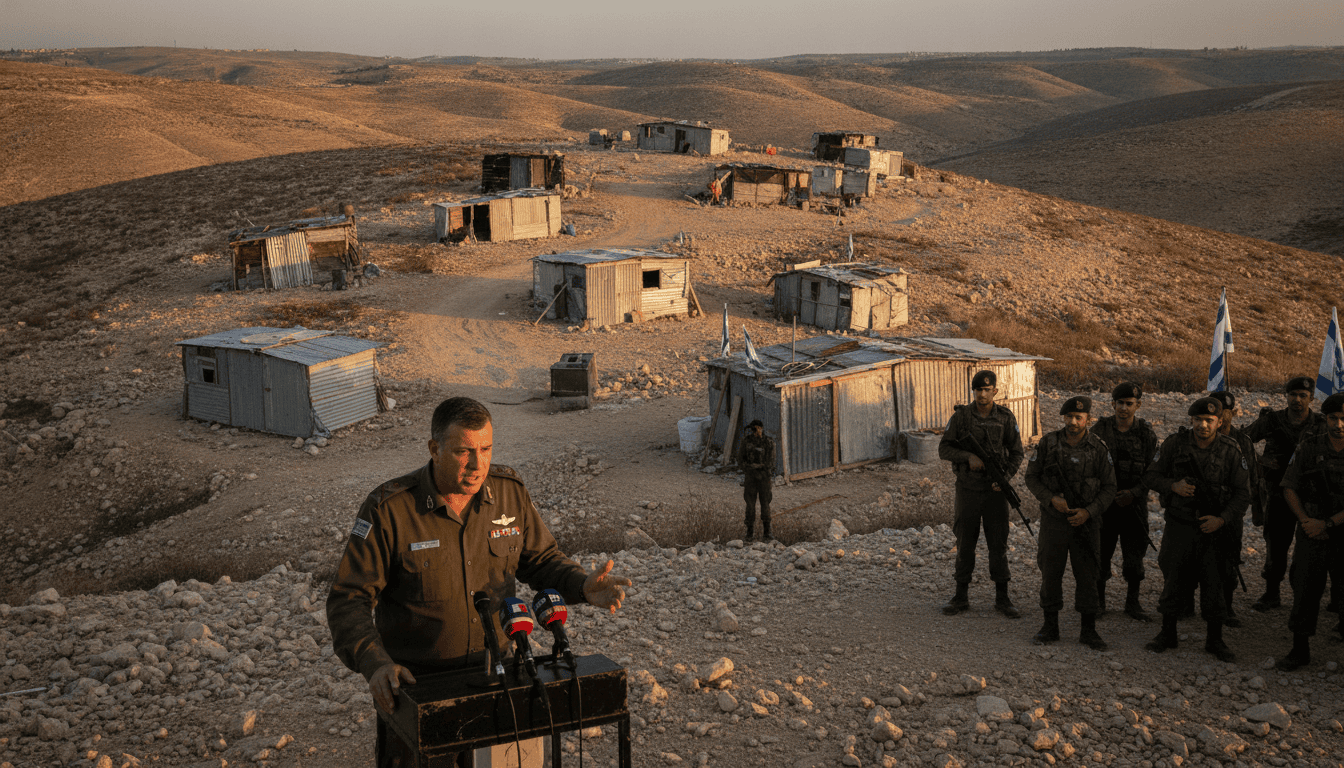
Israeli General Says Illegal Settler Outposts Serve as Security Assets in West Bank
Israeli Central Command chief praised illegal settler outposts as security assets at a Farm Union conference, noting state backing for West Bank settlements.
Major-General Avi Bluth, head of Israel’s Central Command, told a Farm Union conference this week that illegal settler outposts in the occupied West Bank can function as part of Israel’s security architecture. His remarks, which framed the outposts as operationally compatible with military objectives when paired with lawful conduct, highlighted the degree of coordination between some civilian settlement networks and military authorities. Critics responded that official praise underscores long-standing state support for settlement expansion that has intensified tensions across the territory.
Remarks at the Farm Union conference
Major-General Bluth addressed farmers, settlement activists and security officials at the Farm Union event, saying the agricultural outposts “align well” with the broader security concept and can be integrated into operations. He added that such integration, in his view, must be matched by appropriate operational behavior, adherence to ethical standards and compliance with the law. The audience included representatives of settlement organizations that have been central to establishing and sustaining outposts beyond approved municipal boundaries.
Bluth’s comments have been interpreted by supporters as a practical acknowledgement of the role that nearby civilian sites can play in informing military situational awareness. Opponents say the statements amount to legitimisation of settlements that are broadly deemed illegal and controversial. The tone of the address, delivered with military authority, has amplified debate about the relationship between Israel’s security institutions and settler expansion.
International and Israeli legal status
Illegal settler outposts, like all settlements built in occupied territory after 1967, are widely considered unlawful under international law by the United Nations and most governments. The Fourth Geneva Convention and subsequent UN resolutions have been cited repeatedly to argue that the transfer of an occupying power’s civilian population into occupied land violates international obligations. Human rights organizations routinely point to these legal frameworks when documenting the impact of settlement activity.
Within Israel, the legal status of outposts is more complex: some outposts have been erected without formal government approval and are classified as illegal even under Israeli planning and land laws. Over the years, different Israeli administrations have alternated between removal orders, allotments of retroactive legalisation and tacit tolerance. The result is a patchwork of official positions that leaves many outposts in a contested legal and administrative limbo.
Security rationale and critiques
Israeli military officials and some policymakers argue that outposts—especially those located on strategic hilltops—create forward observation points and buffer zones that can aid defence. Bluth’s assertion that outposts can be integrated into “operational conduct” reflects a view among some security planners that civilian presence can complicate hostile actions and provide intelligence. Proponents say, in operational terms, that dispersed rural settlements can extend the state’s reach into sparsely populated areas.
Critics counter that framing civilian settlements as security assets masks the role that outposts and settlers play in displacing Palestinian communities and restricting access to land and resources. Human rights groups and Palestinian representatives say state support, whether overt or covert, enables a network that facilitates dispossession and demographic change across the West Bank. These organizations have repeatedly warned that security rhetoric can be used to justify measures that breach rights and deepen the occupation.
Recent incidents underscore tensions on the ground
Violent confrontations and property damage around outposts have increased scrutiny of settler activity. On July 3, 2026, residents of the village of Salem east of Nablus were shown attempting to extinguish fires on wheat fields that Palestinians say were started by settlers, an incident that drew international media attention. Such episodes are cited by local authorities and rights groups as examples of how expansionist settlement practices contribute to cycles of retaliation and insecurity for Palestinian farmers.
Local councils and Palestinian villagers report that attacks on crops, livestock and infrastructure are often followed by slow or absent enforcement actions, perpetuating a sense of impunity. Israeli officials sometimes attribute conflicts to lawlessness by a minority of settlers, while Palestinians and advocacy groups highlight patterns of violence linked to the expansion and protection of outposts. The interplay of local incidents and higher-level policy pronouncements fuels broader regional tensions.
Policy implications and international reaction
Bluth’s public endorsement of the security value of illegal settler outposts is likely to influence both domestic policy debates and international responses. For governments and organisations that consider settlements illegal, military praise for outposts complicates diplomatic engagement and may prompt renewed calls for enforcement of international law. Some Western capitals and multilateral bodies have already criticised settlement expansion as an obstacle to a negotiated resolution.
At home, the remarks may embolden political and settler movements that seek greater recognition or retroactive legalisation for outposts, while placing pressure on legal institutions to reconcile military priorities with statutory obligations. Observers say the episode illustrates how security imperatives and political objectives can converge to produce outcomes that are difficult to reverse without clear legal and administrative intervention.
The debate prompted by these comments is likely to continue as international actors and local stakeholders assess both the immediate security claims and the wider consequences for Palestinian life and prospects for a diplomatic resolution.
