
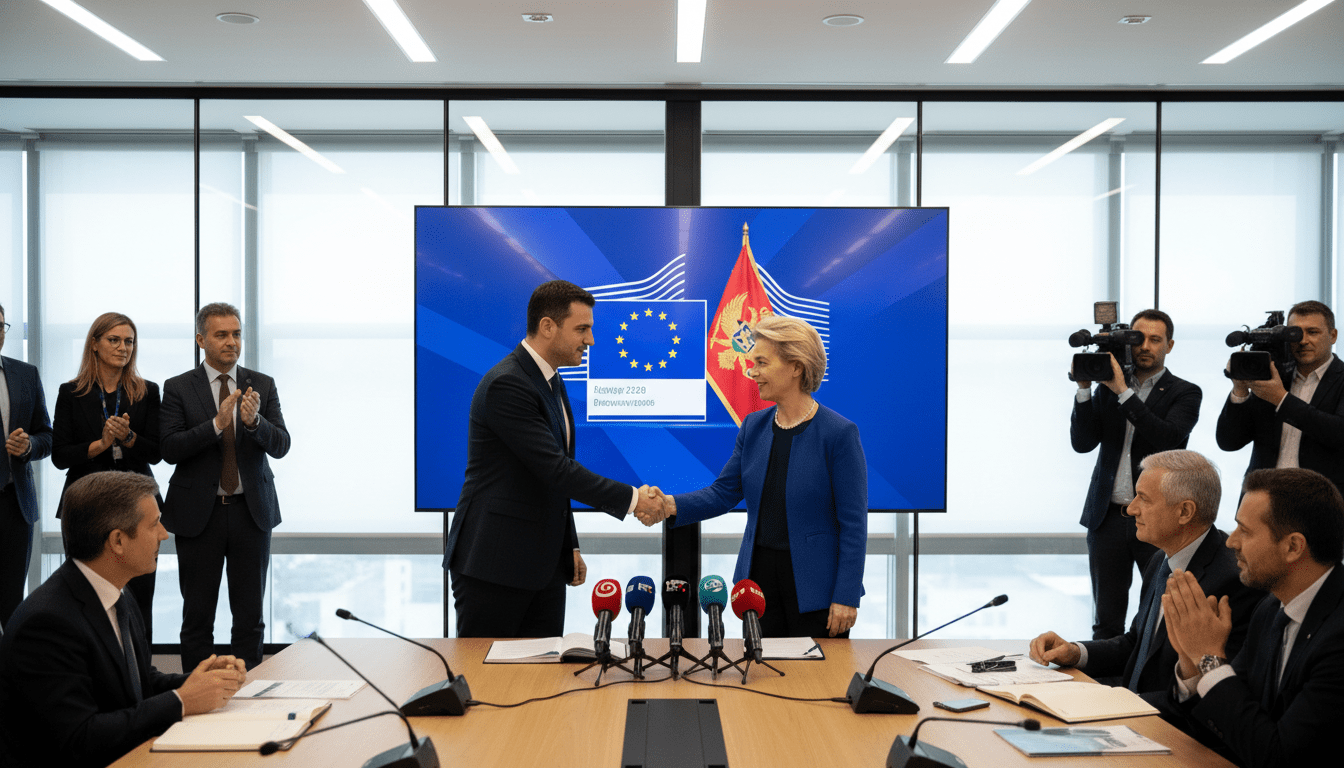
Montenegro EU accession: President reaffirms 2028 target as Brussels hails country a frontrunner
Montenegro EU accession: President reaffirms 2028 target as Brussels calls the country a frontrunner, while diplomatic efforts and veto debates continue.
Montenegro’s president reiterated that the country aims to complete its EU accession process within the current commission’s term, saying membership by 2028 remains a realistic objective. The president highlighted comments by European Commission President Ursula von der Leyen, who described Montenegro as a frontrunner among candidate states, and stressed that the Balkan country has opened all negotiation chapters while closing 14 to date. The pledge frames Montenegro’s bid as both a technical negotiation and a geopolitical priority in the wake of regional security shifts since 2022.
Montenegro Targets 2028 EU Accession
Montenegro says it remains committed to becoming the EU’s 28th member by 2028, though officials concede ratification could extend into 2029 if necessary. The government presented the timetable as an “output scenario,” noting that several remaining negotiation chapters could be completed during the current and next EU presidencies. Officials emphasized that closing all chapters this year or next would leave the latter half of 2027 and parts of 2028 available for national ratification across member-state parliaments.
Progress on Negotiations and Chapter Closures
Montenegro stands out among the ten Western Balkan candidates by having opened every negotiation chapter and closed 14 so far. The president stressed that Montenegro has already aligned most of its foreign and security policy with the EU for more than a decade, which he argued reduces friction on sensitive policy areas. The government aims to accelerate the remaining 19 chapters through concentrated technical work and bilateral diplomacy aimed at securing parliamentary support in member states.
Geopolitical Shift After Russia’s 2022 Invasion
Officials and EU leaders now view enlargement through a geopolitical lens following Russia’s full-scale invasion of Ukraine in early 2022. The president said that politicians in Brussels and in national capitals increasingly see enlargement as tied to European security, not merely a procedural integration. That shift, he argued, has given renewed urgency to candidate dossiers and reshaped political calculations about adding new members to the bloc.
Veto Concerns and Institutional Debate
Concerns that a new member could later obstruct EU foreign policy decisions were raised in light of past cases of veto use by an existing member state. The Montenegrin president dismissed fears that accession would necessarily import future blockage, noting that any member state can change its domestic politics over time. He said the EU should concentrate on whether unanimity remains the right tool for all decisions and suggested qualified-majority pathways might be a more rational institutional approach for some policy areas.
Alternatives and Regional Proposals for Integration
A separate proposal by regional leaders has suggested partial integration into the single market and Schengen for qualified Western Balkan states as an interim measure. The president acknowledged such proposals as legitimate but reaffirmed Montenegro’s commitment to the traditional full-membership path through accession negotiations. He said Montenegro prefers to conclude the standard process that leads to full membership rather than pursue fragmented, interim arrangements.
Diplomatic Push in Paris, Berlin and Beyond
Montenegro’s leadership described sustained, targeted diplomacy in member states as central to the final push for accession, including outreach to both governments and parliamentary opposition parties. The president recounted a setback in December when France blocked closure of at least two negotiation chapters, and said subsequent talks with President Macron and visits to the French parliament helped clear misunderstandings. He stated that persuading national parliaments will be as important as satisfying Brussels’ technical requirements because member-state ratifications ultimately decide accession.
Montenegro’s campaign underscores a dual strategy: intensify domestic reforms to finish negotiation chapters while pursuing diplomatic engagement to build parliamentary majorities across EU capitals. The government argues that a successful accession would send a powerful signal across the Western Balkans that reforms and political modernization yield tangible results.
The outcome will hinge on several factors: the pace of technical chapter work, the political climate in influential member states, and broader EU discussions about decision-making rules and enlargement priorities. Montenegro’s leaders say they will continue to press their case in Brussels and in national capitals with the aim of securing a decision within the current European Commission’s mandate.
