
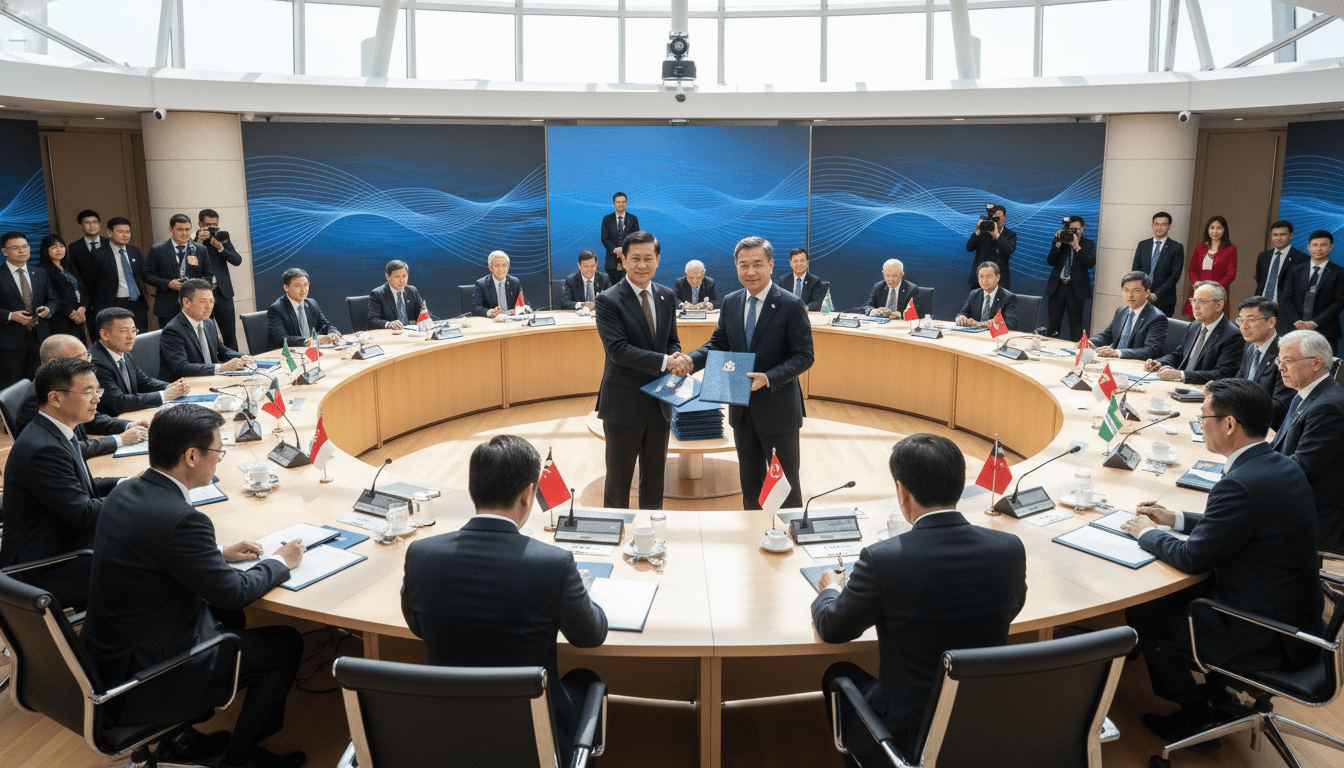
Countries agree to boost protection for undersea cables after recent disruptions
Seventeen nations signed a non-binding framework in Singapore to strengthen the defense of undersea cables after incidents in the Baltic Sea and Taiwan Strait. The move spotlights undersea cables as critical infrastructure that carries more than 95 percent of global internet and data traffic and is increasingly seen as a strategic vulnerability.
17 Nations Sign Non-Binding Framework in Singapore
Seventeen countries from Europe, the Middle East and the Indo-Pacific endorsed the Guiding Principles for Underwater Infrastructure Defence Exchanges (GUIDE) on the sidelines of the Shangri-La Dialogue in Singapore. The accord is explicitly non-binding and aims to foster data sharing, technical cooperation and respect for coastal sovereignty without imposing legal obligations.
Signatories said the framework seeks to speed joint responses to damage or disruption while recognizing that the primary responsibility for many cables remains with private operators. Singapore’s defense minister, Chan Chun Sing, said additional countries could join after completing domestic procedures, underscoring the agreement’s open, cooperative design.
Incidents in the Baltic Sea and Taiwan Strait Spark Alarm
Recent incidents in the Baltic Sea and the Taiwan Strait, which damage or severed subsea lines, drove urgency behind the new initiative. Australian Defense Minister Richard Marles warned at the conference that attacks on subsea infrastructure have occurred with “an extent and frequency” he described as historically unprecedented over the past 18 months.
Marles and other officials noted that investigations into some disruptions have led to allegations involving state actors, with China and Russia among those frequently mentioned in reporting and diplomatic statements. Officials stopped short of definitive, universally agreed legal findings but repeatedly stressed that even accidental damage highlights the fragile nature of global data links.
Questions of Responsibility and National Jurisdiction
The GUIDE document emphasizes cooperation while also acknowledging complex jurisdictional and operational questions. Coastal states retain sovereignty over their territorial waters, yet cables commonly traverse multiple jurisdictions and exclusive economic zones, complicating legal responsibility for protection and repair.
Germany, for example, did not participate in the initial group, officials said, citing unclear domestic lines of responsibility for undersea infrastructure. European and NATO initiatives are already underway to fill gaps at the regional level, reflecting a growing recognition that piecemeal national approaches fail to address transboundary risks.
Australia Flags Fragility and AUKUS Underwater Drone Project
Australia’s delegation highlighted the strategic stakes, noting that roughly 99 percent of the country’s internet traffic flows through just 15 undersea cables. Marles said a single anchor strike could sever access to communications, finance and health services, with immediate, cascading effects for a modern economy.
As part of broader AUKUS collaboration, Australia signed an agreement with the United Kingdom and the United States to develop underwater drone technology intended in part to locate, monitor and protect subsea cables. Officials framed the initiative as a concrete step to bolster the so-called second pillar of AUKUS, alongside the longer-term program for nuclear-powered submarines.
Private Operators, Repair Capacity and Cooperative Response
Speakers at the dialogue underscored that private companies operate most undersea networks and that rapid repair capacity is central to resilience. Thanos Dokos, national security adviser to the Greek prime minister, argued that protection must be coordinated: shielding only cable segments in one country provides limited benefit if neighboring waters remain vulnerable.
Delegates discussed expanding repair fleets, pre-positioning specialized vessels, sharing mapping and real-time monitoring data, and conducting joint exercises to reduce response times. The GUIDE signatories committed to exchanging best practices and technical assistance while continuing to explore legal and operational frameworks for cross-border support.
Technology, Intelligence and Strategic Implications
Officials linked undersea cable protection to a broader shift in defense doctrine that now ranges from seabed operations to space. France’s defense minister, Catherine Vautrin, framed the challenge as part of modern warfare’s multi-domain character, in which tools such as drones, artificial intelligence and quantum technologies play a growing role.
Debate in Singapore touched on surveillance and attribution capabilities, the ethics and legality of offensive countermeasures, and the need for transparency to avoid escalation. Some delegates favored enhanced passive protections — deeper burial, route diversity and hardened repeaters — while others stressed the value of improved situational awareness and international norms to deter deliberate interference.
Coordination among multilateral institutions, allied militaries and private sector operators is likely to accelerate, driven by both strategic worries and practical economics. Officials acknowledged that technical fixes alone will not remove geopolitical risk, but they said combined diplomatic, legal and technological measures can reduce the odds of a disruptive incident.
The GUIDE framework marks an early step in a wider effort to treat undersea cables as high-priority critical infrastructure, but participants agreed that translating principles into wide-ranging, operational cooperation will require further negotiation, funding and domestic policy decisions.
