
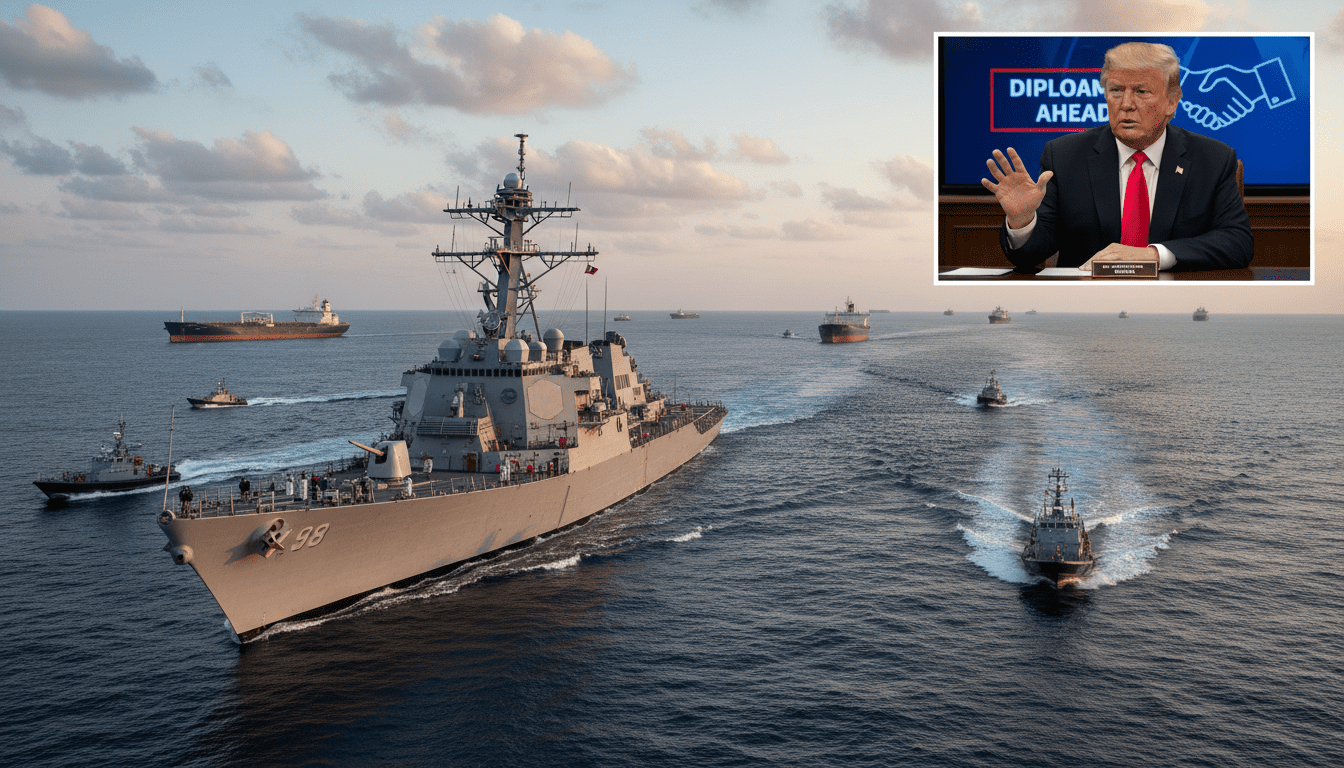
Strait of Hormuz blockade: CENTCOM says no vessels breached in first 24 hours as Trump hints talks may resume
CENTCOM reports no ships breached the Strait of Hormuz blockade in its first 24 hours; diplomatic signals suggest US-Iran talks might resume within days.
Initial CENTCOM update on Strait of Hormuz blockade
The US military’s Central Command (CENTCOM) said no vessels passed through the Strait of Hormuz in violation of the blockade during its first 24 hours, and that six merchant ships complied with orders to turn away. CENTCOM clarified the restriction applies to vessels entering or leaving Iranian ports, while vessels bound for or from non-Iranian ports remain free to transit under US protection. The statement marked the first detailed operational update since President Donald Trump announced the blockade following weekend talks in Islamabad that failed to produce an agreement.
Discrepancies in commercial tracking data
Commercial maritime trackers and news agencies produced conflicting accounts of movements through the strait on Monday, highlighting gaps between field reporting and military assessments. Reuters, citing shipping data, said at least three vessels transited the waterway in the blockade’s opening day, including two tankers under US sanctions that were not destined for Iranian ports. By contrast, AFP and several US outlets, leaning on data from the maritime tracker Kpler, reported two vessels left Iranian ports and continued through the strait. CENTCOM’s assertion that no ships “made it past” the blockade stands in tension with those commercial feeds.
Scale of US deployment and operational posture
CENTCOM reported the blockade is being enforced with roughly 10,000 US sailors, Marines and airmen, supported by more than a dozen warships and dozens of aircraft. Military officials framed the mission as narrowly focused on restricting access to Iranian ports while preserving freedom of navigation for other commercial traffic. The high tempo of forces deployed signals Washington’s intent to sustain the measures for the foreseeable future, even as commanders weigh the risks of escalation inherent in close maritime interdiction.
Political rhetoric and rules of engagement
President Trump has publicly warned that any Iranian vessels attempting to breach the blockade would face lethal action, language that Iranian officials condemned as “piracy.” CENTCOM emphasized that US forces are supporting freedom of navigation for ships transiting the strait to and from non-Iranian ports, suggesting an operational distinction between enforcement targets and general commercial shipping. The administration’s posture raises immediate questions about how commanders will apply rules of engagement if contacts with Iranian naval units or affiliated militia forces intensify.
Diplomatic contacts and the possibility of resumed talks
Despite the military posture, both Washington and Tehran signalled a willingness to continue diplomatic engagement after 21 hours of talks in Pakistan. The US delegation was led by Vice President JD Vance while Iran was represented by parliamentary Speaker Mohammad Bagher Ghalibaf, with Pakistani Field Marshal Asim Munir playing a visible mediation role. President Trump said in an interview he expected “something could be happening over the next two days” in Islamabad, and sources in Tehran told regional reporters that message exchanges on bridgeable issues were already underway. Key unresolved items include control of the Strait of Hormuz, the future of Iran’s nuclear programme, and whether the existing ceasefire covers Israel’s operations in Lebanon.
Regional security dynamics and market consequences
Military analysts cautioned that maintaining the blockade increases the likelihood of Iranian countermeasures, which in turn could jeopardize the two-week ceasefire that began on April 8, 2026. Any Iranian attempt to contest the blockade or retaliatory strikes against US forces would carry a high risk of rapid escalation across the Gulf and eastern Mediterranean. Officials and market observers also warned that interceptions or inspections of vessels linked to strategic partners, including China, could provoke diplomatic incidents and further unsettle global oil markets already sensitive to disruptions in the strait.
The maritime interdiction strategy reflects a calculated trade-off by Washington: apply maximum pressure on Iran’s seaborne commerce while continuing to leave transit lanes open for non-Iranian trade. That balance is fragile, dependent on accurate intelligence, tightly controlled military command-and-control, and parallel diplomatic channels to lower the temperature should incidents occur.
The coming days will test whether parallel tracks of hardline maritime enforcement and tentative diplomacy can coexist, and whether Islamabad can sustain its mediating role long enough to narrow the gaps that remain between the two governments.
