
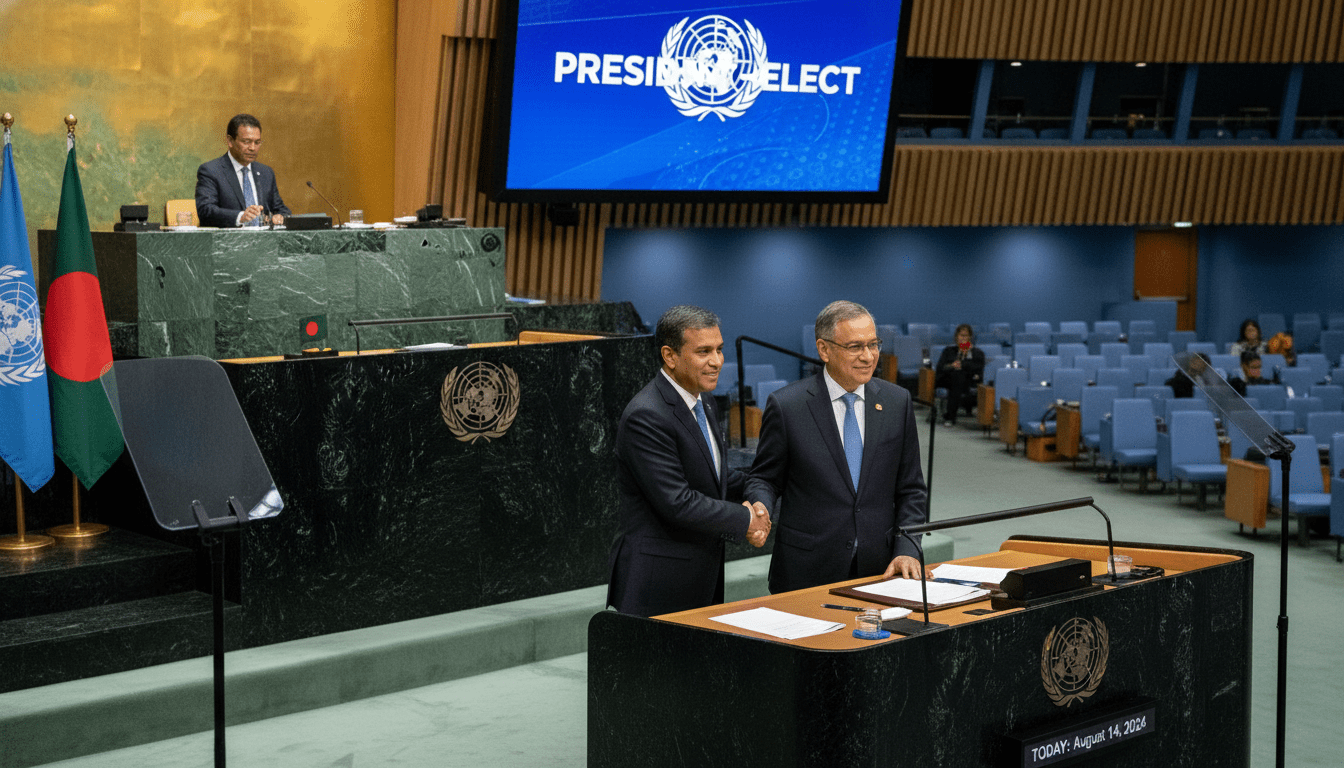
Khalilur Rahman Elected 81st President of the UN General Assembly
Bangladeshi diplomat Khalilur Rahman elected 81st UNGA president in a secret ballot; he will take office in September amid mounting geopolitical strains.
Khalilur Rahman, Bangladesh’s foreign minister, was elected on Wednesday as the 81st president of the United Nations General Assembly and will assume the role when the UNGA opens its session in September. The vote, held by secret ballot, ended a closely contested race and places Rahman at the helm of the world’s most representative diplomatic forum during a period of pronounced global tension. His one-year term will include overseeing a critical timetable for the selection of the next UN secretary-general.
Bangladeshi Diplomat Wins Contested UNGA Presidency
Rahman defeated Cyprus’s ambassador Andreas Kakouris in a rare secret-ballot contest, securing the necessary majority to lead the assembly. The election marks the return of a competitive vote for the UNGA presidency, a position typically resolved by consensus among member states. The result underscored divisions within the assembly even as representatives acknowledged the ceremonial and convening weight the president carries.
Vote tally and procedural details
In the secret ballot, Rahman obtained 99 votes, eight more than his opponent, out of 190 ballots cast, with no invalid votes or abstentions. The presidency rotates among the UN’s five regional groups and the Asia-Pacific group held the right to nominate the candidate for the 81st session. The UN confirmed that Rahman’s term will formally begin on September 8 and last for one year, in keeping with the assembly’s established calendar.
Rahman’s diplomatic career and UN background
A career diplomat who entered Bangladesh’s foreign service in 1979, Rahman has held senior posts both in Dhaka and at the United Nations in New York and Geneva. His résumé includes service as spokesperson for the Least Developed Countries and as a special adviser to the UN Conference on Trade and Development, along with an early posting as first secretary at Bangladesh’s permanent mission to the UN from 1986 to 1991. Domestically, he has occupied roles including national security adviser and high representative on the Rohingya response, and he became foreign minister in February following a change in government earlier this year.
Timing places Rahman at the center of the Secretary‑General selection
Rahman’s presidency will coincide with the assembly’s work to select a successor to Secretary‑General António Guterres, whose term expires at year’s end. That process, which involves consultations with the Security Council and a vote in the General Assembly, will be one of the session’s most consequential tasks. Rahman addressed delegates on the challenges facing the organisation, warning that confidence in the UN is being tested on multiple fronts and urging members to uphold the body’s commitments.
Multilateral strains and political context
Outgoing president Annalena Baerbock, Germany’s foreign minister, framed Rahman’s incoming term against a backdrop of eroding consensus and heightened pressure on the UN Charter. Member states have pointed to past unilateral actions and funding withdrawals by major powers that have strained the organisation’s capacity to address global crises. Those dynamics mean Rahman will preside over debates in which restoring trust in multilateral institutions and defending agreed norms will feature prominently.
Security Council elections and regional implications
The assembly also elected five non‑permanent members to the Security Council for two‑year terms beginning January 1, 2027: Austria, Kyrgyzstan, Portugal, Trinidad and Tobago, and Zimbabwe. The outcome represented a setback for Germany, which had campaigned for a seat and failed to secure sufficient support, creating domestic political reverberations. The Security Council remains the only UN body able to issue legally binding decisions, while its five permanent members retain veto power, making its composition a central element of the UN’s ability to act.
Khalilur Rahman inherits a role that blends ceremonial duties with an opportunity to shape the assembly’s agenda and tone at a pivotal moment for the United Nations. His year in office will be measured by how effectively he can shepherd the Secretary‑General selection, facilitate dialogue among polarized states, and bolster the assembly’s relevance amid competing geopolitical pressures.
