
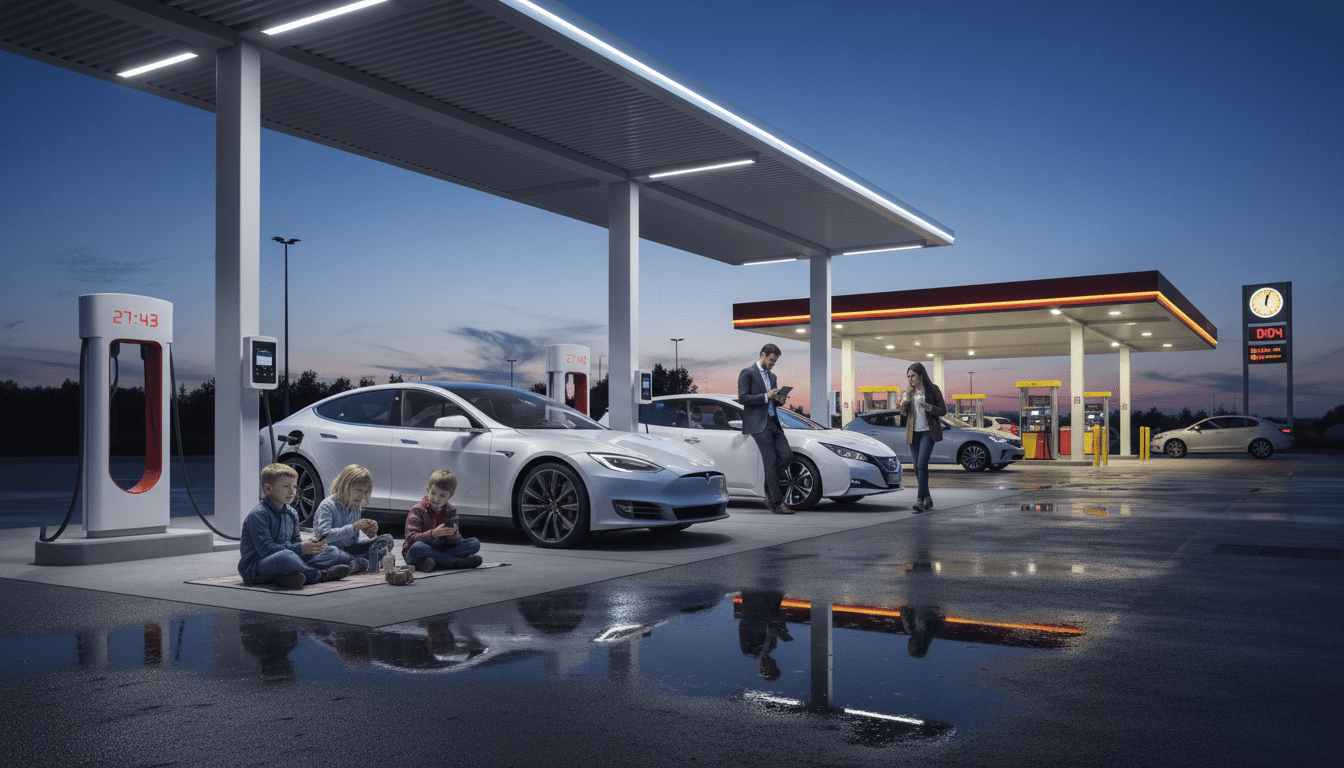
Electric car charging times still lag behind petrol refuelling, fastest chargers need 20–30 minutes
Electric car charging times remain far longer than petrol refuelling; fastest public chargers typically require 20–30 minutes from 10–80%, affecting travel time and driver confidence.
Electric car charging times are improving but remain significantly slower than filling a petrol tank, creating practical and psychological barriers for drivers switching to electric vehicles. Even at the most powerful public chargers, a battery typically needs around 20–30 minutes to jump from 10 to 80 percent, a window that contrasts sharply with the five minutes many drivers expect for a fuel stop. That gap is central to planning for long trips and continues to shape consumer attitudes toward electric mobility.
Fastest public chargers still need 20–30 minutes
Recent measurements and operator data show that ultra-rapid public chargers, while much faster than earlier generations, commonly require 20–30 minutes to charge a battery from roughly 10 to 80 percent. The 10–80 percent window is used because charging slows substantially as a battery approaches full capacity, so the most efficient portion of a session is contained within that range.
Those times represent ideal or near-ideal conditions: compatible vehicles, optimal battery temperature, and chargers operating at peak power. Real-world sessions are often longer after accounting for queuing, connector availability, and variations in vehicle charging curves.
Refuelling remains a fraction of the time
A typical petrol or diesel fill-up usually takes under five minutes from pull-up to payment, a standard that has set driver expectations for decades. That quick turnaround is especially valued on multi-stop journeys, where total travel time is sensitive to even short delays.
By contrast, even with best-case charging, the stop is measured in tens of minutes rather than minutes, which shifts how drivers plan trips and allocate rest or meal breaks. For many users the additional dwell time is acceptable when charging at home or overnight, but it becomes more salient during longer drives.
Why charging cannot simply match pump speed
Battery chemistry and thermal management impose physical limits on how quickly a lithium-ion pack can accept energy without degrading. Fast input causes heat and stresses that manufacturers mitigate by tapering power as a cell nears higher state of charge, which is why the last 20 percent of a charge takes disproportionately longer.
Vehicle design also matters: not all models can accept the maximum power offered by a public charger, and software safeguards reduce peak rates to protect battery longevity. These technical constraints are why improvements in peak charger power do not always translate directly into proportionally shorter real-world charging times.
Improvements have shortened many sessions
Charging times have dropped substantially over the past decade thanks to higher-power chargers, better battery chemistries, and smarter thermal systems. Newer EVs can accept higher sustained power and recover usable range quickly during short stops, reducing the most acute pain points for many drivers.
Manufacturers are also optimizing charging curves and software to deliver more energy in the early minutes of a session, which helps in common stop patterns where drivers add range rather than charge to full. Still, the law of diminishing returns applies: pushing beyond current thresholds yields technical complexity and cost that slow the pace of universal, dramatic cuts in session length.
Infrastructure and access shape the experience
The availability of high-power chargers is uneven across regions, with dense urban networks and major corridors better served than remote or rural areas. That disparity influences whether drivers can routinely rely on fast top-ups or must plan around slower, lower-power stations.
Access can also be constrained by hardware choices at sites, payment friction, and simple congestion at popular nodes. When several vehicles queue for a single ultra-rapid unit, the practical time penalty multiplies, and drivers often face both waiting time and a potentially slower charging session once it is their turn.
Behavioral effects on travel and EV adoption
Longer charging stops change how people drive and plan journeys: overnight home charging becomes the norm for daily needs, and long-distance travel requires route planning with scheduled charging breaks. For some drivers the added complexity reinforces "range anxiety," while others adapt by integrating charging into mealtime or rest stops.
These behavioral shifts affect vehicle choice and ownership models, encouraging consumers toward larger battery packs, subscriptions to charging networks, or hybrid approaches that combine home and public charging. Fleet operators and businesses also adjust scheduling to accommodate longer recharging windows.
Industry players and policymakers are targeting the gap between refuelling and charging times through coordinated investments and technical roadmaps. Networks are installing more ultra-rapid chargers along highways, automakers are racing to improve battery chemistry and thermal controls, and governments are offering incentives and standards to accelerate deployment.
Public-private partnerships aim to alleviate bottlenecks at high-traffic locations and to standardize plugs and payment systems to reduce friction. However, scale-up requires substantial capital and time, and technical limits mean the objective is often narrowing the gap rather than eliminating it entirely.
Charging times have come down markedly, and many drivers find modern electric vehicles practical for daily use, but the difference between a five-minute fuel stop and a 20–30 minute fast charge remains a defining characteristic of current EV ownership. Continued progress on chargers, batteries, and infrastructure will further reduce inconvenience, yet realistic expectations about stop duration remain essential for planning longer trips.
