
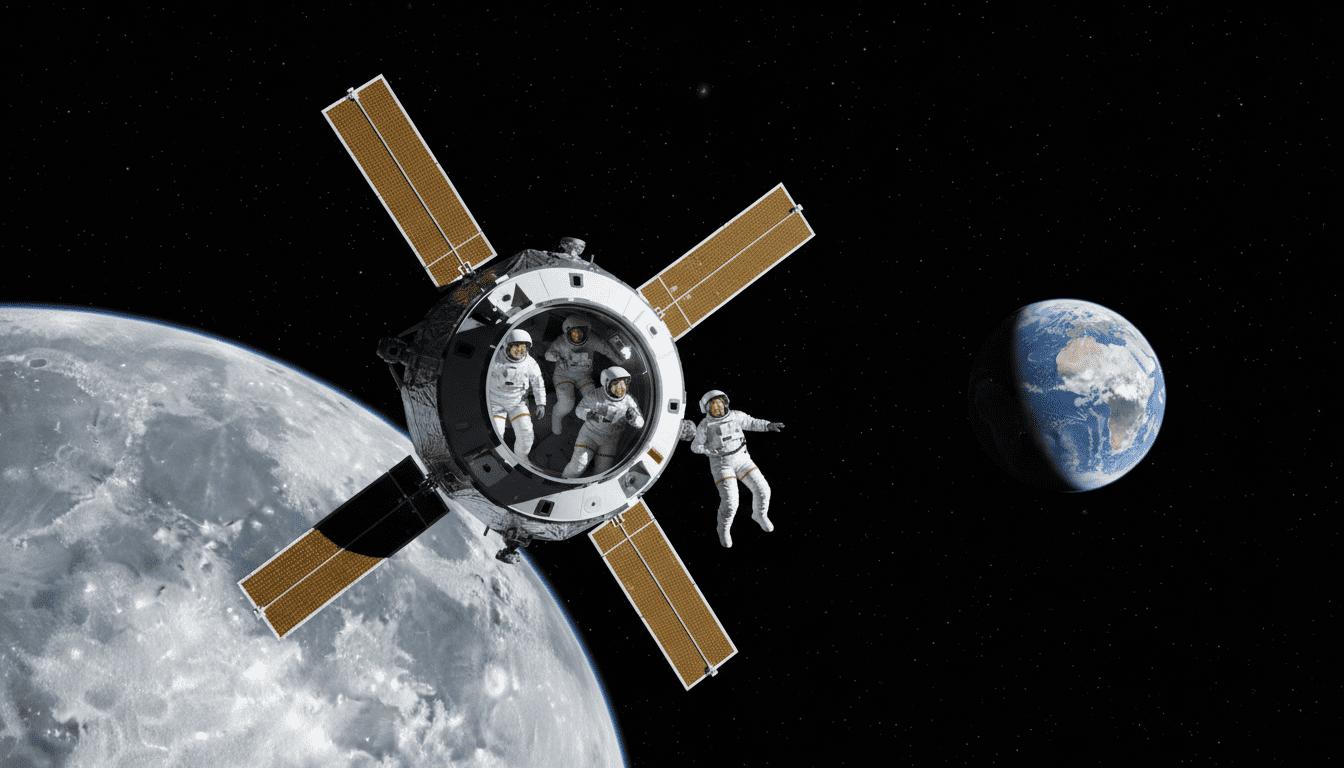
Artemis 2 mission completes crewed lunar flyby and begins return to Earth
Artemis 2 mission completed a planned crewed circumlunar flyby over the Easter period, with four astronauts now en route back to Earth after reaching a record distance from our planet. The flight, which NASA describes as a test of systems and procedures for future lunar operations, briefly lost radio contact when the capsule passed beyond established relay coverage. Mission managers report the spacecraft performed as expected and is proceeding on its return trajectory.
Artemis 2 completes planned lunar flyby
NASA confirmed that the crew aboard the Artemis 2 mission executed the planned trajectory that carried the capsule around the far side of the Moon. The maneuver tested navigation, life support and deep-space operations that will be critical for subsequent Artemis missions aimed at returning humans to the lunar surface.
The crew of four completed the circumlunar arc and initiated the burn sequence to set the vehicle on a trans-Earth trajectory. Officials said system checks conducted before and after the far-side transit showed the spacecraft remained within operational margins.
Crew reached record distance from Earth
At peak distance the Artemis 2 crew traveled farther from Earth than any humans in decades, exceeding ranges typical of low Earth orbit missions. That distance tested both the vehicle’s environmental controls and the crew’s ability to operate autonomously when ground contact is reduced.
The achievement reestablishes human presence at lunar distances and provides a benchmark for communications, navigation and radiation monitoring systems. Engineers will analyze telemetry from the high-altitude phase to evaluate hardware margins for longer-duration missions.
Temporary communications blackout at apogee
During the far-side pass, mission controllers acknowledged a planned interval in which direct radio contact with Earth was not possible. The spacecraft briefly traversed a zone where line-of-sight communications are blocked by the Moon, a scenario mission planners had anticipated.
Controllers relied on onboard autonomy and pre-programmed procedures while the relay blackout persisted. After the vehicle cleared the lunar far side, normal communications resumed and data transmissions confirmed the crew’s status and spacecraft health.
Scientific objectives and mission value
Artemis 2 mission served primarily as a systems validation flight rather than a science expedition, with experiments focused on spacecraft performance and crew operations. Instruments aboard recorded environmental data, while the crew tested medical monitoring and sample procedures intended to inform future surface missions.
Scientists and mission planners note that these validation flights are a necessary step before committing crews to lunar surface landings and extended stays. The mission’s data will influence the design of habitats, suits and logistics for upcoming Artemis missions that aim to place astronauts on the Moon.
Cost, critics and public debate
The mission’s price tag, estimated at about four billion U.S. dollars, has generated debate over the balance between symbolic achievement and tangible scientific return. Critics argue the budget could be allocated to terrestrial priorities, while supporters say the flight is an investment in technology, industry and long-term space infrastructure.
Public comment has also focused on whether a circumlunar test flight yields enough near-term benefit to justify the expense. Agency officials counter that proving hardware and human factors in deep space lowers risk for later, costlier surface operations and commercial partnerships.
Return trajectory and recovery preparations
After completing its lunar arc the spacecraft fired engines to place itself on a re-entry path toward Earth, with recovery teams standing by to receive the crew. Ground and naval assets have been positioned according to contingency plans, and flight surgeons are monitoring crew health for re-entry conditions and post-flight care.
Mission control continues to track the capsule’s systems as the vehicle closes the distance to Earth and prepares for high-speed atmospheric entry. If all goes to plan, recovery teams will secure the spacecraft and begin a detailed post-mission assessment.
The flight also prompted clarifications in some public briefings that this was not the first crewed lunar orbit; earlier missions in the Apollo era carried humans around the Moon decades ago. Analysts say accurate historical context helps frame Artemis 2’s role as a stepping stone in a long-term program to establish a sustained human presence beyond low Earth orbit.
