
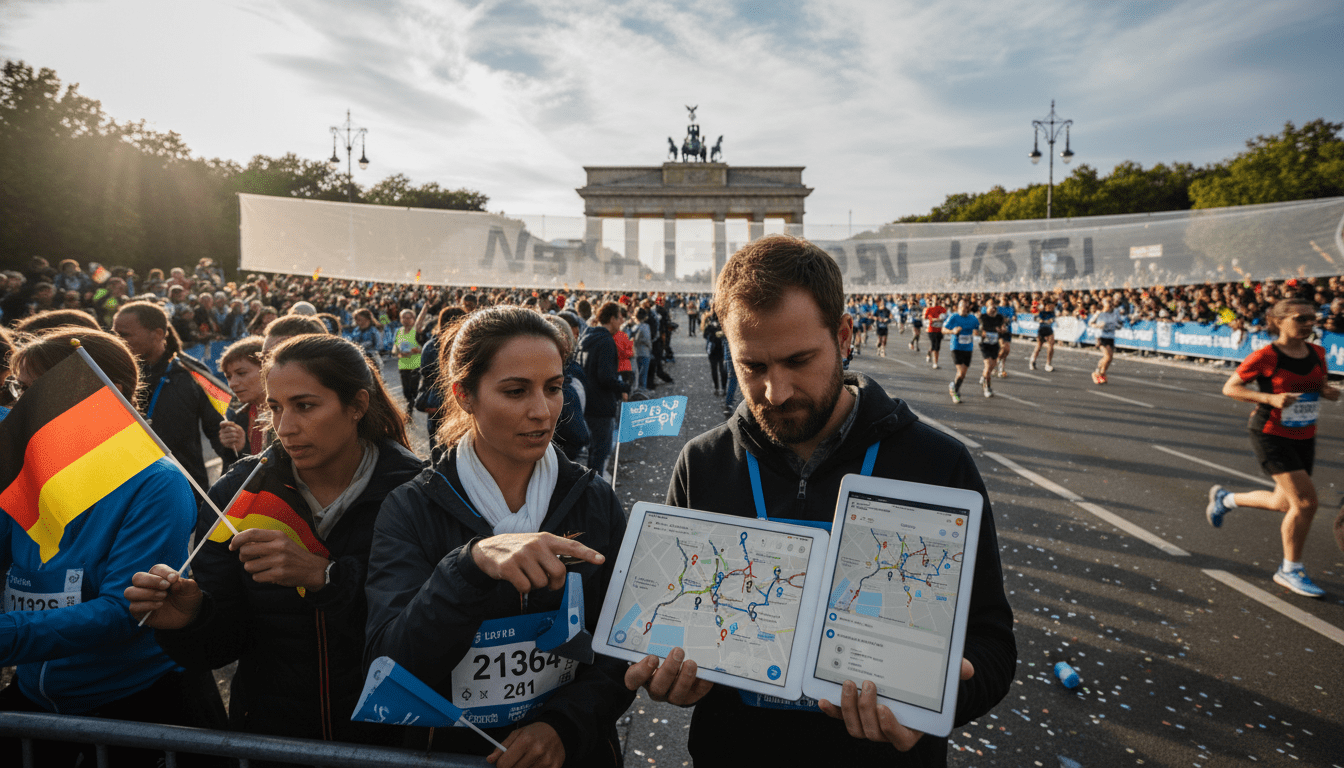
Berlin Marathon cheering made simple with a route planner
Plan where to cheer at the Berlin Marathon: a route planner estimates times at each kilometer, offers four public‑transport routes and practical race‑day tips.
New cheering tool simplifies Berlin Marathon cheering logistics
A new Berlin Marathon cheering planner gives spectators estimated arrival times at every kilometre marker so they can cheer from multiple places without hours of manual calculations. The planner turns a runner’s start time and pace into a kilometre‑by‑kilometre timetable, letting friends and family plan to meet their participant at four or five locations along the course. The tool is designed for people who want to be a visible boost during the race rather than only catching the finish.
The planner also bundles practical public‑transport routing and ready‑made example itineraries for spectators who do not know the city. That combination of timing estimates and transit directions reduces the risk of showing up at a checkpoint after the runner has already passed. Organisers of group spectating and individual supporters will find the approach especially useful on a day when roads, tram lines, and pedestrian flows change quickly.
Developed by an independent Berlin‑based travel author, the product is delivered as a Google spreadsheet with supporting materials and example routes. It is presented as an estimate rather than a guarantee, and the supplier recommends using it alongside official race information and local transport apps to confirm final timings. The planner is offered for a modest fee and includes additional instructions and tips for new visitors to the city.
How estimated arrival times are calculated
The core of the planner is a simple calculation that converts a start time and an expected pace into projected arrival times for each kilometre marker. Users enter the participant’s wave or start time and an average pace per kilometre, and the sheet applies that pace cumulatively across the course. The result is a running timetable you can print or save on your phone so you know roughly when a participant will reach each checkpoint.
These times are explicitly estimates and do not account for every real‑world variable that can alter a runner’s progress. Factors such as crowding, temporary route diversions, weather conditions, mid‑race walk breaks, or medical stops will change actual times on race day. The planner therefore works best when used with conservative margins: choose viewing points that give you extra minutes of leeway and check live updates where possible.
The planner is also set up to handle two participants with differing start times and paces, producing parallel timetables so a single spectator can decide whether to follow one person or attempt to split time between two. That feature is useful for family members who want to track both a friend and a partner, or two teammates who started in different waves. The spreadsheet outputs are easy to edit if a participant updates their expected pace in the days before the race.
Four example cheering routes and transit considerations
To help spectators unfamiliar with Berlin, the planner includes four sample cheering routes with suggested public‑transport legs and timing windows. Two of the examples focus on following a single runner to maximise cheers in a concentrated area, while two are designed to cover two runners who have different paces or start waves. Each example pairs likely viewing spots with nearby U‑Bahn, S‑bahn, tram, or bus connections and notes walking times between stops.
Suggested stops on the example routes include central, high‑visibility locations that are both spectator‑friendly and well served by transport. For instance, Strausberger Platz — shown in course photos as a lively early‑race location — is referenced as a practical mid‑morning cheering point near tram and S‑bahn access. Other example itineraries use hubs such as Alexanderplatz, Potsdamer Platz and the Tiergarten corridor, where short transfers and clear sightlines make spectating simpler.
The planner’s accompanying notes emphasise using the BVG Fahrinfo app or similar journey planners on race day to check service changes and temporary diversions. Race weekends commonly trigger tram and bus detours and occasional S‑bahn alterations, so spectators should verify departures in real time. Where sample routes require a transfer, the tool flags minimum connection times and suggests buffer windows so spectators can move between stations without racing on foot.
The examples show how a single spectator can realistically visit three separate locations during the race or four to five if willing to move briskly and accept tighter margins. Each route is structured to reduce backtracking and uses major lines that maintain frequency during weekend service hours. The materials also point out quieter alternative stops when crowds at the most popular locations become difficult to navigate.
Practical race‑day timing and transfer tips
Timing is the single most important variable when attempting to cheer at multiple spots during a marathon. The planner recommends building in at least five to ten minutes of buffer for each viewing window to accommodate small delays, crowd congestion and the time it takes to exit and re‑enter public‑transport stations. This margin will help you avoid the common disappointment of arriving to find the runner has just passed.
Choose viewing locations near transport nodes that you already understand, and prefer routes with frequent services. U‑Bahn and S‑bahn lines in central Berlin typically run at short intervals on race day, which helps with tight transfers. Trams and buses are useful for reaching outer stretches of the course but can be subject to temporary closures; always have an alternate plan if a tram is suspended.
Packing and preparation matter as much as timing. Bring a compact printed copy of your planned timetable and screenshots of the route segments, along with a portable power bank for your phone. Visible signs and a loud voice can make a quick impact; short, specific messages on placards are easier for fatigued runners to register than long lists of encouragement. Finally, wear layers and be ready for unpredictable early‑morning temperatures or afternoon rain.
Spectators should also consider race‑day access restrictions and security measures. Organisers often cordon sections of the route for emergency access and stage areas near the start and finish, so plan your entries and exits around official access points. If travelling with a group, designate a meeting point and a fallback location in case mobile reception is poor or public‑transport disruptions occur.
Field test following two runners in 2024
The planner’s creator field‑tested the method at the Berlin Marathon in 2024 by attempting to cheer two different participants with separate start times and paces. With detailed planning and early departures, the test resulted in seeing one runner at two distinct points and the other at three locations, with at least one extra stop realistically achievable. The practical takeaway was that careful pre‑planning and conservative pacing estimates make multiple meet‑ups feasible even in a busy urban marathon.
That trial required several hours of pre‑race mapping and arithmetic to synchronise estimated arrivals with public‑transport timetables. On the day, small weather changes and heavier-than-expected crowds compressed some transfers, demonstrating why the planner encourages buffer minutes between legs. The test also showed the value of choosing cheering spots that are easy to exit quickly—places with wide sidewalks and nearby station entrances were significantly faster to move from than densely packed spectator groves.
Witnessing a participant at multiple points had a notable effect on morale, according to observers in the trial. Runners responded visibly to seeing familiar faces along the route, often accelerating their pace or breaking into a smile when supporters appeared. For many amateur and club runners, periodic encouragement from friends or family can translate into sustained momentum during the later stages of the race.
The field test underlined the planner’s role as a decision‑support tool rather than an exact prediction engine. Spectators who used the planner were better prepared than those relying on intuition alone, but they still needed to adapt to live conditions. The experience reinforced the recommendation to combine the planner with official race feeds and local transport alerts for the most reliable day‑of information.
What the cheering route planner includes and cost
The cheering route planner is sold as a package that combines a Google spreadsheet, four example routing itineraries, practical tips, and video guidance. The spreadsheet accepts a participant’s start time and average pace and produces a table of estimated times for each kilometre marker that you can export or view on a mobile device. Example itineraries show how to turn those estimates into a workable day plan using Berlin’s public‑transport network.
In addition to the spreadsheet and routes, the package includes written advice on using local transport apps like BVG Fahrinfo, tips for choosing spectator locations that are easy to reach, and guidance for cheering two participants on the same day. The author also provides a short tutorial video that walks users through the spreadsheet and demonstrates how to enter variables and interpret the outputs. The seller positions the tool as a time‑saving aid for visitors and locals alike who want to make the most of race‑day spectating.
The product is priced at US$15, a one‑time fee that grants access to the files and example routes. Buyers outside Germany should be aware of currency conversion when purchasing, and the seller advises downloading the materials well in advance of race weekend. The planner is not an official product of the marathon’s organising body, and purchasers are reminded to consult the race organisers’ updates and local transport advisories alongside the planner’s output.
Practical considerations for international visitors
For visitors travelling to Berlin specifically to support a runner, planning should begin several days before race weekend. Buy tickets or passes for public transport that cover the zones you expect to use, and familiarise yourself with station layouts for quicker transfers. Many central stations have multiple entrances and exits that save minutes if you know which one to use for your planned transfer.
Language is rarely a barrier for transit information in Berlin, but it helps to download the BVG app and save offline screenshots of your planned route in case mobile reception becomes unreliable during the race. Consider buying a day pass for unlimited rides within the zones you need; that can be more economical and saves time compared with buying multiple single tickets. Keep your timetable printed or in a second device in case battery life becomes an issue.
Respect local rules and other spectators. Standing on running lines, crossing barricades, or obstructing emergency access can create hazards for runners and volunteers. Move to the side of the route if a large group is forming in a narrow area, and follow instructions from race marshals. A friendly, organized spectating presence enhances the experience for runners and helps race operations run smoothly.
The planner’s materials also advise on contingency planning. If a tram or bus is suspended, look for high‑frequency replacement services or choose a nearby U‑bahn station for an alternate leg. While the sample routes focus on efficiency, pragmatic shifts are sometimes necessary on race day, so having a backup viewing spot that is a short walk from your original location is recommended.
For anyone who wants to cheer at multiple points during the Berlin Marathon, a simple, pre‑calculated timetable paired with clear public‑transport directions removes much of the guesswork and stress. The cheering route planner transforms a runner’s start time and pace into a usable sequence of viewing windows and suggests practical itineraries that minimise wasted travel. Used with official race updates and local transport information, the planner can help supporters turn hours of uncertain waiting into targeted bursts of encouragement that make a measurable difference to participants on race day.
