
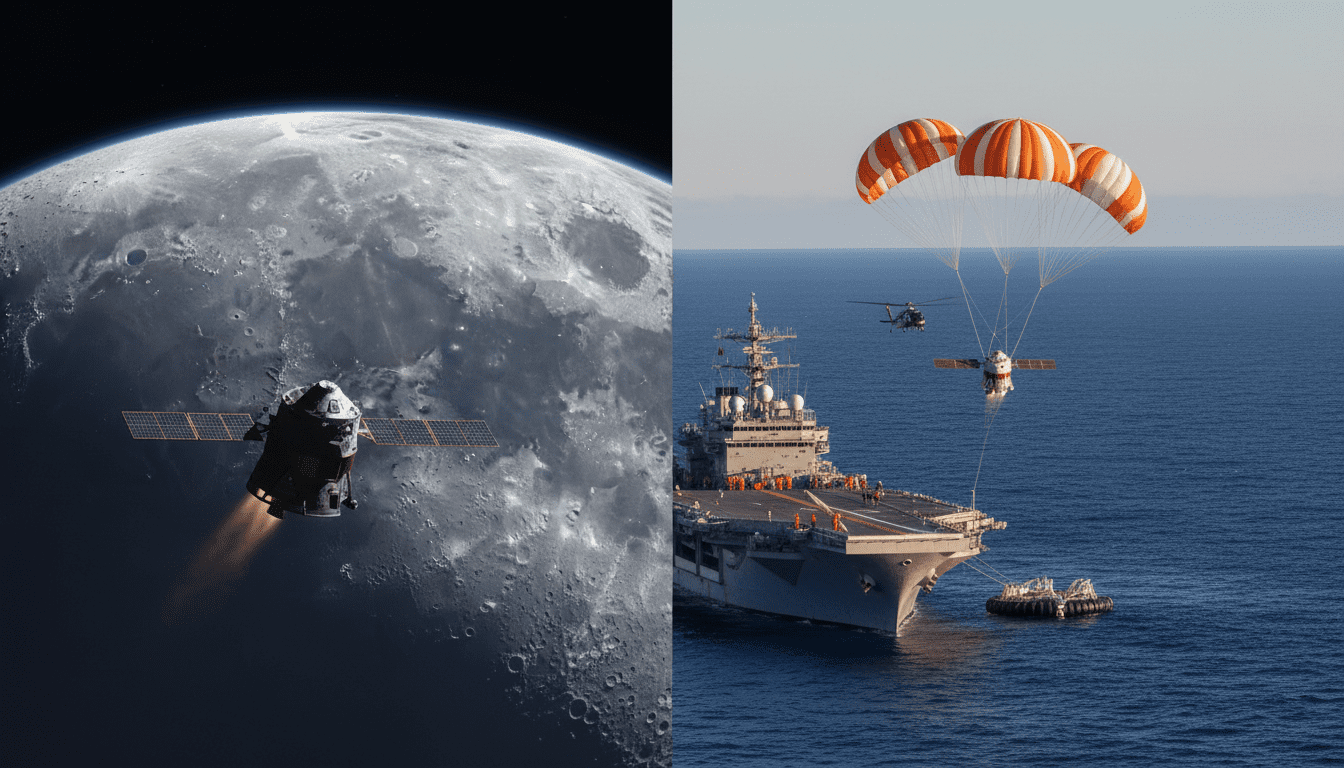
Artemis 2 Completes Far-Side Moon Flyby; Orion Capsule Set to Splash Down April 11, 2026
Artemis 2 achieved a successful flyby of the Moon’s far side, NASA confirmed, as the Orion spacecraft prepares to return to Earth with a four-person crew. The mission, which includes U.S. astronauts Christina Koch, Victor Glover and Reid Wiseman alongside Canadian astronaut Jeremy Hansen, reached its primary objective on the outbound leg and is scheduled for Pacific splashdown early Saturday, April 11, 2026. After a mission lasting nearly ten days, the crew will undergo post-flight medical checks and debriefs once recovery teams secure the capsule. The completion of this lunar flyby marks a key milestone for NASA’s Artemis program as it tests systems and procedures for future lunar operations.
Flyby Completed Behind the Moon
The Orion spacecraft executed a precise trajectory that carried it behind the lunar limb, passing over the Moon’s far side as planned. Navigation and guidance teams reported nominal performance of propulsion and attitude-control systems during the critical burn sequences that established the return corridor. Communications blackout periods while behind the Moon were short and anticipated, with data and telemetry resuming on schedule as Orion re-entered line-of-sight. Mission control emphasized that the spacecraft’s behaviour during this phase met engineering expectations and validated several mission systems.
Crew Composition and In-Flight Activities
The four-person crew aboard Artemis 2 combines veteran spaceflight experience and international participation, with three American astronauts and one Canadian specialist. During the nearly ten-day mission the crew carried out a range of operational checks, monitored Orion’s life‑support systems and ran contingency drills designed for longer-duration deep-space missions. Crew members also performed scheduled medical monitoring and documented spacecraft performance to inform post-mission analysis. NASA highlighted the importance of human factors data gathered on this flight for refining procedures on future Artemis missions.
Orion Return and Planned Splashdown
Orion is on course to re-enter Earth’s atmosphere and splash down in the Pacific Ocean on Saturday, April 11, 2026, in the early hours as planned by mission controllers. Splashdown recovery forces, including naval assets and specialized teams, will be staged to secure the capsule and extract the crew for immediate medical evaluation. The recovery timeline calls for initial health assessments followed by transport to a designated facility where more comprehensive debriefings and inspections will take place. Engineers will also begin an initial post-flight inspection of the capsule to assess hardware performance and wear from re-entry.
Mission Objectives and Test Results
Artemis 2’s flight profile was designed to validate Orion’s systems under operational conditions outside low Earth orbit, with emphasis on propulsion, thermal protection and crew life support. Early reports from NASA indicate that key subsystems performed within expected parameters, providing valuable flight data for both hardware and software components. The mission also served to test human operations in deep-space trajectories, including navigation, communications handover during lunar occultation and emergency procedures. Findings from these tests will help shape procedures and design choices for subsequent crewed lunar missions under the Artemis program.
International Cooperation and Program Implications
The inclusion of a Canadian astronaut aboard Artemis 2 underscores the international partnerships supporting NASA’s Artemis architecture and lunar exploration goals. Collaborative contributions extend to experiment payloads, tracking support and shared technical expertise that enhance mission resilience. The success of this flyby strengthens the case for continued allied participation in sustained lunar operations and future crewed landings. Program officials note that each test flight reduces risk for upcoming missions that will aim to achieve surface operations and longer lunar stays.
Next Steps for Artemis and Orion
Following splashdown and recovery, NASA will conduct an exhaustive review of the mission’s telemetry, crew health data and spacecraft systems to compile lessons learned. That review will inform scheduling and risk assessments for the Artemis mission cadence, including preparations for missions that intend to return humans to the lunar surface. NASA also plans to publish consolidated findings and technical briefs after the initial data analysis is complete and safety clearances are established. Meanwhile, teams will ready Orion and associated hardware for refurbishment or replacement as dictated by the post-flight inspections.
The Artemis 2 mission’s successful navigation of the Moon’s far side and the pending Pacific splashdown on April 11, 2026 mark a substantive advance for NASA’s efforts to return humans to the vicinity of the Moon and to lay groundwork for eventual sustained presence on and around the lunar surface.
