
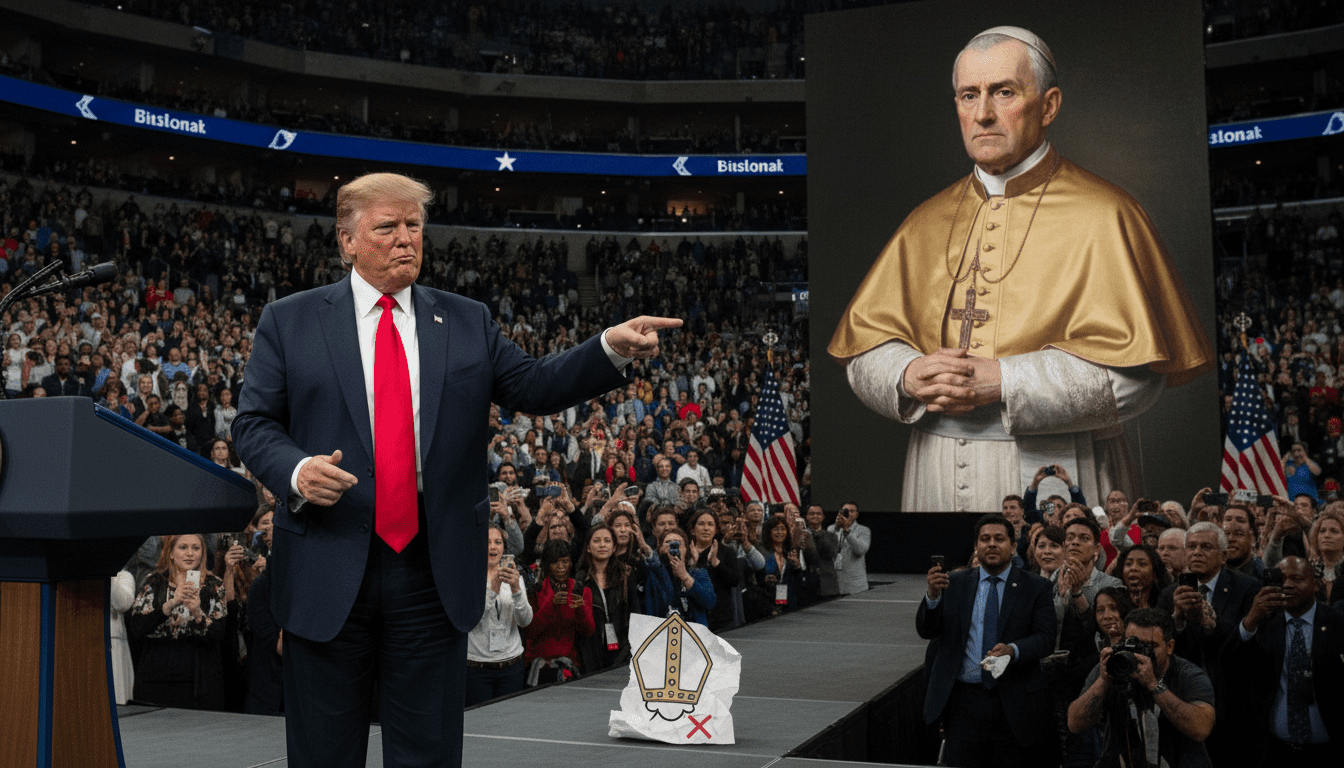
Trump attacks Pope Leo XIV in escalating public confrontation with the Vatican
Trump attacks Pope Leo XIV, deepening a rift with the Vatican and sparking global debate over respect for religious authority and U.S. diplomatic norms worldwide causing fallout.
President Donald Trump has launched a blistering public attack on Pope Leo XIV, accusing the pontiff of political partisanship and questioning the motives behind his election. The dispute — described by critics as personal and unprecedented in its tone — has drawn sharp comment from Vatican officials and U.S. political figures alike. Trump’s remarks, which included dismissive references to religious authority and assertions about the cardinal electors, have intensified a standoff between the White House and the Holy See.
Trump frames the pope’s election as politically motivated
Trump alleged that Pope Leo XIV, born Robert Prevost, was chosen by cardinals as a counterweight to his presidency rather than for spiritual leadership. Supporters of the president seized on the claim as evidence of elite bias, while Vatican sources and commentators rejected the premise as inaccurate and reductive. The White House presented the comments as an attempt to expose political calculation within the conclave, but critics said the intervention crossed customary boundaries of respect toward religious institutions.
Personal attacks and religious provocation escalate tensions
Beyond electoral accusations, Trump used language that many observers regarded as deeply disrespectful toward religious sensibilities, at times casting himself in messianic terms and mocking papal authority. Such personal invective is rare in exchanges between a U.S. president and a pope and has prompted concern among both Catholics and non-Catholics about the erosion of diplomatic civility. Analysts point out that the tenor of the remarks reflects a broader pattern in which Trump has disregarded conventional restraints when confronting adversaries.
Pope Leo XIV and the Vatican responded with measured counters
The Vatican avoided an immediate frontal confrontation, at first delegating public criticism to the cardinal secretary of state and other officials who condemned certain military actions as breaches of international law. Pope Leo XIV himself maintained a composed public posture, issuing more pointed statements only after rhetoric from the U.S. side intensified. Vatican spokesmen emphasized pastoral priorities and the spiritual responsibilities of the papacy while underscoring the Holy See’s commitment to speaking on humanitarian and legal issues.
Context of a broader political pattern of provocation
Observers placed the confrontation in the context of Trump’s history of breaking diplomatic taboos and making provocative geopolitical proposals. Critics noted that personal attacks on foreign leaders and institutions have been a recurring element of his style, and that the latest assault on the pope represents an extension of that approach into the realm of religion. Supporters argue that challenging powerful institutions is part of Trump’s political brand and that questioning elites, including church leadership, fits that narrative.
Diplomatic limits and the Vatican’s unique leverage
Although the Vatican is economically and militarily limited compared with nation-states, it exerts significant moral and spiritual influence over an estimated 1.4 billion Catholics worldwide. That moral authority gives Pope Leo XIV a kind of leverage that traditional statecraft cannot easily counter, a dynamic commentators say complicates any attempt to blunt papal criticism through conventional pressure. The Vatican’s influence over Catholic voters in the United States and elsewhere adds a domestic political dimension to what might otherwise be framed as a purely diplomatic spat.
Political fallout and reactions within the United States
Responses among U.S. political figures were split, with some administration allies defending the president’s critique and others calling for more restrained language. Vice President J.D. Vance and close supporters publicly sided with the president’s assessment, while a range of Catholic leaders urged a return to respectful discourse and emphasized the pastoral role of the papacy. Polling on religious and political attitudes will likely be watched closely as analysts assess whether the clash shifts support among Catholic voters ahead of key electoral contests.
The confrontation raises questions about the boundaries of presidential rhetoric and the role of religious authority in public life, as well as the strategic calculation behind targeting a global religious leader. Whatever the immediate political calculations, the exchange has prompted renewed debate about respect for institutions, the interplay of faith and politics, and the limits of confrontational leadership in international affairs.
