
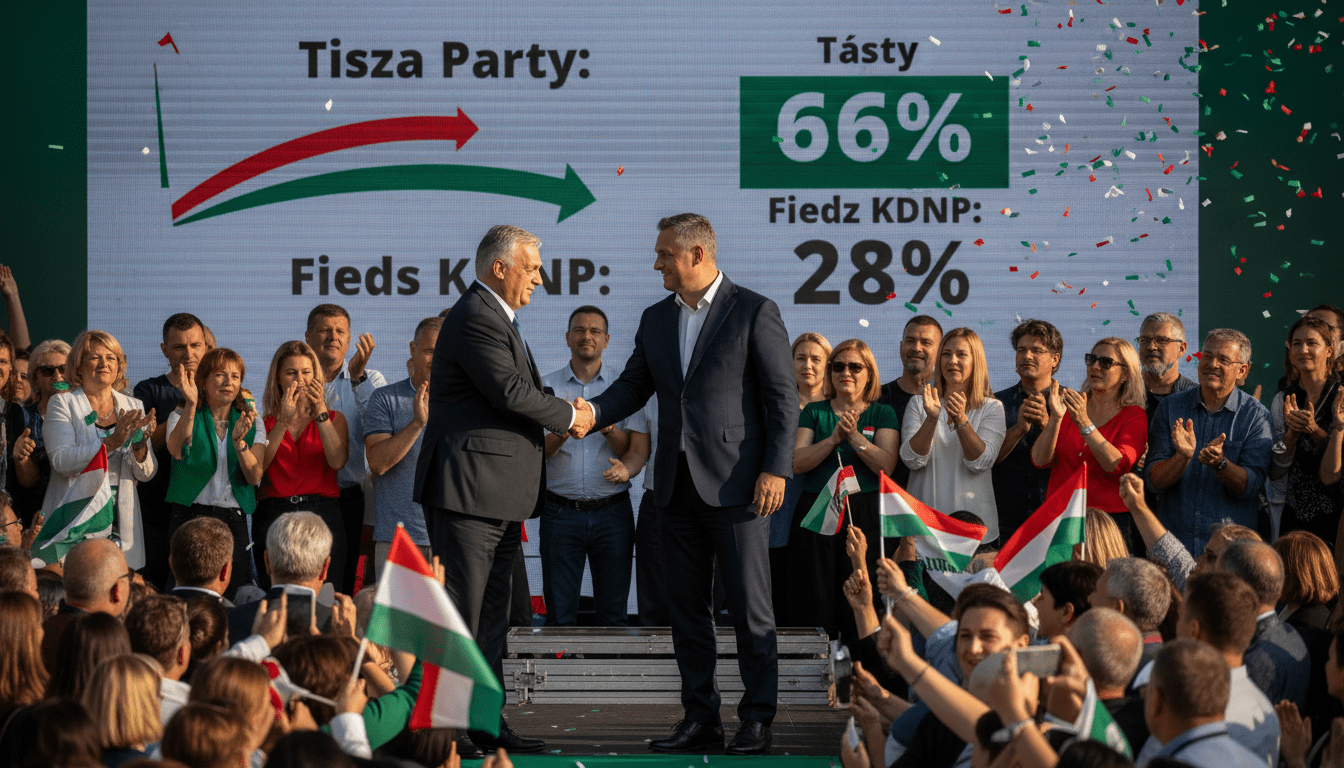
Hungary election results show Tisza party claims two-thirds majority amid mixed media reactions
Hungary election results: Tisza party claims two-thirds majority as counting passes 70%. Independent HVG posted live updates while pro-government Magyar Nemzet delayed coverage.
The latest Hungary election results indicate the Tisza party has secured what local tallies describe as a two-thirds parliamentary majority, with more than 70 percent of votes reported counted. Early reports show divergent coverage between independent outlet HVG, which ran continuous live updates, and the Fidesz-aligned Magyar Nemzet, which initially hesitated to report the outcome. The contrast has highlighted the evolving media narrative as parties and candidates respond to an unexpectedly decisive outcome.
HVG posts continuous results as counts climb past 70 percent
HVG updated its site repeatedly as partial returns came in, headlining a Tisza two-thirds victory and reporting that Prime Minister Viktor Orbán had offered congratulations to Péter Magyar. The outlet’s live feed emphasized the shifting arithmetic on the ground and provided granular interim tallies as they arrived from municipal reporting centers.
Readers on HVG saw a series of succinct headlines conveying developments in near real time, including a prominent line quoting Orbán saying the result was “painful.” The feed framed the outcome as a clear turning point in the contest for several key constituencies.
Magyar Nemzet delays and leans on party messaging
Magyar Nemzet, known for its pro‑Fidesz stance, initially presented the return graphics without immediate celebratory commentary and spent roughly half an hour deliberating on how to frame the result. When the outlet did update its homepage, it placed a banner carrying the message “We never give up,” signaling a rallying posture rather than outright acceptance.
The slower editorial reaction underlines the pressure on partisan media to reconcile party expectations with hard returns. The choice of slogan and placement suggested a strategic preference for resilience messaging over conceding narrative ground.
Election authorities and recount rule changes reported
Multiple reports noted that the procedural rules governing recounts had been altered during the counting process, a development that raised questions among observers and some candidates. Officials and campaign representatives provided differing explanations about the scope and timing of the changes, contributing to the uncertainty that accompanied the late-stage tallies.
The shift in recount procedures only added to a tense atmosphere around results validation, with some local figures publicly noting administrative complications and implying the need for careful verification before final certification.
Local candidates react with mixed messages
Several individual politicians offered notable public responses. Tamás Vargha, a local figure in the affected constituency, said he would have congratulated the victor but claimed the newly declared MP lacked time for a meeting. Meanwhile, Bence Rétvári publicly thanked supporters for their votes, acknowledging the role of grassroots mobilization in the outcome.
The most visible exchange involved Viktor Orbán’s reported acknowledgement of Péter Magyar’s victory, a gesture that was highlighted early by HVG but received more muted and later attention in pro‑government outlets. Those discrepancies in coverage reflected both editorial priorities and the uneven flow of information at the local level.
Implications for Fidesz messaging and the opposition landscape
The apparent two-thirds margin, if sustained in final certified results, would represent a significant consolidation of parliamentary power for the Tisza party’s camp and create fresh questions for Fidesz’s strategic positioning. Pro‑government media’s choice to emphasize resilience and perseverance rather than a straightforward acceptance suggests an effort to maintain a mobilized base even after a substantial setback.
For opposition figures and smaller parties, the result will require rapid recalibration of alliances and tactics, especially where seat allocations and committee control are at stake. Analysts will watch how official tallies and any legal challenges shape the parliamentary arithmetic in the coming days.
Final certification and any legal or procedural challenges remain the immediate next steps, and both media framing and administrative decisions will shape public understanding of the election’s legitimacy. Observers across the spectrum signaled their intention to follow the recount and certification process closely to determine whether interim leads hold.
The unfolding reactions from HVG and Magyar Nemzet illustrated how the same set of returns can be narrated in sharply different ways depending on editorial stance. As authorities move toward formalizing results and candidates settle their immediate responses, the broader political consequences of the reported two-thirds outcome will become clearer.
