
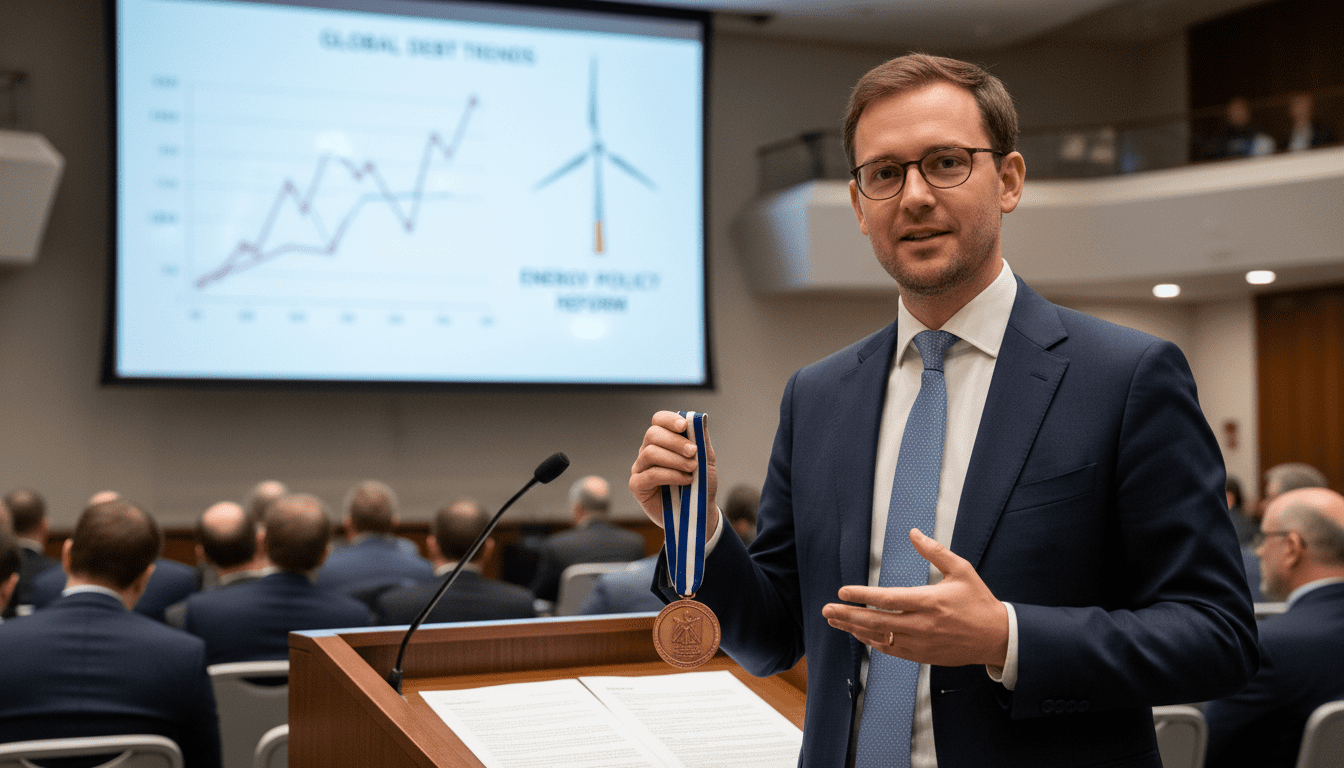
Ludwig Straub awarded John Bates Clark Medal for research on public debt and energy-crisis aid
German-born Harvard economist Ludwig Straub wins the John Bates Clark Medal on April 12, 2026, for influential work on state debt and energy-crisis support, offering policy lessons for governments.
Ludwig Straub, a German economist based at Harvard, was awarded the John Bates Clark Medal on April 12, 2026, recognizing his influential research on state debt dynamics and the design of aid during the energy crisis. The prize, presented annually to an outstanding economist under 40, highlights Straub’s contributions to understanding how public borrowing and targeted relief interact in periods of fiscal stress. His findings, scholars say, have direct implications for current policy debates in Germany and across Europe.
Straub awarded John Bates Clark Medal
Straub’s work was cited by the awarding body for advancing theoretical and empirical analysis of sovereign debt and fiscal policy under uncertainty. The medal places him among a small group of economists whose research has altered how policymakers and academics think about borrowing constraints and crisis response. Observers note that the recognition also elevates the visibility of his proposals for more efficient, temporary aid measures during energy shocks.
The award announcement singled out Straub’s combination of rigorous modeling and attention to real-world policy problems. He has published studies that link debt structure to long-term growth prospects and model the trade-offs governments face when financing emergency support. The Clark Medal underscores the policy relevance of those models at a moment when many advanced economies remain sensitive to borrowing costs.
Research on state debt and fiscal limits
Straub’s research examines how public debt interacts with private sector expectations and market discipline, clarifying when borrowing is sustainable and when it induces harmful adjustments. He uses formal models to show that the distribution of debt across maturities and the credibility of fiscal plans shape borrowing costs more than headline debt figures alone. These insights challenge simplistic prescriptions and argue for nuanced fiscal frameworks.
Empirical elements of Straub’s work test model implications using data on sovereign issuance, interest spreads, and macroeconomic performance. Results suggest that well-communicated medium-term fiscal strategies can reduce the sovereign risk premium without immediate austerity. Straub’s approach stresses the importance of policy design that preserves flexibility while maintaining investor confidence.
Findings on targeted energy-crisis aid
A central strand of Straub’s recent work focuses on the energy crisis and the optimal design of government support for households and firms. He argues that temporary, targeted transfers—paired with transparent sunset clauses—outperform blanket subsidies when the goal is to limit long-term fiscal damage. Targeting helps conserve public resources and reduces distortions in energy markets while protecting the most vulnerable.
Straub’s models also analyze the interaction between aid and inflationary pressures, finding that short-lived, means-tested support can mitigate distributional harm without fueling persistent price increases. He emphasizes that financing choices—whether through short-term borrowing, reallocation, or limited tax measures—alter the trade-offs between equity and debt sustainability. Policymakers are urged to tailor designs to country-specific fiscal space and market conditions.
Lessons for the Merz government and fiscal debate in Germany
Straub’s findings arrive as the German government under Chancellor Merz and Vice-Chancellor Klingbeil faces decisions on energy assistance and medium-term fiscal planning. Analysts say his work offers a framework for balancing immediate relief with debt management, stressing temporary, well-targeted programs rather than permanent transfers. That prescription resonates amid concerns over rising public liabilities and the need to preserve fiscal headroom for future shocks.
Implementation challenges remain political as well as technical, since targeted measures often require administrative capacity and public communication to secure acceptance. Straub’s emphasis on transparent timelines and credible exit strategies could help bridge political constraints and fiscal prudence. For Berlin, the core takeaway is a policy mix that protects households now while safeguarding borrowing capacity later.
Academic and policy reactions to the award
Colleagues in academia welcomed the Clark Medal as recognition of research that bridges theory and policymaking. Economists praised Straub for methodological clarity and for addressing pressing questions about public finance during crises. The award is likely to broaden the uptake of his proposals in central banks, finance ministries, and international institutions.
Policy circles have shown immediate interest, with advisers and officials signaling that Straub’s work will inform debates on subsidy design and debt management. Some fiscal conservatives caution that model-based prescriptions require careful calibration to political realities. Others see in his research a basis for reforms that would make emergency aid more efficient and less costly over the long term.
Straub’s Clark Medal marks a moment of recognition for research that speaks directly to contemporary fiscal challenges, from energy shocks to sovereign risk management.
His work does not offer one-size-fits-all answers but provides tools for policymakers to weigh trade-offs between short-term relief and long-term sustainability. As governments across Europe consider the next phase of economic support and debt strategy, Straub’s research will likely remain part of the policy conversation.
