
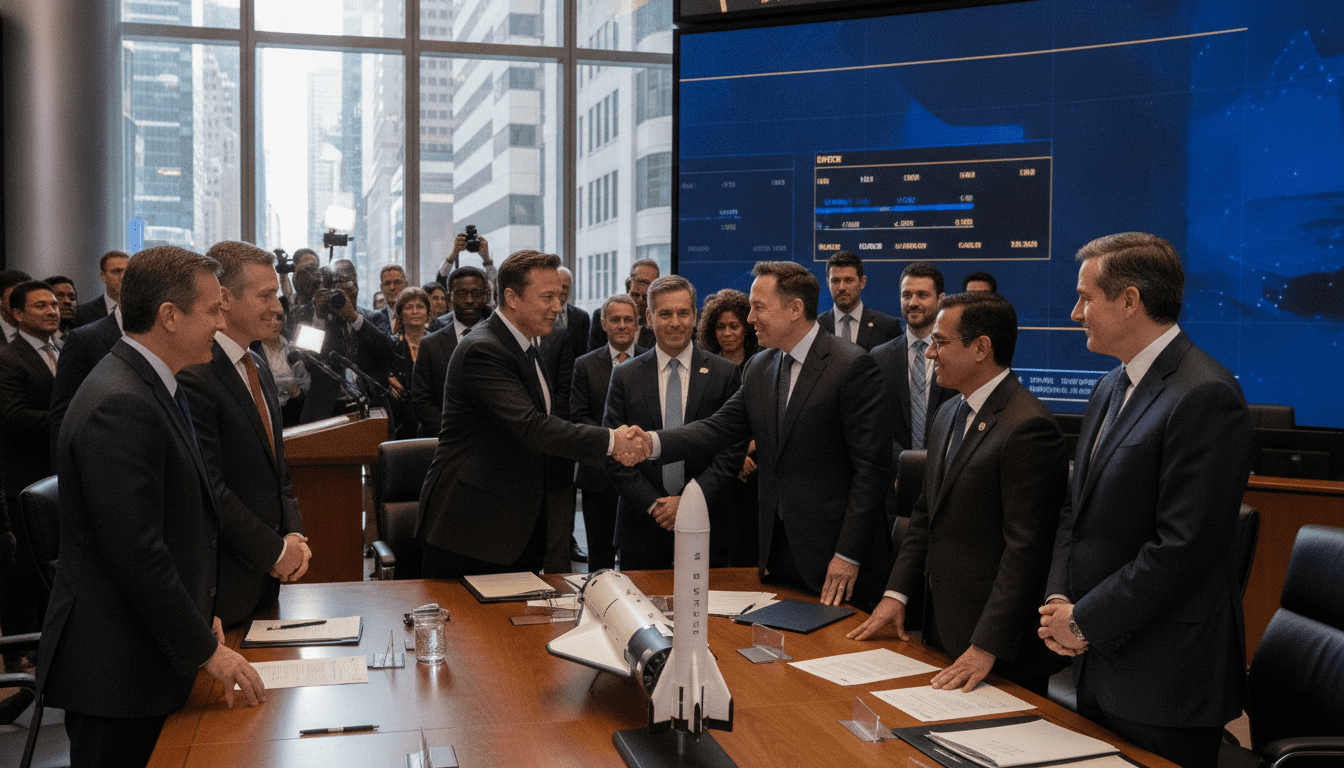
SpaceX IPO Priced at $135 per Share, Raising $75 Billion in Largest Offering Ever
SpaceX IPO priced at $135 per share for 555.6 million shares, raising $75 billion — the largest IPO ever; SPCX to begin Nasdaq trading amid strong demand.
Elon Musk’s Space Exploration Technologies Corp. priced its initial public offering at $135 a share, selling 555.6 million shares to raise $75 billion and creating what the company says is the largest IPO in history. The SpaceX IPO will list under the ticker SPCX and is slated to begin trading on the Nasdaq exchange as underwriters begin public marketing. At the set price, the deal places a record-scale valuation on the private space and AI conglomerate and raises immediate questions about market appetite and long-term justification.
SpaceX prices 555.6 million shares at $135, raising $75 billion
SpaceX’s pricing announcement confirms sales to underwriters that produced gross proceeds of $75 billion based on 555.6 million shares at $135 each. That total eclipses the previous record set by Saudi Aramco and positions this offering as the largest public markets debut on record. Underwriters also hold an option to sell an additional 83.3 million shares, which could add roughly $11 billion if exercised at the offering price.
The deal structure and the size of the offering reflect an aggressive capital-raising strategy as SpaceX seeks to convert a long-standing private valuation into public equity. The company’s choice of share count and price suggests underwriters and insiders judged investor demand strong enough to absorb the record-sized float.
Nasdaq listing to begin under ticker SPCX as underwriters launch marketing
SpaceX will trade on the Nasdaq under the SPCX ticker, with active trading set to begin as underwriters move the shares into public distribution. The company’s announcement frames the listing as a milestone for a business now more than two decades old and widely known for its launch vehicles, satellite broadband network and AI investments. Market participants will watch opening trades closely for signs of initial price discovery and volatility.
The first day of trading often produces sharp moves as institutional and retail investors establish positions. SpaceX’s high-profile status and the size of the float mean order flow could be substantial, putting pressure on early bid-ask spreads and creating a wide range of potential opening scenarios.
Investor demand and aftermarket signals point to a possible IPO pop
Anecdotal reports from bankers and market observers suggest strong interest from large institutions and individual buyers ahead of the Nasdaq debut. Some secondary-market venues that provide synthetic exposure to unpriced shares were valuing SpaceX higher than the offering price, signaling expectations of a first-day “pop.” Those indicators, combined with typical aftermarket dynamics, have led some market participants to forecast an initial uplift of roughly 15–25 percent.
If demand far outstrips supply, underwriters are positioned to exercise the overallotment option to bring more shares to market, a move that would increase available liquidity but also dilute near-term ownership. Underwriters will balance those forces as they seek to stabilize the stock after the initial trades.
Valuation leap fuels debate over Musk’s net worth milestone
At the offered price, the IPO’s implied market capitalization lifts Elon Musk’s equity stake in SpaceX toward a threshold that analysts say could make him the world’s first trillionaire on paper. That potential milestone has attracted media attention and debate among investors about the sustainability of such wealth calculations. Observers caution that stock performance, dilution from future capital raises, and the company’s remaining private holdings all affect any definitive assessment of individual net worth.
The headline-grabbing nature of a potential trillionaire status underscores the symbolic weight of this IPO, but market participants are quick to emphasize that market capitalization is a moving figure tied to share price performance and investor sentiment.
Operational projects and revenue paths underpin long-term valuation questions
Despite the record fundraising, analysts and investors remain focused on how SpaceX will convert engineering ambition into durable revenue streams that justify the valuation. The company’s roadmap includes development of large reusable rockets, expansion of its Starlink broadband constellation, work on advanced manufacturing and a proposed semiconductor fabrication initiative. Each project entails significant capital expenditure, technical risk and multi-year timelines before scaled, predictable cash flows emerge.
SpaceX’s pitch to public markets depends on demonstrating that its high-margin space services and potential new businesses can sustain growth while funding ambitious hardware and infrastructure programs. That gap between present revenues and future promises is central to the valuation debate.
Market implications and potential next steps for SpaceX
The size and success of the SpaceX IPO will likely reverberate across equity markets and the technology sector, influencing how investors price other high-profile private companies considering public listings. A strong debut could reopen wider appetite for mega-offerings, while a muted reception would prompt reassessments of how growth expectations are being priced. For SpaceX itself, the capital raised provides flexibility to accelerate projects, retire debt, or pursue strategic investments depending on board and management priorities.
In the weeks ahead, attention will turn to lock-up expirations, insider selling patterns and the company’s first public disclosures as a listed entity, all of which will shape longer-term investor confidence.
The SpaceX IPO marks a watershed moment for a company that has driven dramatic advances in launch services and satellite internet, while signaling a new phase in its capital and ownership structure. Investors, competitors and policymakers will watch how the market values those promises once trading begins and initial price discovery unfolds.
