
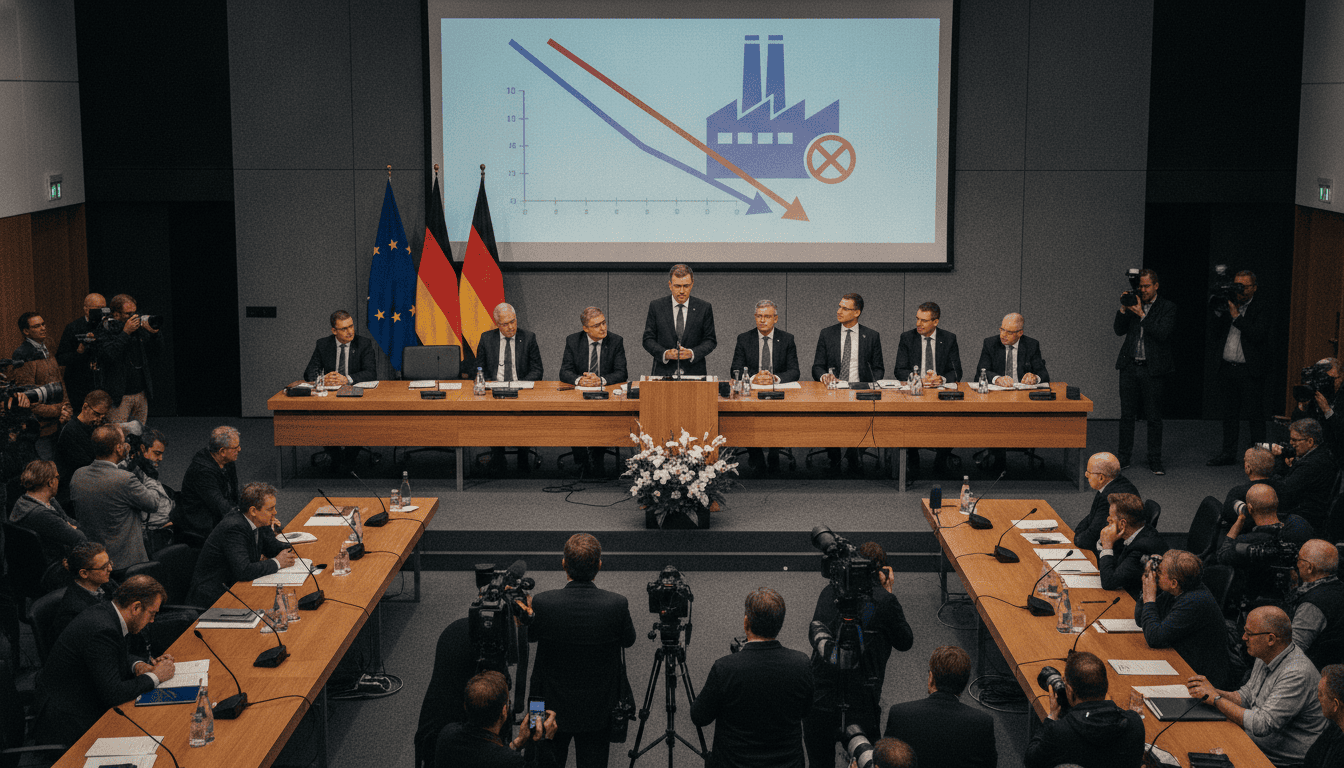
German steel industry faces deep restructuring as modest production uptick fails to stem job losses
German steel industry faces shrinking production and thousands of job cuts as green transition begins; unions and employers seek job-bridges, tax relief.
The German steel industry is entering a period of profound structural change even as raw steel production shows a small rebound, industry officials warn. Gerhard Erdmann, head of the employers’ association AGV Stahl, said the uptick is welcome but comes off a very low base and does not reverse long-term declines. Stakeholders across manufacturing, from automakers to machinery makers, continue to report weak demand and the sector faces an uncertain path back to pre-crisis volumes.
Production rebound is limited and built on a low baseline
Recent data and industry statements point to a slight recovery in crude steel output, but officials caution this is far from a return to previous norms. Erdmann noted last year’s production levels were historically low and that current increases do not eliminate the structural breaks the sector is experiencing.
Industry capacity is being reconfigured rather than expanded, with only a portion of traditional blast-furnace operations being converted to low-carbon technologies. That means overall production potential is likely to remain below the 40 million tonnes per year benchmark many in the sector considered sustainable in earlier decades.
Regional employment toll concentrated in Duisburg and steel hubs
The most immediate impact of the structural shift is concentrated job losses in key steel regions, where single sites underpin entire local economies. Erdmann highlighted planned reductions in the Duisburg–Lower Rhine area alone that could eliminate roughly 10,000 direct steel jobs, a loss equivalent to more than twelve percent of the sector’s remaining workforce of about 80,000.
Because each steel job supports multiple positions in supplier and service chains, the total regional fallout could reach 30,000 to 40,000 jobs in a single area. Similar risks exist for the Saarland and Eisenhüttenstadt, where plants play an outsized role in local employment and fiscal stability.
Green steel transition underway but scale and timing remain uncertain
A shift to greener production methods—using direct reduction and electric arc furnaces powered by hydrogen and renewable electricity—is under way at several major plants. Erdmann listed companies such as Salzgitter, Thyssen, Saarstahl and HKM as undertaking conversions, but he noted only five of 14 remaining blast-furnace units are currently being transformed.
That partial conversion raises questions about how many sites can be adapted and how quickly the industry can absorb the costs of new technology and energy supply. Public funding in the billions has been proposed to support the shift, yet industry leaders stress that investment and operational constraints will determine the eventual size and configuration of the sector.
Social partners advocate employment bridges and rapid re-employment
Trade unions and employers are discussing targeted measures to reduce social disruption, with so-called employment bridges or job hubs at the center of proposals. These mechanisms aim to place affected workers directly into vacancies at growing firms, minimizing time in transfer schemes or unemployment, and would require cooperation with the Federal Employment Agency.
Practical obstacles remain: many expanding employers list different skill sets and the offered wages may be lower than a worker’s previous pay, which complicates decisions for employees facing relocation or lower income. Erdmann stressed the need for clear eligibility rules and binding commitments to make these bridges viable at scale.
Calls for tax relief on severance and retention of phased retirement
Employers and unions both see fiscal incentives as crucial tools to smooth the transition, and the federal coalition has reportedly considered tax exemption for severance pay when displaced workers quickly take up new jobs. Industry leaders welcome such measures as a way to encourage reinvestment of severance into retraining or relocation, rather than financing early retirement.
At the same time, employer representatives urged policymakers not to strip away established instruments like verblockte Altersteilzeit (blocked phased retirement), arguing such options are indispensable for cushioning older workers and avoiding the dismissal of younger staff. Erdmann warned that removing these tools would shift the burden onto companies and employees precisely when resources are already stretched.
Social partners plan an autumn proposal to frame political action
Erdmann said employers and IG Metall are working toward a joint, practical concept that could be presented to government by late September or early October. The idea is for social partners to lead with a coordinated plan setting out the instruments and expectations they believe are needed, rather than waiting for political directives.
He emphasized separating these structural measures from routine wage negotiations, with the expectation that a dedicated dialogue through the summer would allow a clearer negotiating position in the autumn. Without proactive social-partner engagement, he warned, insolvency practitioners might determine outcomes for companies and workers.
The shift in Germany’s steel sector underscores a broader industrial dilemma: how to reconcile decarbonization, competitiveness and social stability while production models and employment patterns change. Employers, unions and policymakers now face a compressed timeline to design instruments that limit disruption, preserve regional economies and steer the industry toward a lower-carbon future.
