
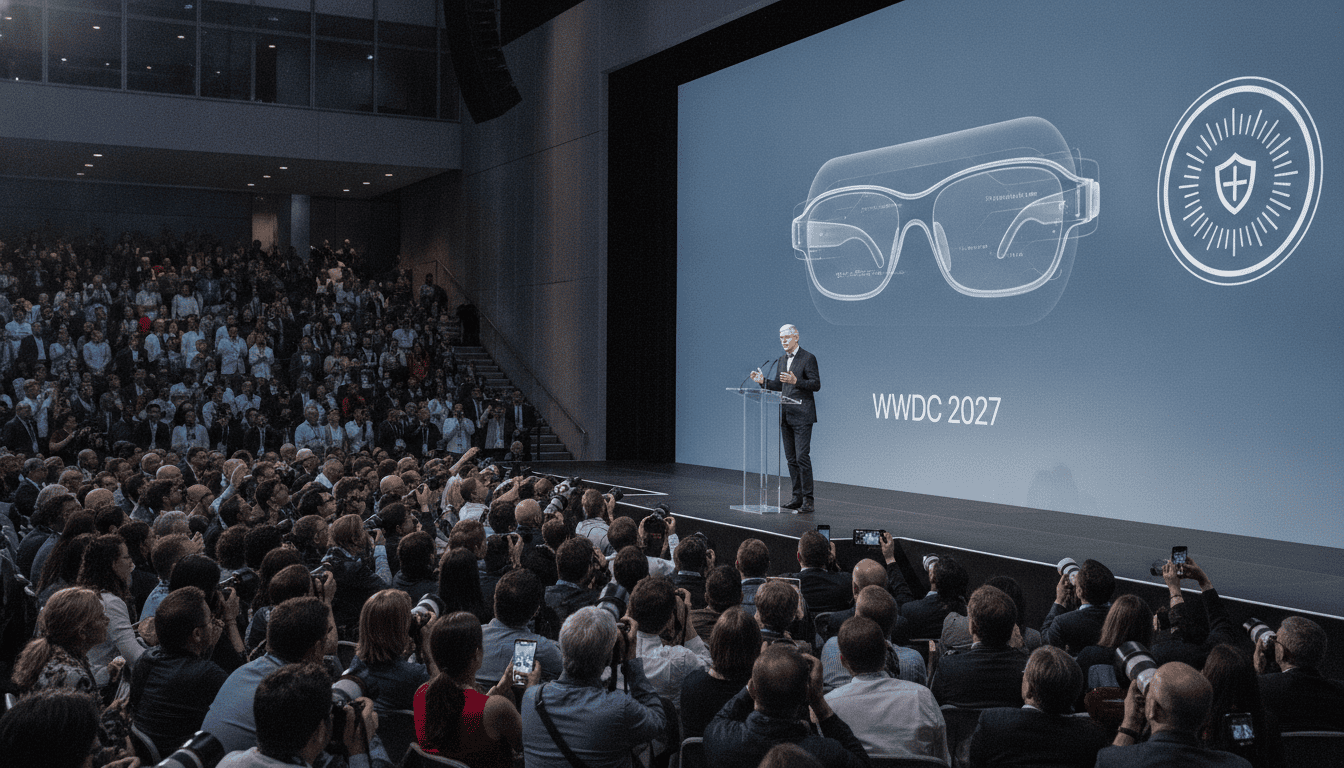
Apple smart glasses delayed to WWDC 2027 as Apple emphasizes privacy
Apple delays Apple smart glasses to WWDC 2027, prioritizing privacy with on-device processing, no facial recognition, and no contractor review of footage.
Apple has pushed the debut of its Apple smart glasses to the Worldwide Developers Conference in June 2027, delaying an earlier target and placing privacy front and center in product messaging. The move, reported by Bloomberg’s Mark Gurman, shifts availability to later in 2027 while giving Apple time to refine both hardware and the privacy features that distinguish the device. The company plans to highlight on-device processing and the absence of facial recognition as core safeguards for users.
Apple delays smart glasses debut to WWDC 2027
Apple now expects to unveil its Apple smart glasses at WWDC in June 2027 and to make them available to consumers by the end of that year. The launch timetable was moved from an initial early-2027 target to allow additional development and more deliberate communications about privacy. Apple leadership concluded the product and the surrounding public messaging required extra work to align with the company’s longstanding privacy positioning.
Industry sources say the delay is intended to give engineers more time to fine-tune sensors and software integration. Executives also want clear, demonstrable privacy protections in place before a high-profile debut. That combination of product maturity and narrative control is unusual for Apple but reflects the sensitivity of glasses as a consumer wearable.
Privacy safeguards shaping product design
Apple plans to emphasize on-device processing as a primary privacy feature for the smart glasses, reducing the need to transmit raw audio or video to external servers. The company is reportedly avoiding facial recognition capabilities and intends not to use customer recordings for AI training, decisions that would limit remote access to sensitive personal data. These design choices aim to reassure users worried about continuous sensing and background recording.
Technical measures will likely be paired with visible, hardware-level indicators that recording is active, though exact implementations remain under wraps. Apple’s approach appears to focus on minimizing the amount of data that leaves the device and ensuring user control over how content is stored and shared. That architecture aligns with other Apple product strategies that favor local computation for sensitive tasks.
Meta’s controversies influence Apple’s approach
Apple’s shift follows public backlash against other smart-glasses products, notably Meta’s eyewear, which has been criticized for enabling non-consensual recording in public and private settings. Reports and viral incidents around those devices have heightened scrutiny of camera-equipped wearables and prompted calls for stronger safeguards. Apple’s move to foreground privacy reflects an attempt to avoid similar reputational and regulatory pitfalls.
Executives have taken those controversies into account while planning both product features and the launch narrative. Observers say Apple recognizes that public trust will be a critical factor in mainstream adoption of smart glasses, and that missteps early in the product lifecycle could have outsized consequences. The company’s reputation for framing privacy as a competitive advantage is likely driving more conservative choices.
Availability timeline and engineering trade-offs
Pushing availability to the end of 2027 gives Apple engineers more time to resolve hardware challenges and battery limitations that are common in head-worn devices. Balancing sensor quality, battery life, and discreet design often forces trade-offs in features such as always-on recording or continuous on-device AI inference. Apple appears willing to pare back some capabilities to deliver a device that meets privacy and usability expectations.
Supply chain and manufacturing readiness are also factors in the revised schedule, with suppliers needing to scale production of specialized components for eyewear form factors. Apple’s launch cadence often includes staggered rollouts; a WWDC unveiling followed by broader availability later in the year would mirror that pattern. Analysts expect the company to use the additional months to refine both the software stack and compliance documentation.
Potential market and regulatory impact
A privacy-first positioning could shape how regulators and lawmakers view smart glasses, especially in jurisdictions sensitive to surveillance and biometric tracking. By committing to no facial recognition and limiting external review of footage, Apple may seek to pre-empt regulatory demands and mitigate legislative scrutiny. Nonetheless, consumer advocates and privacy groups will likely continue to test the device once it is in public hands.
Competitors will be watching closely to see whether Apple’s choices slow feature arms races or instead set a new baseline for privacy in wearables. If the product succeeds on privacy and usability, it could push rivals to adopt similar constraints. Conversely, some competitors may pursue more feature-rich models that trade off privacy for advanced capabilities, leaving consumers to weigh those differences.
What buyers should expect from Apple smart glasses
Consumers should anticipate a product that prioritizes local processing, visible privacy controls, and a narrower set of cloud-dependent features compared with other camera glasses on the market. Apple’s emphasis on avoiding contractor review of user footage and not using recordings to train AI models suggests tighter limits on data sharing. Pricing, app support, and accessory ecosystems remain open questions ahead of the formal announcement.
Early adopters and privacy-conscious buyers will likely scrutinize Apple’s implementation details at the unveiling and during hands-on tests. The company’s public demonstrations and developer guidance at WWDC will be important for shaping first impressions and developer adoption. How well Apple balances functionality with privacy promises will determine the device’s reception.
Apple’s decision to delay the Apple smart glasses underscores how privacy considerations are now pivotal in the design and rollout of camera-enabled wearables. The company is betting that careful engineering and clear communication will protect consumer trust and avoid the controversies that have surrounded rival products.
