
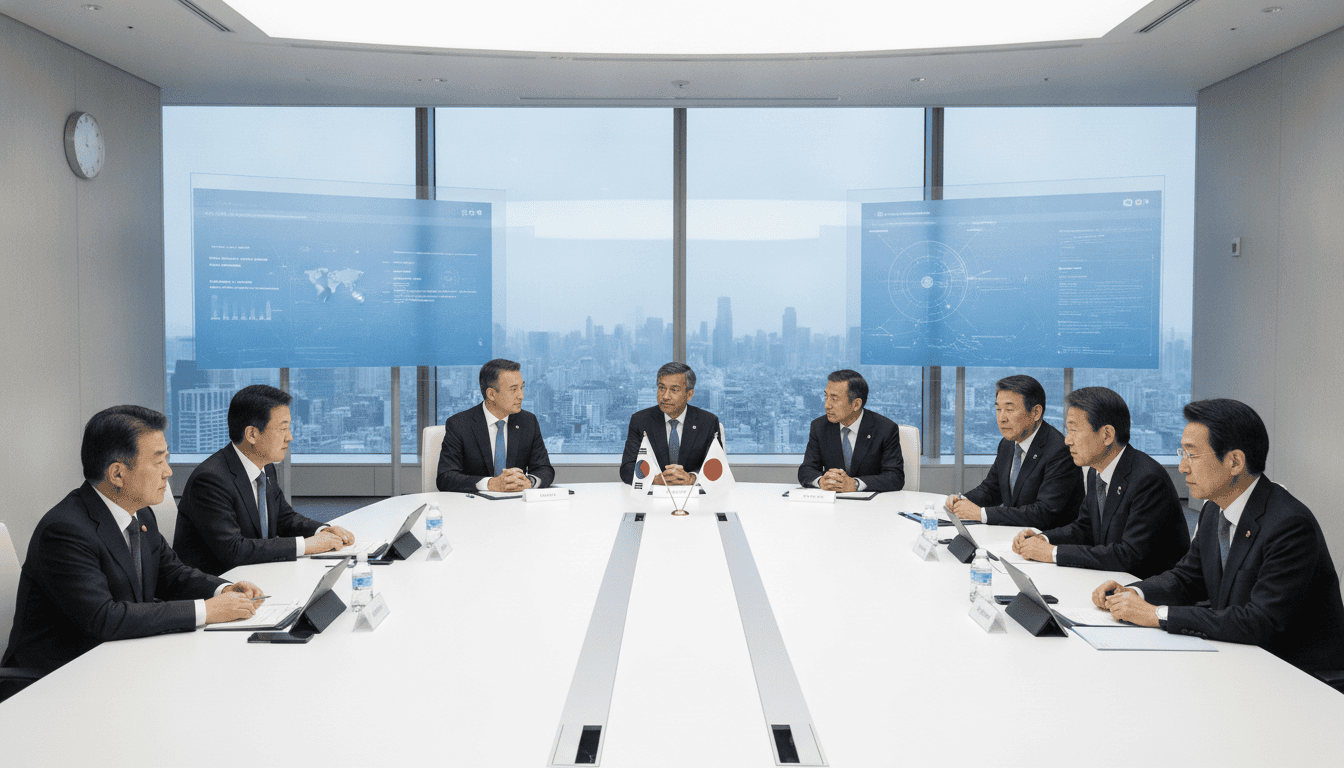
Japan and South Korea Pursue Separate AI Industry Policies to Become Indispensable Partners to U.S. Tech
Japan and South Korea AI industry policy aims to position each country as an indispensable partner to the U.S. AI industry while courting other Asian nations as neutral, preferred collaborators.
Japan and South Korea are pursuing separate industrial strategies to deepen ties with the U.S. artificial intelligence ecosystem while offering themselves as neutral partners to other countries in Asia. The moves reflect a deliberate effort by both Tokyo and Seoul to build domestic capabilities—from semiconductors to data governance—that make them essential nodes in global AI supply chains. Each government is emphasizing its own strengths and policy instruments rather than a joint approach, signaling a competitive dynamic alongside shared geopolitical imperatives. Observers say the strategies are meant to attract U.S. investment and expand influence across regional markets without forcing alignment on every diplomatic issue.
Tokyo and Seoul Opt for Independent Industrial Strategies
Japan and South Korea have chosen to advance AI competitiveness through national, not joint, industrial policy frameworks that stress self-reliance and strategic partnership with U.S. firms.
Both capitals are tailoring subsidies, regulatory adjustments, and public–private collaborations to strengthen their attractiveness to foreign AI companies. Tokyo’s approach leans on longstanding strengths in advanced materials, robotics and infrastructure integration, while Seoul emphasizes its leadership in memory chips, chip packaging and fast industrial deployment. These divergent emphases reflect domestic industrial legacies and the desire of each government to retain control over the terms of engagement with foreign investors.
Policy Tools Focused on Chips, Data and Talent
Governments in Tokyo and Seoul are prioritizing core inputs to AI systems—semiconductor manufacturing, secure data ecosystems and high-end talent pipelines—to become indispensable to the U.S. AI industry.
Both countries are expanding incentives for chip fabrication and design, investing in data centers and promoting training programs to keep skilled engineers and researchers. Regulatory measures to protect sensitive technologies are being paired with initiatives to facilitate collaboration with foreign companies under controlled conditions. The combined effect is to create national environments where U.S. firms can rely on secure, high-quality components and human capital without moving entire operations overseas.
Neutral Partner Pitch to Other Asian Markets
Beyond courting U.S. investment, Japan and South Korea are marketing themselves as neutral AI partners that can serve other Asian states seeking alternatives to larger powers.
This neutrality pitch is designed to win business in markets wary of being drawn into geopolitical rivalries while still requiring advanced AI technology and supply chain links. By offering trusted procurement options, local partnerships and interoperability standards, Tokyo and Seoul aim to capture regional projects in health, manufacturing and public administration. The strategy also allows both countries to diversify export markets and to present themselves as stabilizing influences in a fragmented regional technology landscape.
Corporate Reactions and Private-Sector Moves
Major Japanese and Korean technology and semiconductor firms are already aligning product road maps and investment plans to fit national priorities and to appeal to U.S. partners.
Companies are accelerating partnerships with global cloud providers, expanding production capacity for chips and components, and investing in AI model development and testing facilities. Private firms report increased engagement with national ministries to shape incentive packages and regulatory frameworks that will govern cross-border data use and technology transfers. Industry insiders say the combination of government support and corporate action could shorten timelines for bringing advanced AI hardware and secure services to market.
Strategic and Economic Risks on the Horizon
Analysts warn that while independent industrial policies may yield competitive advantages, they also carry geopolitical and economic risks that Tokyo and Seoul must manage carefully.
Key risks include the potential for supply-chain fragmentation, export-control frictions, and a race for subsidies that could strain public finances. There is also a diplomatic balancing act: positioning as a preferred U.S. partner while courting other Asian governments may require delicate negotiations over technology transfer and standards. Failure to harmonize national policies with international norms could limit long-term market access and increase political tensions in an already complex regional environment.
Implications for the Global AI Ecosystem
If Japan and South Korea succeed in becoming indispensable partners to the U.S. AI industry, global supply chains and market dynamics are likely to shift toward more pluralized architectures.
A stronger role for Tokyo and Seoul could diversify sources of critical components, reduce single-country dependence, and offer more choices for countries seeking reliable AI suppliers. At the same time, this pluralization may complicate efforts to establish uniform technical standards and oversight mechanisms across jurisdictions. The eventual outcome will hinge on how effectively each government balances domestic industrial ambitions with the need for predictable, interoperable international cooperation.
The separate but parallel campaigns by Japan and South Korea to anchor themselves within the U.S. AI supply chain while positioning as neutral partners for Asia reflect a new phase of technology diplomacy. Both countries are betting that targeted industrial policy, combined with corporate execution, can secure economic gains and geopolitical influence without necessitating a joint strategy. The coming years will test whether parallel national paths can deliver the stability and scale that global AI development requires.
