
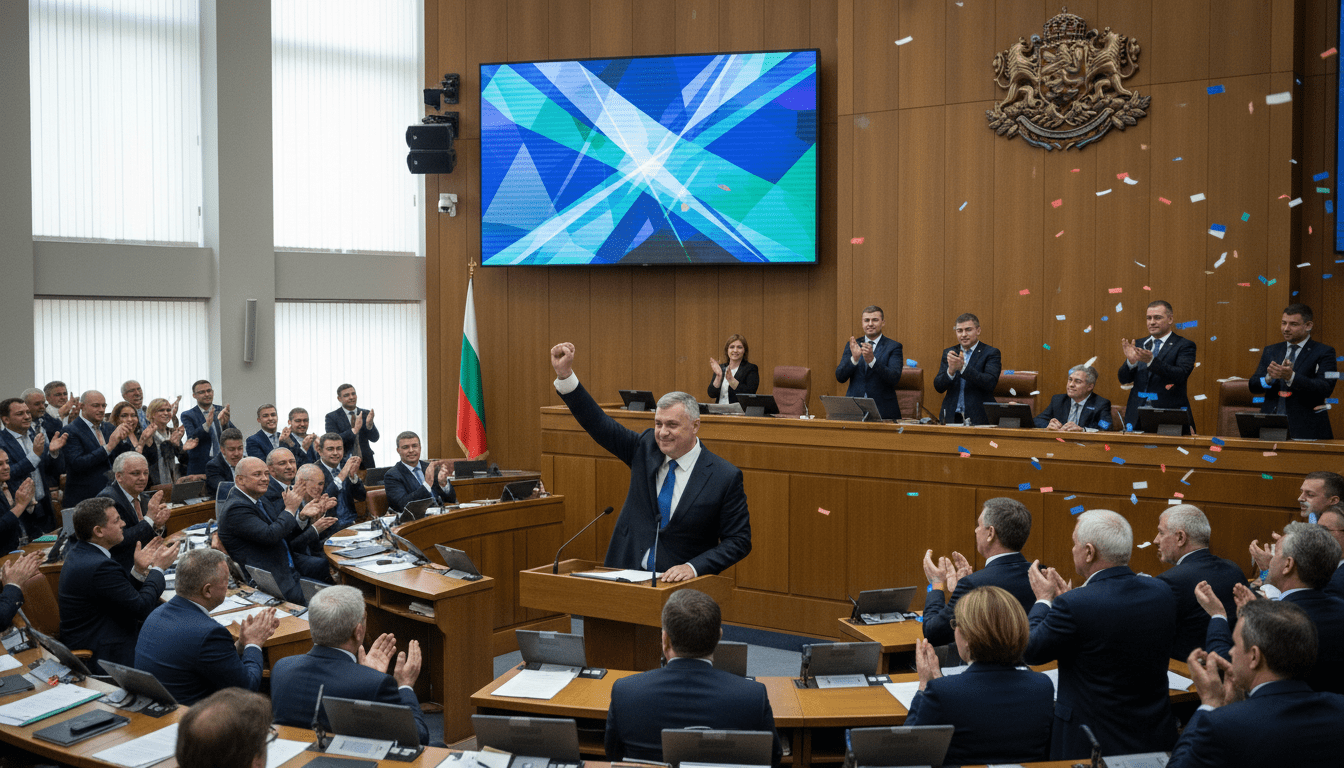
Bulgaria election delivers surprise majority for Rumen Radev’s new movement
Bulgaria election: Former president Rumen Radev’s newly formed movement won an absolute parliamentary majority, raising hopes for stability and concerns over his Russia-leaning rhetoric.
Historic eighth vote in five years
The latest Bulgaria election ended a prolonged cycle of political instability with the country’s eighth parliamentary ballot in five years producing a clear winner. Voter fatigue had driven turnout down during previous contests that repeatedly failed to produce lasting governments. The result offers Sofia a chance to move beyond short-lived coalitions and caretaker cabinets that have dominated national politics.
Public relief at the prospect of a functioning administration is tempered by uncertainty about who Rumen Radev’s movement will govern with and how it will translate campaign promises into policy. Observers note that the immediate challenge will be turning an electoral mandate into durable institutions and workable policy.
Rapid rise of a party-less movement
Rumen Radev’s movement, launched only weeks before the election, claimed an absolute majority despite lacking traditional party structures. The surprise victory reflects a volatile electorate willing to back a charismatic leader over established parties. Political analysts point to a mix of protest votes, dissatisfaction with entrenched elites, and acute economic anxieties as key drivers of the surge.
Operating without the ordinary party machinery may complicate governance, however. Building parliamentary discipline, administrative capacity, and durable local party networks will be necessary to sustain majority rule and deliver on campaign pledges.
Western concern over Russia-leaning rhetoric
Radev’s past statements that have been described as Russia-leaning have triggered apprehension in Brussels and among Western partners. Critics argue that some of his rhetoric downplays Moscow’s threats to Ukraine and broader European security, raising questions about future foreign policy orientation. European officials are watching closely for signs that Sofia might shift away from the bloc’s posture on defense and sanctions.
Supporters counter that Bulgaria’s foreign-policy choices will be constrained by EU membership and NATO ties, and that immediate domestic priorities are likely to temper any radical reorientation. The balance between international expectations and domestic political survival will shape Radev’s options in the months ahead.
Populist tactics and economic messaging
Despite international attention on geopolitics, the campaign in Bulgaria was dominated by economic concerns, with inflation and cost-of-living pressures foremost in voters’ minds. Radev’s appeal blended populist rhetoric with promises to challenge an entrenched elite, a formula that resonated across both conservative provinces and liberal urban centers. His record as a polarizing outsider and earlier use of referendums signaled a willingness to use emotive issues to mobilize support.
Yet governing often constrains populist playbooks. Translating campaign slogans into coherent fiscal, social, and judicial reforms will test the movement’s capacity to manage complex policy trade-offs and retain a broad coalition of voters.
Commitment to dismantle the ‘oligarchic pyramid’
A central plank of Radev’s platform was a pledge to dismantle what he termed an “oligarchic pyramid of corruption,” a system many Bulgarians associate with former prime minister Boyko Borissov and influential figures such as Deljan Peewski. Voters responding to long-standing complaints about selective justice and shadowy influence signaled their appetite for meaningful anti-corruption measures.
Delivering on that promise would require deep reforms across law enforcement, judicial appointments, public procurement, and oversight of EU funds. Observers warn that corruption in Bulgaria is decentralized and supported by competing beneficiaries, meaning structural change will encounter numerous vested interests and likely slow implementation.
Constraints on sweeping constitutional change
European comparisons to Hungary under Viktor Orbán have circulated in the wake of the election, but analysts caution against simple analogies. Radev does not command the supermajorities required for constitutional overhaul, and Bulgaria’s political landscape differs from Hungary’s centralized model. Moreover, a move toward a strongly personalist or illiberal regime would risk alienating parts of Radev’s heterogeneous electorate and provoke domestic resistance.
Pragmatism may prevail if Radev seeks to maintain broad public support: pursuing incremental institutional reforms and delivering tangible improvements in public services could consolidate his position without pursuing radical constitutional change.
The immediate months will test whether the electoral mandate translates into effective governance or whether old patterns of fragmentation re-emerge. Radev’s movement must now build administrative capacity, outline clear policy priorities, and demonstrate that it can curb corruption while managing Bulgaria’s international obligations.
If Radev succeeds in delivering concrete results on the economy and justice, he could reshape Bulgarian politics in a durable way; if he fails, the electorate may return to the cycle of distrust and repeated elections that has characterized the last half-decade.
