
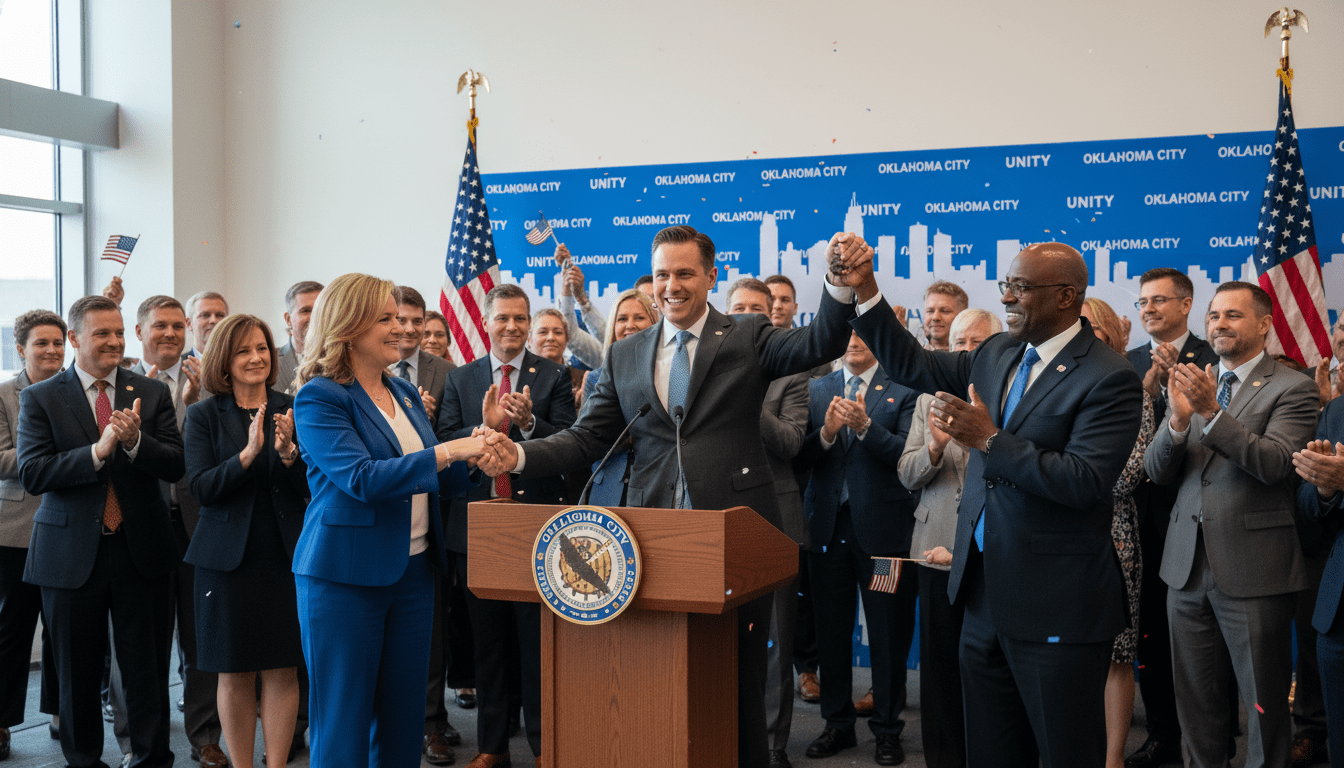
Oklahoma City mayor David Holt credits nonpartisan system and pragmatism for shielding city from national polarization
Oklahoma City mayor David Holt says the city’s nonpartisan ballot system and pragmatic coalition-building have preserved civic unity amid U.S. political polarization, and he has joined international mayors to defend democratic norms.
Oklahoma City’s mayoral name‑only ballot and recent landslide outcome have drawn national attention as a counterexample to bitter partisan divide, according to David Holt, who secured a commanding third term this year with broad voter support. The mayor frames the city’s approach as deliberately designed to reward coalition-building and practical problem‑solving rather than ideological purity. Advocates say the model produces officials who are accountable to a full cross section of residents rather than an energized slice of party activists.
Holt’s decisive third-term victory
Holt won reelection with an overwhelming margin that local officials say reflects widespread approval for steady governance and results-driven policy. Observers point to turnout patterns and the structure of the municipal contest as factors that allowed a moderate, incumbent mayor to attract backing from Republicans, Democrats and independents. City leaders argue the result signals a municipal politics that privileges competence over confrontation.
Nonpartisan ballot system shapes local politics
Oklahoma City uses a ballot in which candidates’ party registrations are not listed, a format supporters credit with shifting incentives toward consensus. Without a party label beside a name, candidates must appeal directly to a broad electorate, creating pressure to address pragmatic local concerns such as public safety, infrastructure and economic growth. Officials say this mechanism reduces the payoff for courting the primary‑base extremes and encourages elected leaders to build diverse coalitions.
The mayor contends that the nonpartisan system is more representative of everyday voters’ priorities than the partisan primary model used in many state and federal contests. In that partisan system, candidates frequently must win over small, highly motivated groups of activists to secure nominations, which can push rhetoric and policy toward the margins. City advocates maintain the name‑only ballot fosters a political environment where compromise and incremental progress are rewarded.
Primaries give the political extremes disproportionate leverage
Holt and other municipal leaders warn that state and federal primaries often amplify voices at the ideological fringes because participation in those contests tends to skew toward unusually engaged partisans. That dynamic, they say, produces nominees who are less likely to govern from the center once elected and more likely to produce gridlock. The mayor describes the national picture as distorted by nomination mechanics that do not reflect the preferences of the broader, more moderate majority.
Local officials express concern that when those polarized nominees arrive in state capitols or Congress, they contribute to partisan stalemate and diminished capacity for compromise. The Oklahoma City approach, by contrast, discourages politicians from tailoring appeals solely to activists and instead incentivizes problem‑solving that attracts a wider base. City leaders argue this produces steadier municipal governance and policies with durable public support.
Building cross-party coalitions in a diverse city
Holt emphasizes coalition‑building that reaches across party lines as the practical engine of local progress, assembling voters from different ideological backgrounds around concrete initiatives. He describes forming partnerships with ordinary Republicans, Democrats and unaffiliated residents to pursue shared objectives, from downtown development to public safety strategies. Officials and civic groups say those coalitions have enabled projects that might stall elsewhere to move forward with bipartisan buy‑in.
City administrators and community leaders point to routine governance tasks — budgeting, zoning, emergency response — as areas where cross‑ideological cooperation is both common and necessary. By focusing on deliverables rather than symbolic battles, the administration says it has kept public debate tied to measurable outcomes. That pragmatic posture, they add, makes it easier to sustain public trust across the electorate.
Pragmatism in dealing with national political figures
While once a vocal critic of some national figures within his party, Holt now frames his stance in practical terms: acknowledge electoral outcomes, then work within that reality to secure resources and protections for cities. He says elected city leaders must be able to function regardless of who holds the White House, because municipal responsibilities are immediate and nonpartisan in everyday effect. The mayor stresses that defending municipal interests does not preclude holding national policymakers accountable when local autonomy is threatened.
This posture has extended to public messaging on crime statistics, federal funding and municipal prerogatives, where Holt says his office will push back against rhetoric that misrepresents local conditions. By combining criticism with collaboration, the mayor aims to preserve access to federal programs while protecting city prerogatives. City officials describe this dual approach as necessary to safeguard services and civic stability.
Joining an international pact to resist authoritarian trends
In a move that links local governance to global democratic concerns, Holt recently joined a coalition of mayors from Europe and elsewhere who have formed a Pact to defend free city governance against autocratic tendencies. The pact, originally founded by several Central European capital mayors, commits members to speak out against attacks on municipal autonomy and to combat disinformation targeting urban communities. For Holt and supporters, the partnership signals an effort to align municipal leaders across borders on the fundamentals of democratic practice.
Local advocates say the alliance provides a platform to spotlight data‑driven realities about crime and civic health that sometimes conflict with national political narratives. The city’s participation also underscores a belief among mayors that municipal governments can be first responders not only to disasters and infrastructure needs but also to threats against democratic norms. Holt argues that when cities collaborate internationally, they fortify the institutional checks that sustain open societies.
As Oklahoma City positions itself as a model for nonpartisan, results‑oriented governance, its leaders invite scrutiny and emulation from municipalities facing acute polarization. Whether the city’s practices can be scaled to regions governed by different electoral systems remains uncertain, but local officials insist the emphasis on coalition politics and institutional steadiness offers a practical alternative to the zero‑sum contests that dominate national headlines.
