
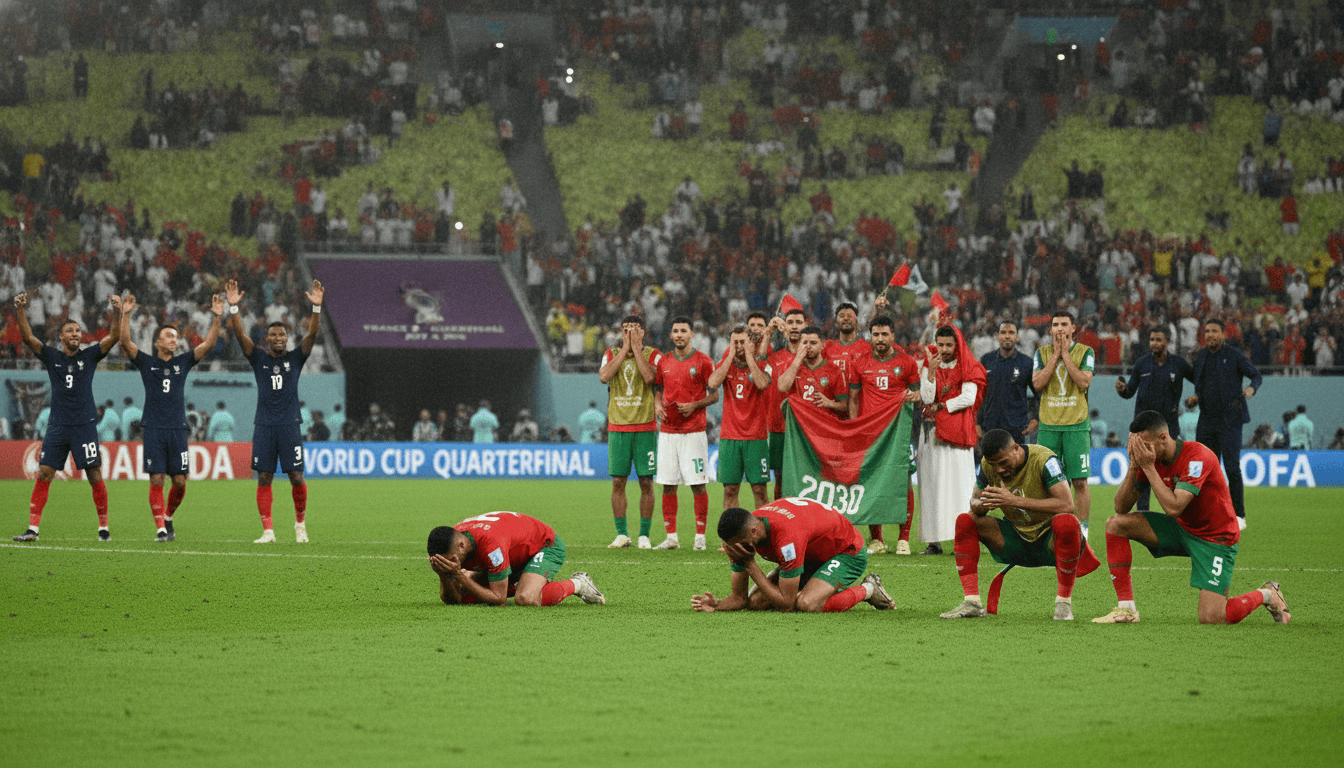
Morocco World Cup exit as France beat them 2-0 in Boston
Morocco World Cup hopes ended as France beat Morocco 2-0 in Boston in the 2026 quarterfinals. The loss ends Morocco’s run at the expanded tournament while giving the team a clear line of sight to 2030, when they will co-host the finals.
France eliminate Morocco with a 2-0 victory in Boston
Morocco were undone by a clinical French performance that produced two decisive goals and controlled large spells of the quarterfinal match. Les Bleus repeated their semifinal triumph from 2022, denying Morocco a similar deep run at the 2026 World Cup. The defeat leaves Morocco eliminated at the quarterfinal stage and prompts immediate questions about the team’s short-term planning.
Morocco achieve historic back-to-back quarterfinals despite exit
Despite the loss, Morocco’s campaign at the expanded 48-team World Cup contained milestones, including becoming the first African nation to reach successive quarterfinals. The squad also knocked out the Netherlands and pressured Brazil in the group stage, signalling deeper progress on the global stage. Tournament organisers and continental federations have noted the wider significance for African football and the team’s rising profile.
Coaching transition held steady but scrutiny will intensify
Mohamed Ouahbi, who stepped up from youth ranks three months before the finals, maintained continuity and tactical coherence during the tournament. He led Morocco to respectable results under difficult circumstances, and praised his young squad’s potential after the match. Still, Ouahbi faces looming pressure common in African national team posts, where short-term expectations and tournament outcomes often determine job security.
2030 co-hosting secures Morocco a place at the next World Cup
As one of the co-hosts of the 2030 World Cup alongside Portugal and Spain, Morocco is already assured qualification for the tournament on home soil. That automatic berth shifts the federation’s planning horizon from qualification to squad development and long-term competitiveness. Officials and technical staff must now balance immediate competitive needs with preparations to present a polished, tournament-ready squad in 2030.
Africa Cup of Nations schedule presents immediate tests
Before 2030, Ouahbi and his staff must navigate Africa Cup of Nations qualifiers and two AFCON finals in 2027 and 2028 that will test squad depth and tactical versatility. Morocco’s recent continental record is mixed; the team has struggled historically at AFCON despite high FIFA rankings on the continent. Coaches will need to use qualifiers against teams such as Gabon, Lesotho and Niger to sharpen combinations while pursuing results expected by supporters.
Squad makeup and areas for tactical improvement
Morocco’s young roster provided energy and adaptability but also revealed needs in game management and exposure to varied playing styles. The coaching staff highlighted the necessity of matches against stronger, diverse opponents to replicate World Cup intensity. Defensive coordination on transitional play and set-piece management were areas exposed by France’s approach, and planners will likely prioritize those issues in upcoming camps.
Youth development pathways have delivered talent, and the seamless promotion of personnel like Ouahbi demonstrates the strength of Morocco’s recent coaching pipeline. Translating youth success into sustained senior achievement will hinge on regular competitive fixtures, clearer rotation policies, and targeted reinforcements in key positions.
Ouahbi spoke openly about setting realistic stepping stones toward trophies, starting with qualifying for and winning continental tournaments to build belief. The federation must also weigh public expectations and the memory of prior coaching departures that followed high-profile defeats. Long-term stability, the coach argued, will be essential if Morocco is to aim beyond co-hosting and toward winning the World Cup itself.
Morocco now returns to immediate preparations for September’s AFCON qualifying window, where tactical adjustments and player decisions will begin to shape the next era. The federation has room to craft a development-focused schedule, but must avoid complacency given the gulf between regional dominance and global success.
The 2-0 loss to France closes this chapter of Morocco’s World Cup story but frames the next phase: consolidating the gains of back-to-back quarterfinals while building a squad capable of contesting continental trophies and projected success on home soil in 2030.
Morocco’s football leadership faces a balancing act between protecting a promising coach’s tenure and demanding accelerated progress; how they manage that balance will define the team’s trajectory over the next four years.
