
Tour de France 2026: Barcelona start, Alpe d’Huez double and decisive Galibier test
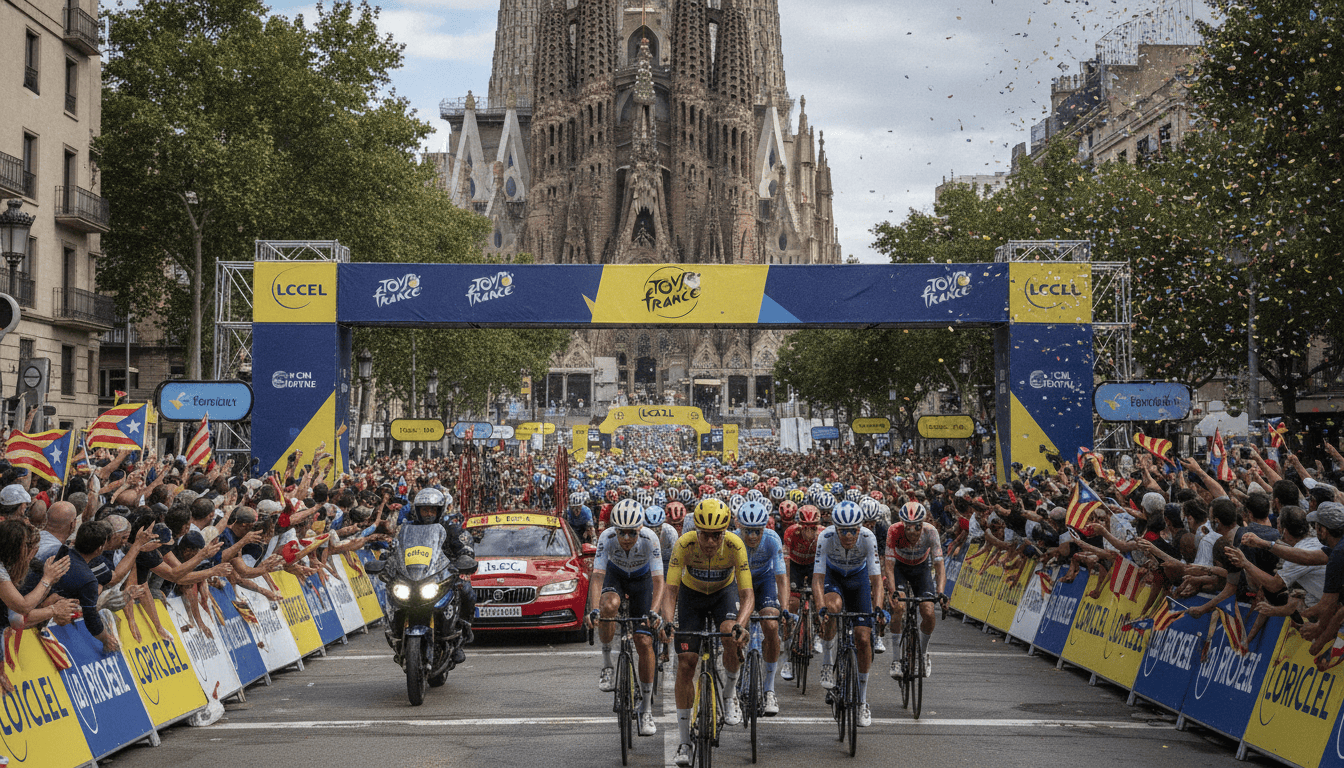
Tour de France 2026 heats up as the race began in Barcelona on July 4, 2026 and will finish on the Champs-Élysées in Paris on July 26, 2026. The 21-stage route covers 3,321 kilometres, features two Alpe d’Huez summit finishes and a high, 2,624-metre passage over the Col du Galibier. A total of 184 riders across 23 teams are contesting the overall and stage honours.
Race schedule and opening in Barcelona
The race opened with a 19.6-kilometre team time trial in Barcelona on July 4, 2026, a rare curtain-raiser held outside France and echoing previous non-French starts. Teams negotiated the city’s Montjuïc hill and finished near the Olympic Stadium, where small gradients could already create early time gaps. The peloton then moved through Catalonia and southern France, alternating sprinter-friendly stages with early mountain tests.
Route length, stage types and rest days
Organizers laid out 21 stages that combine seven flat days, four hilly stages and eight mountain days, with two dedicated time trials. The total elevation gain for the race is listed at 54,450 metres across 29 departments, underscoring the sustained climbing the riders face. Rest days are scheduled for July 13 and July 20, offering crews short recovery windows before heavy Alpine and Pyrenean assaults.
Early stage winners and shifting standings
Early stages produced a mix of team and individual victories that have shaped the race narrative to date. Team Visma-Lease a Bike won the opening team time trial, while sprinters and breakaway specialists such as Olav Kooij and Tim Merlier have taken stage spoils on flatter profiles. Tadej Pogacar has already shown form by sealing multiple mountain stage wins in the opening week, establishing himself as the rider to beat in the general classification.
Mountain tests and the king stage on July 25
The race’s toughest day is scheduled for Saturday, July 25, 2026 and is widely regarded as the king stage of this edition. That 170.9-kilometre stage includes about 5,450 metres of climbing and a summit at the Col du Galibier, where the route reaches 2,624 metres. Riders will also tackle the Col de la Croix de Fer and Col du Télégraphe before dropping toward the Col de Sarenne and the final ascent to Alpe d’Huez, making it a multi-climb finale likely to decide the podium.
Alpe d’Huez double and Alpine route choices
Alpe d’Huez serves as a stage finish twice, an uncommon double that creates two distinct tactical opportunities for contenders. Stage 19 offers a shorter, intensely steep route with 21 hairpin bends after 130 kilometres of racing, while Stage 20 approaches via the Col de Sarenne over terrain less familiar as an ascent. Organizers routed the latter through the Écrins National Park, introducing a novel uphill line that teams have had little time to reconnoitre.
Principal contenders and season form
The general classification battle is built around a familiar rivalry between Jonas Vingegaard and Tadej Pogacar, with Pogacar defending the 2025 title and Vingegaard seeking to overturn recent deficits. Vingegaard claimed victory at the Giro d’Italia and Paris–Nice earlier this season, while Pogacar arrived after wins in several spring Classics and two stage races. Emerging French talent Paul Seixas, 19, and last year’s podium finisher Florian Lipowitz are also in the conversation as dark-horse podium hopefuls.
Teams, captains and German riders to watch
Twenty-three teams with 184 riders line up under named captains, including UAE Team Emirates-XRG with Tadej Pogacar, Team Visma-Lease a Bike with Jonas Vingegaard, and Red Bull – Bora-hansgrohe riding with Remco Evenepoel. German interest centers on Florian Lipowitz, who joins the Red Bull – Bora-hansgrohe pairing alongside Evenepoel, and on support riders such as Nils Politt. Several German riders make notable appearances, including John Degenkolb in what may be his eleventh Tour, and debutants Georg Steinhauser, Max Kanter and Michel Hessmann.
Broadcast coverage and how to follow
Live coverage in Germany is available on ARD, which begins daily transmissions at about 14:00 local time, with extended coverage on the broadcaster’s streaming platform. Eurosport carries free-to-air coverage, while paid streaming options from Discovery, HBOMax and DAZN provide additional feeds and extended analysis. Fans can follow stage-by-stage results and standings through broadcasters’ live tickers and official race communications.
The Tour de France 2026 presents a compact, intense route that mixes early tactical time trials with relentless Alpine tests, leaving open the question of who will control the race across the Pyrenees and the high Alps before the ceremonial and decisive arrival on the Champs-Élysées on July 26, 2026.
