
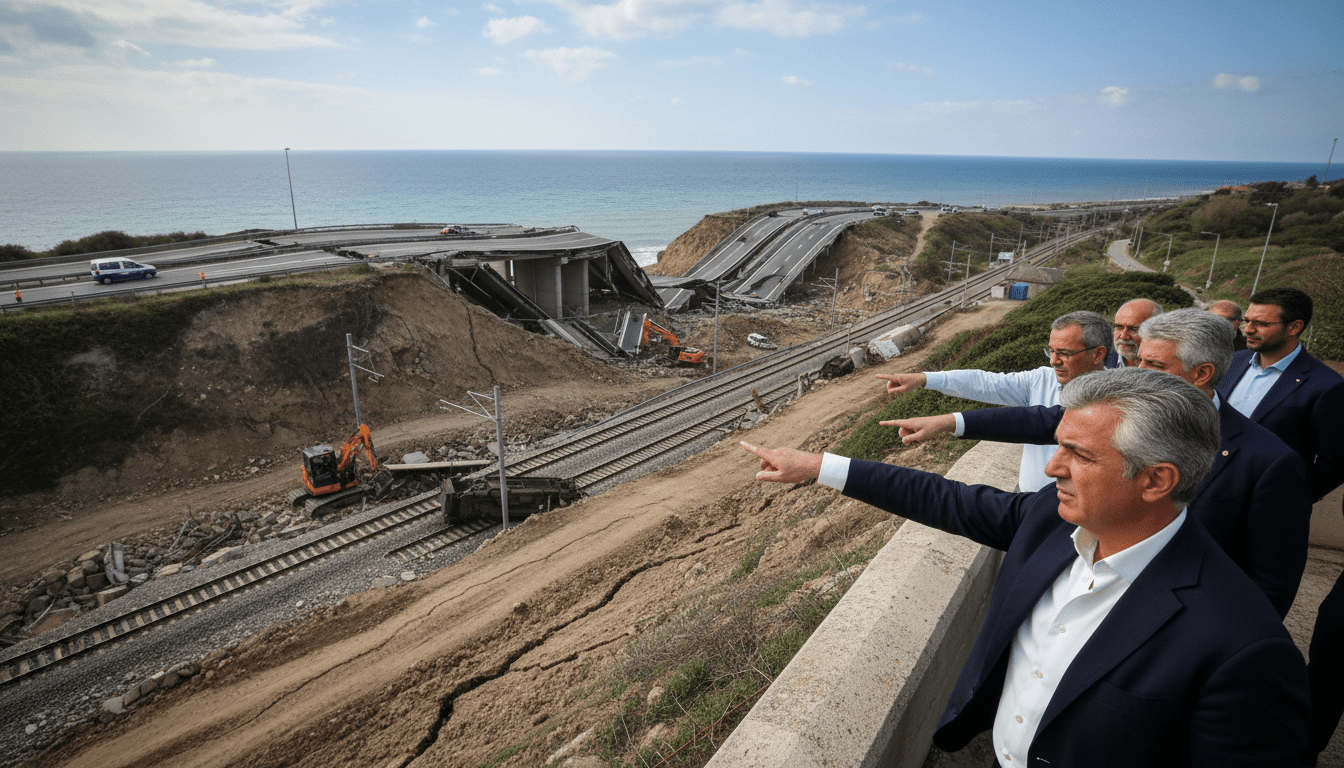
Molise landslide reactivates on Adriatic coast, cutting A14 and rail links
Massive Molise landslide on Italy’s Adriatic coast severs A14 and rail links, forces evacuations and partial service suspensions as experts warn of weeks to months of ground instability.
A large, historical landslide in the Molise region of southern Italy reactivated in early April 2026, forcing the closure of a roughly two-kilometre stretch of coastal ground and severing key transport links along the Adriatic corridor. The Molise landslide left parts of the A14 motorway and the Pescara–Bari railway unusable, and prompted authorities to describe the disruption as effectively splitting the country for the duration of the emergency. Local and national agencies mobilised evacuations, traffic diversions and continuous monitoring as geologists warned the slope remains active and unstable.
Transport links severed along the Adriatic corridor
Road and rail infrastructure suffered immediate and significant damage when the Molise landslide reactivated, officials said. The A14 motorway, a main north–south artery on Italy’s Adriatic flank, was interrupted, and the Pescara–Bari rail service was suspended along the affected section. Authorities announced temporary diversions for some roads and said limited rail traffic could resume on a partial basis later in the week, but full restoration will depend on detailed geotechnical assessments.
Evacuations and emergency operations
As a precautionary measure, civil protection teams removed around 50 residents from the municipality of Petacciato and relocated them to safer accommodation, the head of Italy’s civil protection agency reported. Emergency services established exclusion zones and are conducting continuous inspections of threatened properties and infrastructure. Firefighters and survey teams remain on site while monitoring instruments record movement across the slope.
Geological factors behind the reactivation
Geologists at the national research institutes point to a combination of factors that triggered the landslide’s renewed activity. Experts say the coastal toe of the slope has been undercut by marine erosion for decades, while recent heavy rainfall has percolated through highly permeable sand and gravel layers above clay-rich strata. That influx of water reduces shear strength in the clay and can mobilise deep-seated slump planes, potentially affecting soil down to depths of around 80 metres, according to field assessments.
Experts warn of prolonged instability
Officials caution that the slope is unlikely to stabilise quickly. The civil protection chief has described the situation as complex and has warned that observable movement could persist for weeks or even months as the ground adjusts. Independent researchers note that deep, compound landslides often exhibit long dormancy intervals punctuated by sudden reactivation, with slow creep preceding faster failures when conditions change.
Scientific context and land-use factors
Recent research highlights how land-use change can influence landslide frequency and severity, and Italy stands out in Europe for its exposure to such hazards. A study by international geoscientists, including researchers involved in ongoing monitoring, found links between altered land practices and increased landslide occurrence in certain regions. Despite Italy’s high hazard potential, experts emphasize that robust monitoring, early-warning systems and land-management policies have so far limited casualties compared with the scale of exposure.
Ongoing monitoring and infrastructure response
Authorities have deployed geotechnical instrumentation, radar surveys and aerial reconnaissance to map deformation and guide emergency decisions. Traffic authorities implemented detours and are coordinating with rail operators on phased service restoration where safe. Engineers say long-term remediation will likely require slope reinforcement, managed drainage to lower groundwater levels, and possibly relocation of critical infrastructure away from the most vulnerable strip of coastline.
The Molise landslide underlines the persistent vulnerability of coastal slopes where erosion and hydrological change intersect with human infrastructure. As recovery and assessment continue, planners and scientists will need to weigh immediate repairs against longer-term strategies that reduce exposure and improve resilience along Italy’s Adriatic corridor.
