
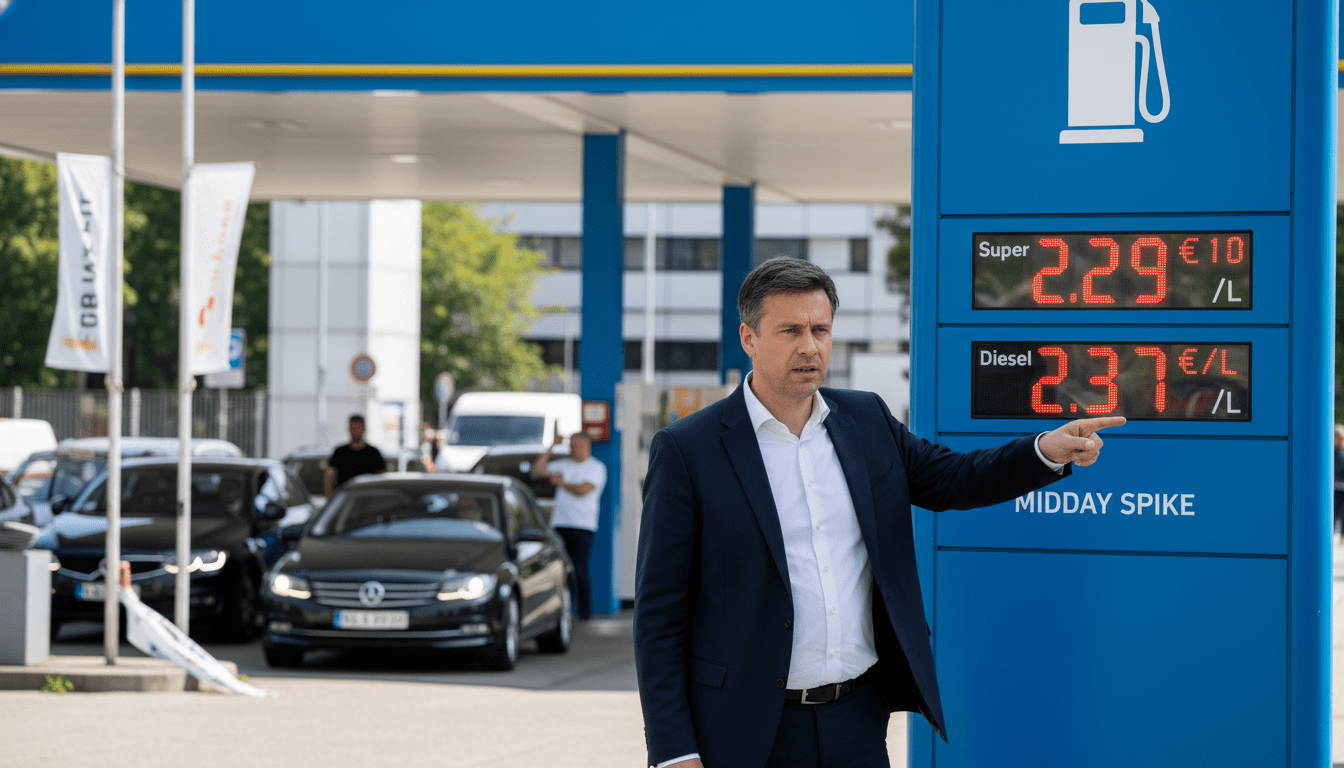
Fuel prices rise again in Germany after midday spike, ADAC data shows
Germany sees renewed increase in fuel prices after a midday surge; ADAC reports sharp jumps in E10 and diesel while government announces a temporary tax cut.
Germany’s fuel prices climbed again Monday after a sharp midday surge, ADAC data shows, reversing a short period of relief and pushing average pump costs above yesterday’s levels. The spike between 11:45 and 12:15 saw the largest single increase since a new rule limiting price changes at noon came into force, and the development has driven fresh debate over how best to shield motorists from volatile oil markets.
ADAC records the largest midday increases since new pricing rule
ADAC monitoring of nationwide station prices recorded an unusual acceleration in increases around midday, with the strongest movements since the restriction on multiple price hikes at 12:00 was introduced. The association’s intraday figures show jumps of 12.5 cents per litre for diesel and 11.4 cents for Super E10 within a thirty-minute window, marks that industry watchers called significant. Those intraday moves pushed the national average above the level recorded at the same time on the previous day.
Price levels after the midday jump
Before the noon surge, Super E10 was slightly cheaper than the same time on Sunday; after the jump it averaged €2.181 per litre, roughly 1.7 cents higher than the previous day. Diesel followed a similar pattern: marginally below Sunday levels earlier in the morning, then rising to about €2.385 per litre after the spike, a gain of roughly 2.1 cents. On a weekly basis, however, Sunday’s daily averages had shown declines: Super E10 averaged €2.10, down 9.1 cents from a week earlier, while diesel fell by 14.7 cents to €2.293.
Global oil tensions cited as immediate driver
Market participants point to rising crude prices after talks between the United States and Iran failed to produce a settlement as the immediate trigger for the renewed pump-price strength. Analysts said the deterioration in diplomatic prospects lifted risk premia on oil, reversing recent price falls that had produced several days of lower retail fuel rates. Those swings underline how quickly wholesale oil movements can feed through to national pump prices despite constraints on the timing of retailer adjustments.
Government announces two-month tax cut on petrol and diesel
In response to sustained high energy costs, the federal government unveiled a temporary cut in the energy tax on petrol and diesel amounting to around 17 cents per litre gross for a two-month period. Chancellor Friedrich Merz presented the measure alongside CSU leader Markus Söder and SPD parliamentary leaders Bärbel Bas and Lars Klingbeil, saying the reduction is intended to provide rapid relief to households and businesses. The government also made clear it expects the mineral oil sector to pass the full tax cut directly through to consumers "without restrictions."
Economic experts voice reservations about the measure
Several economists and research institutes expressed doubts about the effectiveness of the planned tax reduction, arguing it is short-lived and may not address underlying price volatility. Monika Schnitzer described the measure in stark terms, calling it among the least favorable options under consideration. Marcel Fratzscher, president of the German Institute for Economic Research (DIW), said the announced steps risk being too limited and could even have counterproductive effects if they divert attention from longer-term structural measures.
Market implications and consumer outlook
Retailers now face the challenge of reconciling the government’s demand for immediate pass-through with rapid wholesale price shifts that can occur intraday, particularly around the regulated noon window. For consumers, the coming days will show whether the tax cut can meaningfully lower pump prices or whether global oil dynamics will offset fiscal relief. Industry observers note that even with tax changes, retail prices can remain volatile as stations adjust margins and react to supply and demand signals.
The midday jumps underlined the tension between regulatory attempts to smooth price movements and the speed at which world oil markets can transmit shocks to consumers. As the two-month tax relief takes effect, motorists and policymakers will be watching daily price data closely to see whether the intervention delivers the intended immediate relief or if further measures will be necessary to stabilise costs at the pump.
