
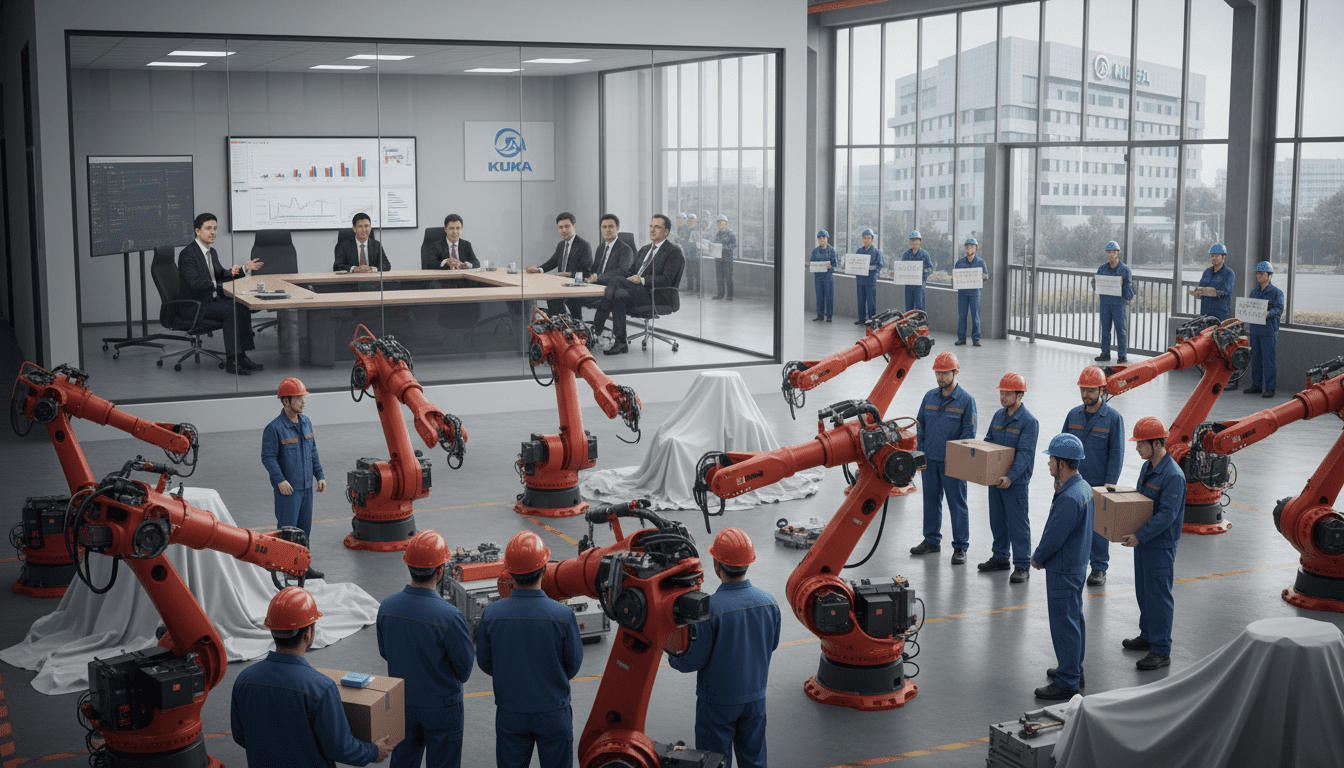
KUKA takeover turns ten: Augsburg plant weathers job cuts as innovation shifts toward China
Ten years after the KUKA takeover by China’s Midea, Augsburg’s robotics leader faces job cuts, a shift of innovation to China and stricter German foreign-investment rules.
The KUKA takeover is now a decade old and the company that once symbolized German industrial prowess has become a focal point for debates over technology, jobs and foreign ownership. The Augsburg headquarters remains, but the balance of power and much of the innovation momentum have moved toward China since Midea announced its bid on May 18, 2016. The deal reshaped KUKA’s corporate strategy and triggered political responses in Berlin that continue to affect investment scrutiny.
Augsburg site remains headquarters but faces cuts
Sites in Augsburg still employ roughly 3,000 people, and the city remains the official seat of the company that pioneered heavy industrial automation. Despite record order levels and revenues reported in recent years, management has implemented substantial workforce reductions at the German site, increasing planned cuts to 560 full-time jobs. A labor accord with IG Metall prolonged protection against dismissals until 2029 but required concessions in wages to secure that stability.
Financial performance and changing business mix
KUKA’s business has shown resilience on the balance sheet even as its composition has changed, with robot sales accounting for a little over half of recent revenues. The company reported significant order volumes in recent periods, yet overall revenue dynamics now reflect a broader portfolio including plant engineering, intralogistics, healthcare logistics and software. This diversification has buffered earnings but also diluted the public perception of KUKA as a pure-play robot maker.
Global market shifts and production in China
Since the takeover, the global robotics market has expanded rapidly and China has become dominant in installations and production capacity. Annual new robot installations worldwide grew from roughly 240,000 to about 550,000, and Chinese manufacturers now account for the largest share of that market. KUKA’s market share has remained around the mid-single digits globally, while its position in China improved from approximately seven percent to about ten percent, helped by a large new factory in Foshan designed to produce at least 15,000 robots annually.
Debate over political influence and financing
Questions about the role of Chinese state-affiliated financing in the acquisition have persisted. Reports cited at the time indicated that a consortium led by Chinese policy banks provided significant credit to support Midea’s bid, and critics argued the transaction fit broader strategic initiatives such as the Belt and Road framework. Midea and its executives publicly framed the takeover as a commercial investment focused on growth rather than geopolitics, but unease in industrial and political circles in Europe endured.
Strategy on emerging humanoid robotics and innovation
KUKA has explored humanoid and collaborative robot technologies but has publicly calibrated expectations, describing humanoids as a long-term possibility rather than an immediate product target. The company emphasizes the proven reliability of its industrial robots, which operate continuously in factory environments worldwide, while acknowledging that startups and new entrants have taken the lead in small, flexible cobot systems. Decisions on how aggressively KUKA will pursue consumer-facing or humanoid platforms appear likely to be influenced by its parent company’s strategic priorities in China.
Regulatory fallout and stronger foreign-investment controls
The takeover’s ripple effects extended to German policy, prompting a stepwise tightening of foreign-investment rules to guard key technologies and infrastructure. Thresholds for reviews of non-EU investments were lowered and specific limits introduced for future technologies and critical infrastructure, making government scrutiny routine for larger stakes. Successive ministers across party lines supported these changes, and notable interventions since have reflected sustained political consensus on limiting potential transfers of sensitive capabilities.
Midea’s acquisition of KUKA marked a turning point for a firm long viewed as a German industrial jewel, and its tenth anniversary is prompting sober reassessments rather than celebration. The company’s dual footprint—headquartered in Augsburg while expanding rapidly in China—illustrates the tensions between local employment, global market access and national policy priorities. KUKA continues to win major contracts and to supply thousands of robots across industries, but the locus of growth and many strategic choices now lie where demand and production have accelerated fastest.
The decade since the sale has left a mixed legacy for Augsburg and for Germany’s robotics sector: commercial success in some measures, but also job losses, fragmented innovation leadership and a political response that has reshaped how foreign acquisitions are evaluated.
