
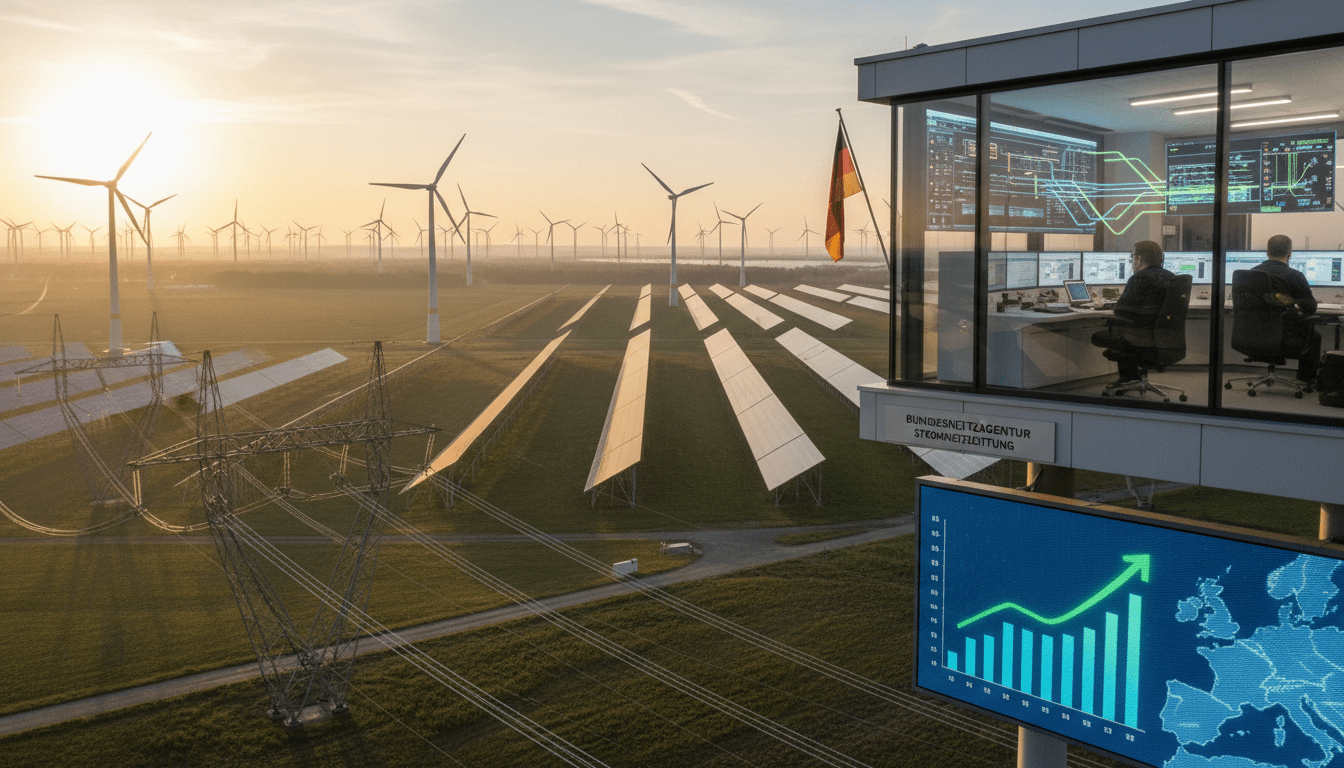
German electricity exports turned net positive in Q1 2026 as renewables lead shipments
German electricity exports were net positive in Q1 2026; renewables accounted for 57% of exports as lower wholesale prices drove sales to neighbouring markets.
Germany recorded a net export of electricity in the first quarter of 2026, marking the first quarterly surplus since late 2023. According to the Bundesnetzagentur, German producers exported 17.9 terawatt-hours while imports totaled 15.3 terawatt-hours, producing a net export of 2.6 TWh. The regulator noted that the result contrasts with the first quarter of 2025, when Germany posted an import surplus of 4.0 TWh.
Price gap with neighbours
The Bundesnetzagentur identified falling domestic wholesale prices as the principal driver behind the shift to net exports. Lower German prices relative to most neighbouring markets made it more economical for foreign utilities to purchase electricity from German generators. That reduced the incentive for German suppliers to import power and increased cross-border sales.
Traders and grid operators often route flows where price spreads are maximized, and in Q1 2026 this pattern favoured outbound transfers from Germany. The agency’s data show that commercial incentives rather than physical shortages determined much of the directional flow during the quarter.
Destinations and sources
Austria remained the largest single recipient of German electricity in the quarter, continuing a trend from the previous year. Exports to Denmark and Norway grew most sharply, while deliveries to France fell materially — roughly halving compared with the same quarter a year earlier. On the supply side, Denmark was the biggest foreign supplier to Germany, followed by the Netherlands and France.
These bilateral shifts reflect a mix of seasonal demand, generation availability abroad and commercial trading strategies. Cross-border interconnector capacity and scheduled maintenance windows also influence which routes see the greatest volumes at any given time.
Generation mix of trade
Onshore wind accounted for the largest share of electricity that Germany exported, and renewables made up 57.1% of total exports in Q1. At the same time, the share of renewables in imports climbed to 50.2%, illustrating growing bilateral flows of green power across Europe. Despite that rise, nuclear-generated electricity remained the largest single fuel source among imports into Germany for the quarter.
The prominence of renewables in exports reflects higher wind and solar output phases, while imported nuclear reflects stable baseload supplies from neighbours that still operate reactors. The co-existence of variable renewables and firm nuclear imports underscores the complex composition of Europe’s integrated power system.
Implications for markets and grid operations
A net export quarter can relieve domestic balancing pressure but also transfers variability management to interconnected systems. Grid operators must coordinate to accommodate different generation profiles and to ensure stability as power moves across borders. Increased exports during low-price periods can reduce revenues for domestic suppliers and change the economics for peaking plants and storage projects.
Policy-makers and industry participants are watching how frequent such net export quarters become as the German fleet evolves. If price differentials persist, traders may increasingly exploit arbitrage opportunities, influencing investment signals for batteries, demand-side response and flexible gas-fired capacity.
Outlook and factors to watch
Seasonal changes in wind and solar generation will be central to whether Germany remains a net exporter in coming quarters. Summer weather patterns, planned maintenance on neighbouring grids, and shifts in nuclear availability abroad are all likely to affect flows. Wholesale price convergence or divergence across the region will continue to be the crucial determinant of cross-border trade volumes.
Regulatory developments, including changes to transmission tariffs or market coupling arrangements, could also reshape incentives for importing or exporting electricity. Stakeholders will monitor upcoming quarters to see if Q1 represents a temporary swing or the start of a more sustained pattern.
Looking ahead, the interplay of renewable growth in Germany, nuclear and hydro capacity in neighbouring countries, and evolving market structures will determine whether Germany remains a frequent net exporter or returns to regular net imports in different seasons.
