
Japan earthquake prompts urgent tsunami alerts and renewed megathrust concerns
Japan earthquake: coastal residents were urged to evacuate as a magnitude 7.5 quake off the east coast triggered tsunami warnings and fresh debate over long-term risk reduction.
Urgent tsunami alert interrupted evening broadcasts
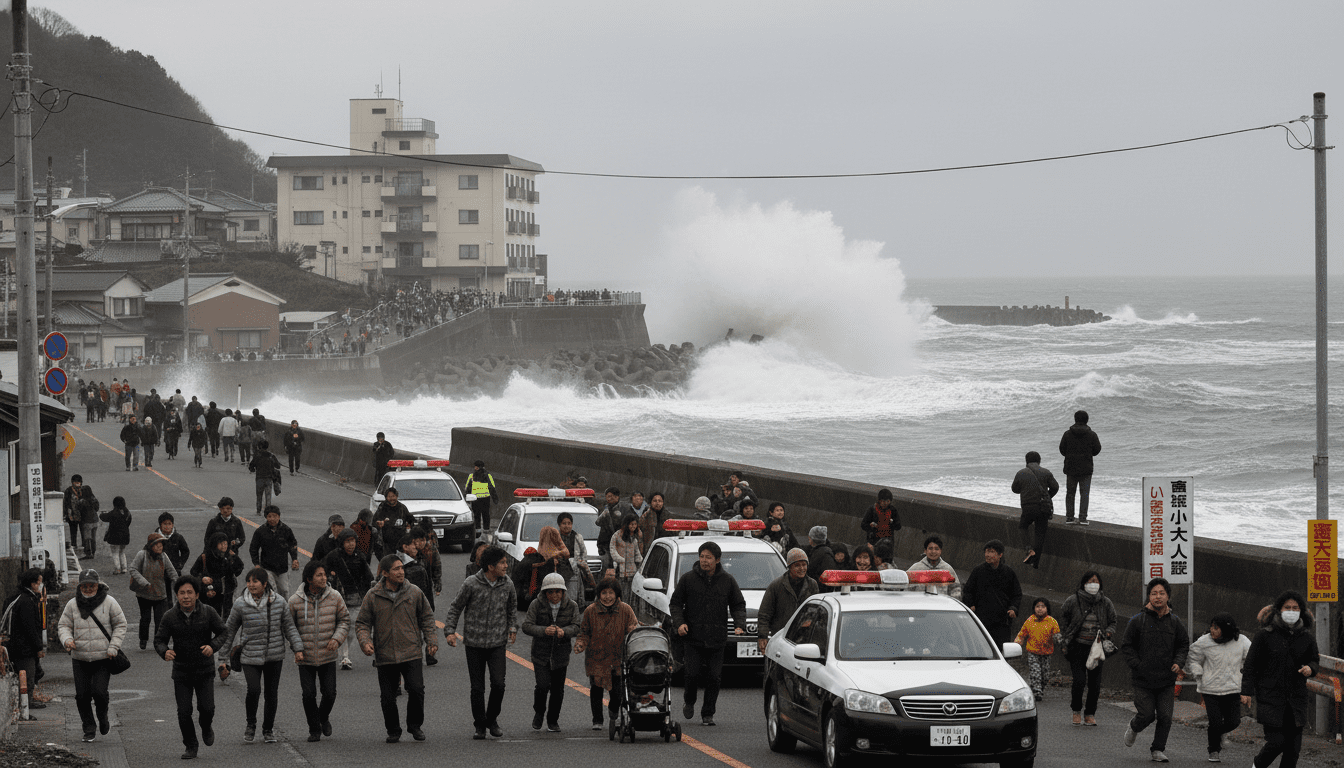
A Japan earthquake on an April afternoon sent emergency messages into living rooms and onto mobile phones across the country. Television presenters switched to stark, repeated warnings advising anyone near the coast to move to higher ground immediately. Emergency sirens and coordinated loudspeaker announcements were activated in affected towns as authorities relayed forecasts of waves as high as three meters and reports of large swells at sea.
Local broadcasters and the meteorological agency emphasized imminent danger, a change in tone officials say reflects lessons learned from the 2011 disaster. The repeated, urgent language and synchronized alerts helped prompt rapid evacuation of coastal neighborhoods and fishing ports as officials awaited wave developments.
Magnitude 7.5 quake shook wide areas, including Tokyo
Seismological authorities measured the offshore event at magnitude 7.5, with strong tremors felt across large swaths of Japan. High-rise buildings in Tokyo, roughly 600 kilometers from the epicenter, swayed noticeably as aftershocks and subsequent alarms followed. In the immediate aftermath, the highest recorded tsunami run-up was modest—about 80 centimeters—while damage and casualties remained limited.
Emergency services kept a heightened posture in the week after the quake, citing a short-term rise in the probability of a stronger event. Officials reported that the chance of a markedly larger quake in the days following the initial shock was elevated compared with routine background levels, but no larger event materialized.
Scientists warn of elevated long-term megathrust risk
Japan’s unique geologic setting—where several tectonic plates converge—means seismic activity is a constant hazard. On average authorities register about 73 perceptible tremors each month, most of which cause only light shaking. Yet seismologists continue to caution about the prospect of a “megaearthquake,” defined as events of magnitude eight or higher, whose timing and exact location cannot be predicted.
For the northern Pacific margin that experienced the April quake, government assessments estimate a roughly 90 percent probability of a very large quake occurring within the next 30 years. Elsewhere, the Nankai Trough south of Honshu, which underlies major urban centers including Osaka, Nagoya and Kobe, has been assigned an increased 30-year probability—recently raised to around 80 percent—of producing a catastrophic tremor and tsunami.
Potential human toll drives preparedness planning
Models prepared by government panels and academic researchers present stark scenarios for a major metropolitan shock. A worst-case urban earthquake projection cited in recent briefings estimated that a single severe event in the Tokyo metropolitan area could claim thousands of lives and destroy hundreds of thousands of buildings. One government report suggested a particular scenario might cause about 18,000 fatalities and the loss of roughly 400,000 structures.
Disaster researchers warn that beyond immediate fatalities, long-term displacement would be severe. One study referenced predicted that millions could be left homeless following a major quake in the capital, with many still without permanent shelter six months later. Those projections have prompted sustained investment and public policy measures to reduce vulnerability.
Tokyo and municipalities investing in structural and social resilience
City planners and national agencies have responded with a mix of hard and soft measures designed to limit casualties and facilitate recovery. Urban redevelopment has widened major thoroughfares, increased open spaces and created firebreaks to halt the spread of post-quake blazes, a major cause of destruction in past events. Since earlier estimates, the share of Tokyo housing meeting stricter seismic standards has risen to more than 90 percent, up from about 75 percent fifteen years ago.
The municipal government has earmarked substantial funding for retrofits and resilience projects, including a multiyear plan that allocates trillions of yen for protective measures. High-rise construction now routinely incorporates sophisticated vibration dampers and active mass systems that counteract shaking, while incentives finance the seismic reinforcement of older residential buildings.
Everyday readiness remains a public priority
Preparedness extends beyond engineering to household and community habits. Children practice monthly earthquake drills in preschools, donning small protective helmets and rehearsing safe evacuation routes to schoolyards or parks. At public educational centers, visitors experience simulated shaking and training that reinforces actions such as sheltering under tables and shutting off gas and electricity.
Many households keep an “earthquake kit” near the entrance, stocked with water, medicines, blankets and torches so families can sustain themselves for at least three days without outside assistance. Local authorities also maintain evacuation routes and conduct public awareness campaigns to ensure citizens know how to respond quickly when alarms sound.
The April event, while not causing catastrophic loss, has renewed attention across Japan to both the immediacy of warning systems and the long-term challenge of living with high seismic risk. Ongoing investment in early warning technology, infrastructure reinforcement and public drills aims to reduce the human cost when the next large quake inevitably arrives.
