
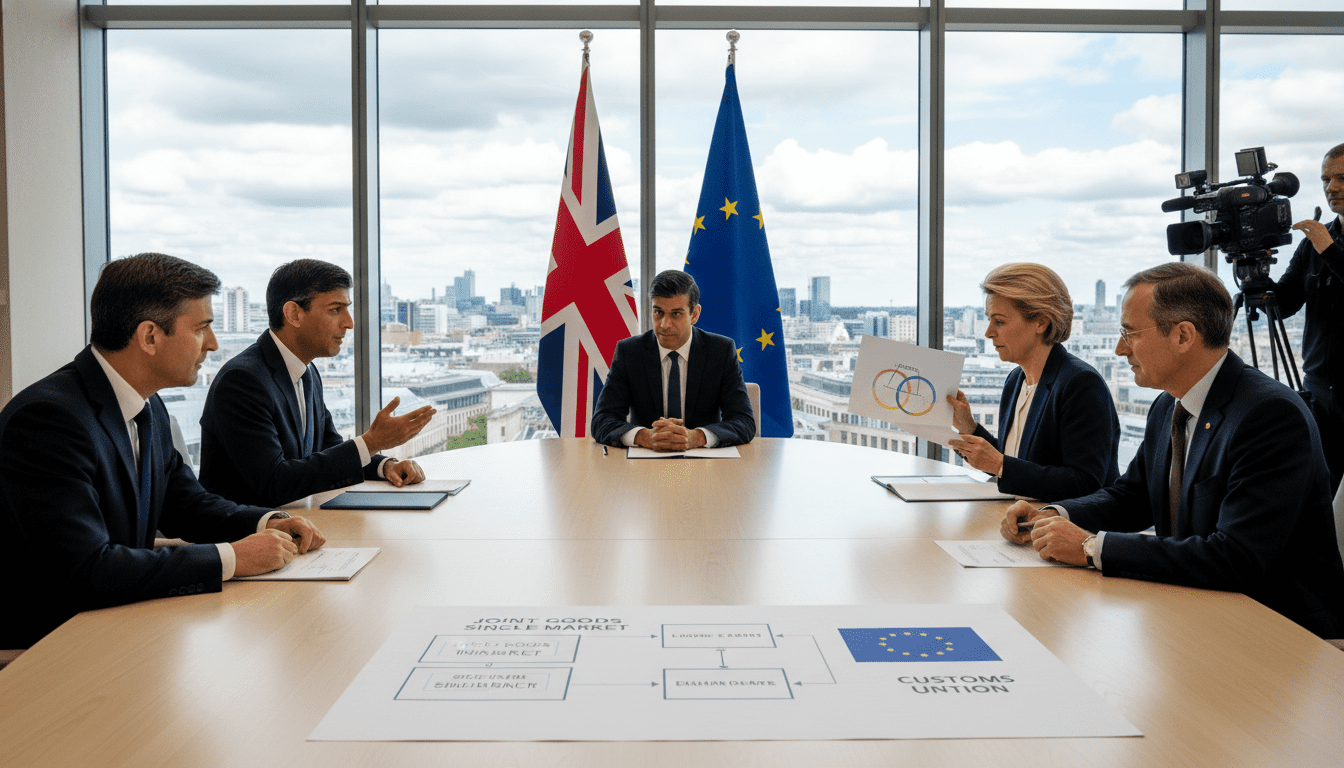
UK proposes UK‑EU single market for goods as Brussels urges customs union or EEA
UK proposes a UK-EU single market for goods; Brussels prefers a customs union or EEA, insisting on free movement as a precondition before the July 2026 summit.
The British government has reportedly offered the European Union a joint UK‑EU single market for goods, a move that Brussels has so far met with resistance, according to reports by the Guardian and the BBC. The proposal is presented as a way to reduce trade friction that emerged after the United Kingdom’s exit from the EU, and the idea is set to be discussed ahead of a planned EU–UK summit in July 2026. EU officials have, according to those reports, countered by recommending a customs union or membership of the European Economic Area, both of which would require the UK to accept the free movement of people for workers.
UK submits new goods market proposal
The government’s proposal centers on a single market arrangement limited to goods, aiming to align regulatory and customs processes to ease cross‑border trade. British officials framed the approach as a pragmatic step to restore smoother trading relations without full political reintegration into EU structures. Media accounts say the EU has not flatly ruled out the goods market option, leaving room for further negotiation at the upcoming summit. British ministers are reported to be pursuing the proposal alongside other trade and regulatory initiatives intended to lower the economic costs of Brexit.
Brussels recommends customs union or EEA membership
European negotiators have reportedly pushed back, favoring a customs union or EEA membership as established frameworks that would better guarantee regulatory cohesion and tariff‑free commerce. Both alternatives, the reports say, carry the explicit expectation that any close trading arrangement must include acceptance of free movement for workers. EU officials view those mechanisms as tried and tested, providing legal and institutional structures that a bespoke goods‑only market might lack. The suggestion reflects Brussels’ broader insistence on reciprocal commitments where single‑market access is sought.
Free movement emerges as the central sticking point
A central hurdle in discussions is the EU’s insistence that closer market ties require acceptance of people’s free movement for work purposes, a policy red line for many in the UK political landscape. Officials in Brussels have signaled that regulatory alignment alone is unlikely to satisfy their demands without corresponding commitments on mobility. Downing Street and the Cabinet Office have avoided confirming details of the exchanges, while acknowledging that talks continue and that negotiating positions remain fluid. The mobility issue thus sits at the heart of whether any new trade framework can bridge the post‑Brexit divide.
Preparations intensify for the July 2026 summit
Both sides intend to bring these competing proposals to a scheduled EU–UK summit in July 2026, where senior leaders are expected to seek political direction on the next steps. The UK Cabinet Office declined to comment specifically on the media accounts but said the government was negotiating an “ambitious package” ahead of the summit. That package reportedly includes separate talks on the trade in food and drink and cooperation on emissions trading systems, areas seen as priorities for business and environmental policy alike. The summit will therefore test whether political will exists to convert technical offers into a durable agreement.
Domestic political reverberations for Prime Minister Starmer
The timing of the goods market proposal comes amid mounting domestic political pressure on Prime Minister Keir Starmer, whose Labour government has emphasized the economic costs of Brexit. Finance Minister Rachel Reeves signaled in March that the government was prepared to align with numerous EU rules to reduce trade barriers, a stance that some critics view as an opening toward closer ties with Brussels. Those tensions have been magnified by disappointing results for Labour in recent local and regional elections, which have prompted speculation about leadership stability. The resignation of Health Secretary Wes Streeting, who has argued for a future return to the EU, underscores internal debate about strategy and direction.
Business and trade groups await clarity
Industry groups and exporters are watching the negotiations closely, as any shift toward a single market, customs union, or EEA‑style arrangement would carry significant implications for supply chains and regulatory compliance. Producers of food and beverages, in particular, have expressed interest in streamlined rules that reduce checks and paperwork while preserving EU market access. Equally, firms concerned about immigration policy are wary of any arrangements that might reinstate broad free movement without guarantees on labour controls. The business community is calling for clarity from both governments so companies can plan investment and logistics with greater certainty.
The coming weeks will determine whether the UK’s proposal for a UK‑EU single market for goods can be refined into a compromise acceptable to Brussels, or whether the talks will pivot toward one of the EU’s preferred frameworks ahead of the July 2026 summit. The negotiations will test political resolve on both sides as leaders weigh economic benefits against sovereignty and migration concerns.
