
Germany reports sharp rise in voluntary return support in 2025
Germany saw a surge in voluntary return support in 2025, 16,600 assisted departures, expanded counselling and tailored financial packages for returnees.
Federal Office reports rise in supported voluntary returns
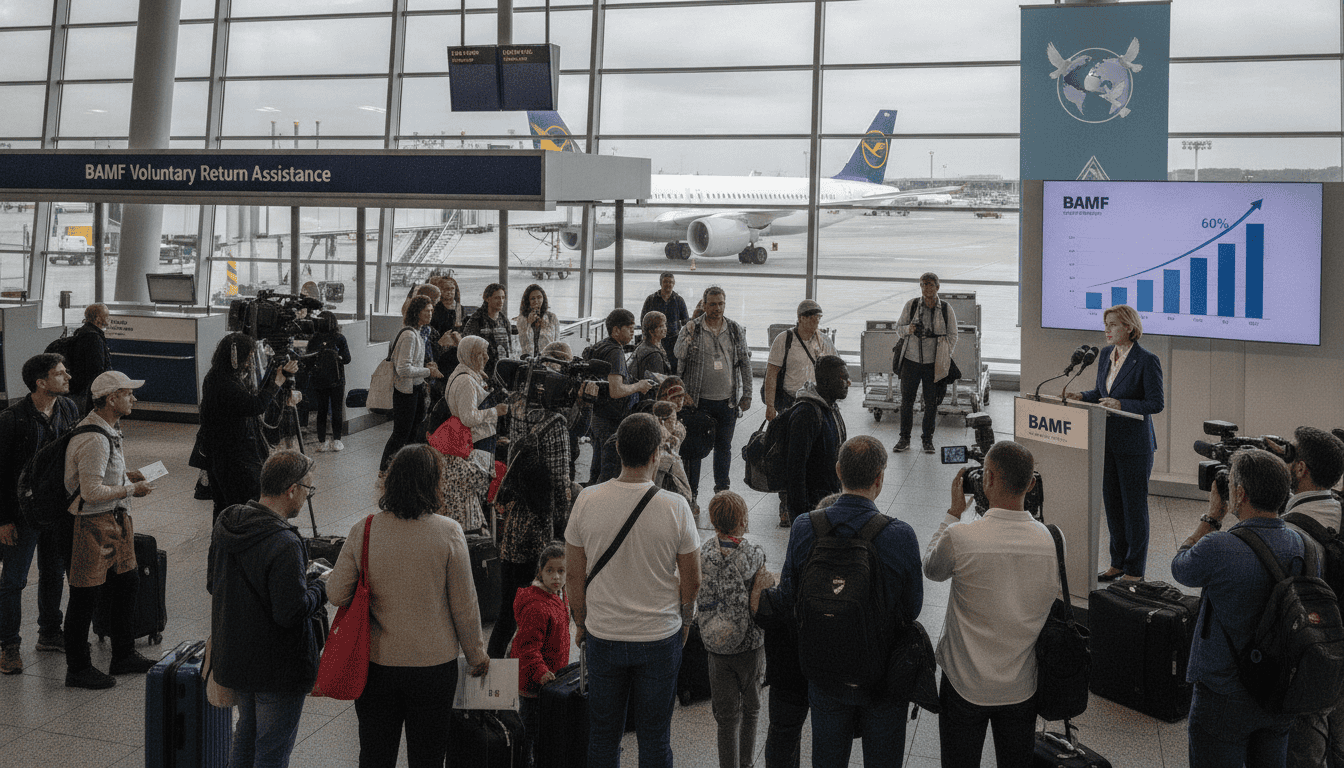
A record increase in voluntary return assistance was recorded in 2025, with the Federal Office for Migration and Refugees reporting about 16,600 people who left Germany with state support. The figure marks roughly a 60 percent rise from 2024, when just over 10,000 departures were funded. Officials frame voluntary return as preferable to forced removal and emphasize counselling and financial aid as incentives.
Top destinations and national trends
The largest share of assisted departures in 2025 went to Turkey, followed by Syria, the Russian Federation and Georgia. Turkey accounted for about a third of supported returns, while Syria made up more than a quarter. The pattern contrasts with earlier years: numbers of funded returns were similar in 2023 but substantially lower in 2022, when fewer than 8,000 were supported.
Local counselling network and the Hesse example
Counselling for people considering return is delivered locally rather than from the federal office in Nuremberg, with states operating their own advisory networks. In Hesse, return counselling is available through regional offices in Gießen, Kassel and Darmstadt, supplemented by non‑governmental service providers. The Darmstadt office, which updated its state return programme at the end of 2025, now staffs nine permanent employees in its unit for residence law and voluntary departures.
Legal status, timing and cost considerations
Advisers typically work with people deemed “subject to enforceable departure”, meaning their asylum claims have been rejected and legal recourse is exhausted. Those individuals receive a deadline—commonly up to 30 days—to leave before enforcement action may follow, and they are offered return counselling at that stage. Authorities argue that facilitating voluntary departures is more cost‑effective than tracking and forcibly removing people, a calculation that underpins the emphasis on assisted return.
Financial packages and programme details
The federal return programme covers travel costs and offers modest cash grants that vary by destination. Under the national scheme, adults receive a travel allowance and a start‑up payment, with lower sums for children and family caps in place. Additional support is available for medical needs and mobility assistance during travel, and some federal and state initiatives provide further top‑ups. For returnees to Turkey, for example, federal and EU reintegration funds can be combined to provide higher short‑ and long‑term assistance for households.
Demand pressures and casework realities
Counsellors report growing demand from specific groups, notably Syrians, which has lengthened waiting times for appointments to as much as four weeks in some areas. The Darmstadt unit recorded roughly 1,100 initial consultations in 2025 and often conducts multiple follow‑ups to finalise arrangements. Advisers travel to refugee accommodation and local counselling centres to lower access barriers, but they avoid private home visits and prioritise clients with urgent needs such as serious illness or mobility limitations.
Support beyond logistics: reintegration and tailored help
State programmes supplement federal payments with practical assistance tailored to individual circumstances, ranging from household moving costs to small business coaching. Examples cited by advisers include paying onward transport from an arrival airport to a home village, funding vocational coaching for a would‑be entrepreneur, and helping to secure local housing or employment through partner organisations. In many cases these interventions amount to several hundred euros but can be decisive for reintegration prospects.
Many stakeholders debate whether current support levels are sufficient, pointing to higher incentives offered by some other European countries and to historical German programmes that once provided larger grants and business start‑up loans. Advocates for more generous packages argue that stronger reintegration aid would both ease returns and address root causes by supporting livelihoods in countries of origin.
Voluntary return remains a complex choice for those affected: it can spare people the trauma of enforced deportation and often avoids automatic re‑entry bans, but it also confronts families with uncertainty and the practical challenge of rebuilding lives. Counsellors stress that, for those who opt to go, having control over the timing and conditions of departure is a key relief, even as many returnees seek to leave quickly once they decide.
Overall, the 2025 rise in assisted departures reflects a mix of policy emphasis, increased demand and expanded local counselling capacity, while ongoing debates over funding levels and reintegration measures suggest the topic will remain politically and socially contested.
