
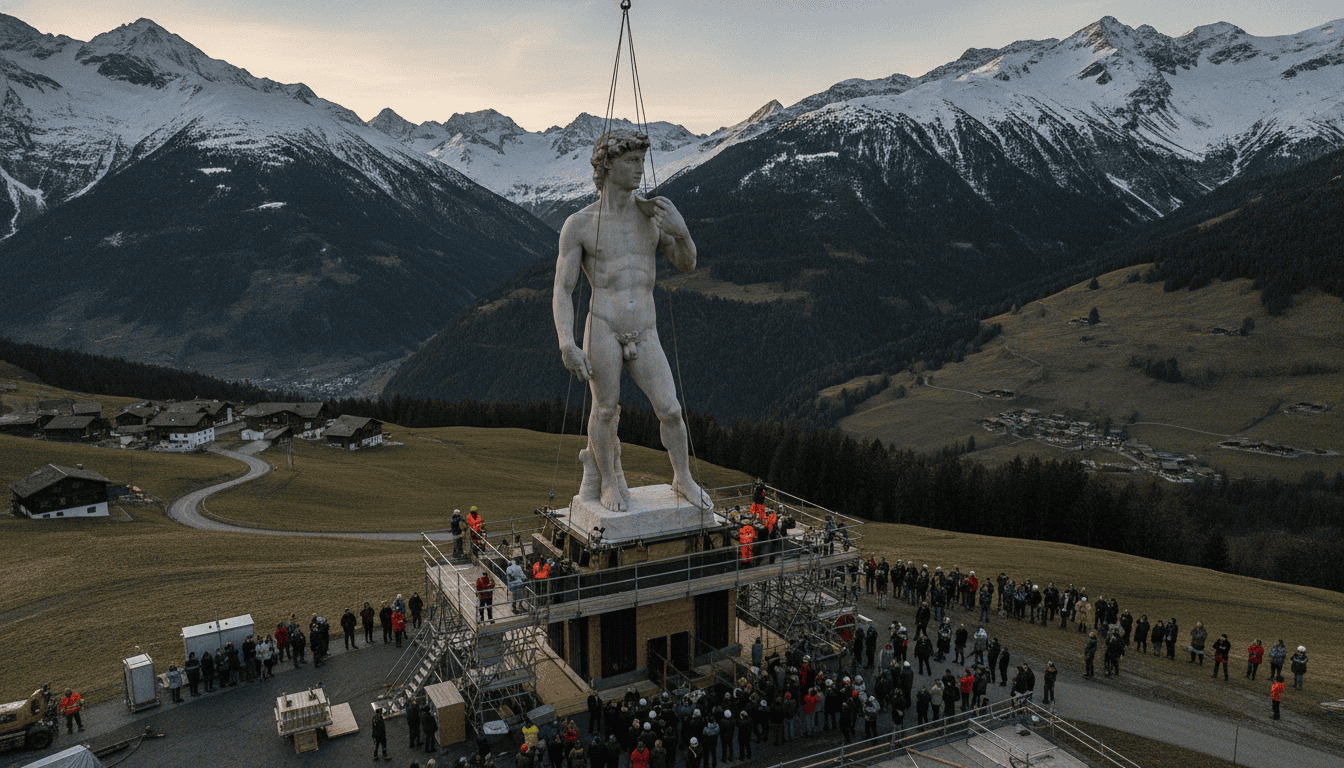
David in Klosters: Five-Metre Marble Replica Installed in Swiss Alps
A five-metre marble replica of Michelangelo’s David was installed in Klosters Switzerland, raising questions about scale provenance and its alpine setting.
Michelangelo’s David has been placed in the municipality of Klosters as a five metre marble figure that dominates a public square and the surrounding mountain views. The David in Klosters was brought to the Alpine site by a local cultural initiative called Scultura Viva and set on a substantial base to withstand the mountain environment. The arrival of the sculpture has prompted interest in its manufacture provenance and the decision to site a Renaissance icon in a high altitude Swiss village.
Installation and transport completed in Klosters
The marble figure arrived on a Sattelschlepper and was lifted into place using one of the largest available mobile cranes to secure it on a prepared plinth. The statue alone weighs more than nine tonnes and together with its base the installation reaches roughly seventeen tonnes in total. Organizers coordinated specialists and heavy equipment to manage the delicate lift and ensure the figure was positioned without damage.
Local officials and the Scultura Viva team supervised the final anchoring procedures and inspected the statue for transport stress when it reached its destination. The placement deliberately gives the sculpture a commanding view of the surrounding peaks and passes, turning the public square into an exhibition site. Safety measures and public access plans were communicated to residents to balance preservation with community engagement.
Sourced from Carrara’s Polvaccio quarries
The marble used is identified as Marmo bianco Michelangelo from the Polvaccio quarries in the Carrara region, a material historically associated with the Renaissance master. The replica was completed in 2017 by the sculpting workshop Studi d’Arte Cave Michelangelo in Carrara, where modern techniques and traditional carving were combined. Initial blocking was done by robotic milling for rough forms and skilled sculptors then refined facial features hands and musculature.
Working with a single large block of high quality marble requires exceptional quarrying and logistical capability, which is why such full size marble executions are rare. The Carrara workshop that produced the work followed a hybrid workflow to respect the material while speeding some stages of production. That approach allowed artisans to focus on the subtle modeling that gives the figure its lifelike presence.
Scultura Viva and Christian Bolt commissioned the work
The installation is driven by Scultura Viva a local cultural initiative dedicated to preserving and promoting sculptural heritage across the region. The project was championed by Christian Bolt who is noted as the first Swiss sculptor to hold a professorship at the Accademia delle Arti del Disegno in Florence. Bolt has emphasized that the intention is not to offer a straightforward reproduction but to observe how an icon changes meaning when relocated from its original context.
Organizers say the placement is meant to prompt reflection on art public space and cultural continuity in a setting far removed from Florence. Scultura Viva will oversee maintenance and interpretive materials aimed at helping visitors understand provenance technique and the dialogue between original and copy. The initiative expects the work to function both as a draw for cultural tourism and as a stimulus for local events and educational programming.
Replica size and rarity underline high cost and complexity
Full size marble versions of David are comparatively scarce with the number worldwide measured in single digits due to the expense and technical difficulty involved. Large homogeneous marble blocks suitable for life size carving are limited even in the Carrara quarries and require careful extraction and testing. Costs rise quickly once transport craning and specialist conservation considerations are factored in.
Beyond financial factors the logistics of moving and installing a multi tonne marble figure in mountainous terrain add further complexity. Conservators note that climate and exposure must be considered when placing marble outdoors since freeze thaw cycles and pollution can degrade the stone over time. The Klosters installation therefore involved an assessment of protective measures and long term monitoring strategies.
Connection to Michelangelo’s 1504 original and its history
The lineage of the image reaches back to Michelangelo’s creation completed in 1504 which became a civic emblem for Florence and a symbol of Renaissance ideals. Michelangelo worked the original from a challenging block that had been rejected by earlier sculptors and transformed it into a figure that stood for republican pride on the Piazza della Signoria. In 1873 the original was moved indoors to the Galleria dell’Accademia to protect the delicate marble while a replica remained outdoors for public display.
Historic conservation choices reflect the vulnerability of the material to weather and urban conditions which informed the decision to relocate the original to a controlled environment. The Klosters replica therefore joins a long tradition of copies and casts that carry the image into new settings while the original remains under careful protection. That history frames contemporary debates about authenticity context and public access.
David gazes over Alpine peaks and local reaction grows
The presence of the David in Klosters has already attracted residents and visitors who pause to examine the figure and consider its placement among mountain vistas. Some locals welcome the cultural boost and the conversation it generates about art and community while others question the choice to transplant a Renaissance icon to an alpine town. Organizers plan guided visits and information panels to explain the work’s origins fabrication and the curatorial reasoning behind the siting.
Cultural commentators see the installation as an experiment in recontextualization in which an established image acquires new readings in a different landscape. Whether viewed as homage provocation or civic enrichment the statue has altered the visual and cultural dynamics of the village square. Scultura Viva says the objective is to keep the dialogue open and to invite interpretation rather than to prescribe a single meaning.
The David in Klosters now stands as both a technical achievement in marble carving and a prompt for discussion about how artworks travel and transform across time and place.
