
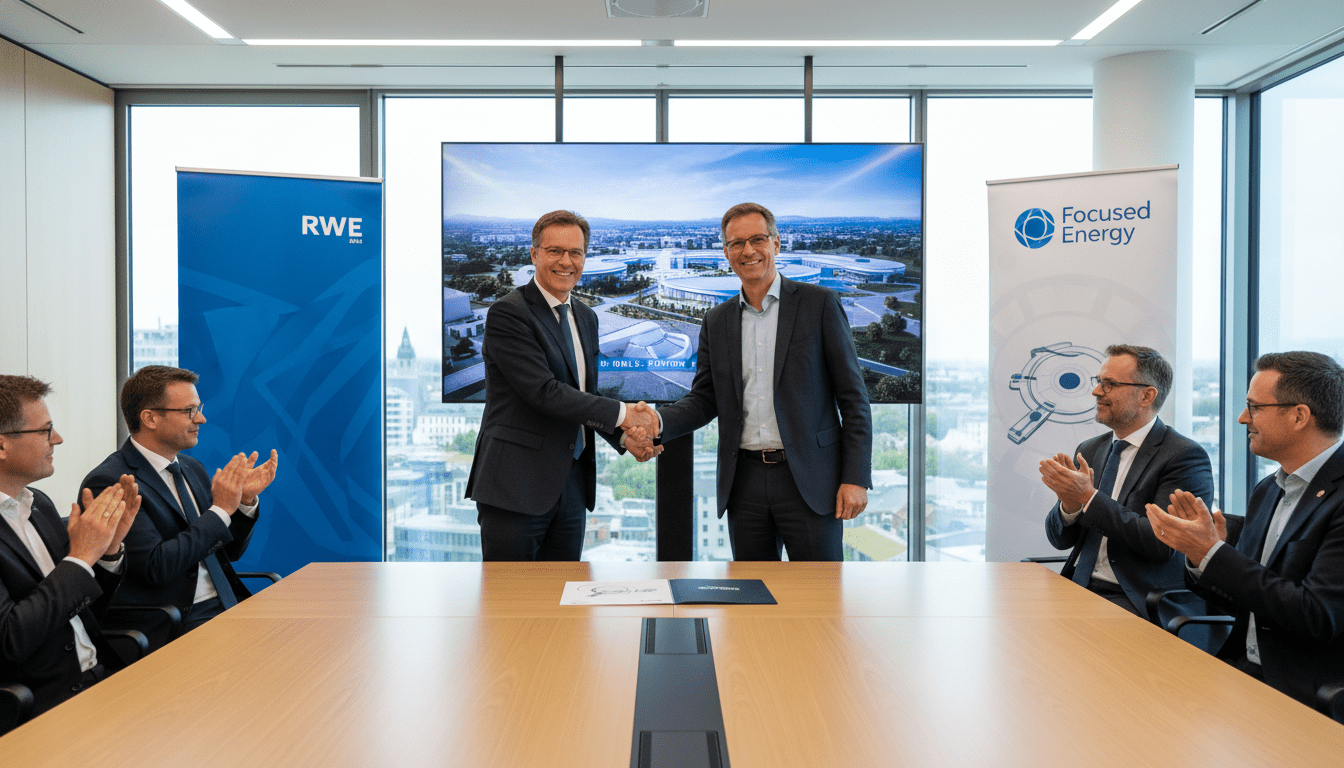
Focused Energy raises nearly $250 million to build laser-fusion labs at former Biblis site
Focused Energy secures nearly $250M to equip laser-fusion labs at the former Biblis nuclear site, backed by RWE and European funds to accelerate fusion.
Focused Energy, the Darmstadt-based laser-fusion start-up, has closed a financing round worth just under $250 million that will be used mainly to outfit new laboratories at the former Biblis nuclear power plant. The investment, led by a group including utility RWE and public and private European funds, is intended to accelerate the company’s development of laser-driven nuclear fusion technology. The round elevates the company into unicorn territory and signals a major industrial bet on fusion in Germany.
Details of the financing round
Focused Energy attracted capital from a mix of strategic industrial partners and innovation investors, including RWE, the German Federal Agency for Disruptive Innovation (Sprind), Futury Capital, and the European Innovation Council Fund. U.S. investor Prime Movers Lab, an existing backer, also participated in the round. RWE expanded its stake, underlining a strategic partnership between the utility and the start-up.
The funding will be allocated almost entirely to building and equipping laboratories on the Biblis site, converting parts of the decommissioned nuclear plant into a fusion research and development campus. Company leaders say the capital will be used to broaden their technical lead and accelerate progress toward demonstration systems.
Planned Biblis campus and local industry ties
The repurposed Biblis campus is planned as a hub for device assembly, testing and supply-chain coordination for fusion components. Focused Energy intends the site to host laser systems, target fabrication facilities and diagnostic equipment needed for scaled experiments. The location leverages existing industrial infrastructure in Hesse and proximity to research centers.
Germany’s industrial ecosystem — including firms such as Siemens, laser specialist Trumpf and optics maker Zeiss — is cited by the company as a key advantage for building the supply chains fusion will require. Local university collaborations, notably with TU Darmstadt, are expected to provide research continuity and workforce development.
Technical approach: laser-driven fusion
Focused Energy pursues a laser-fusion method that differs from magnetic confinement approaches by using high-power lasers to compress and heat tiny fuel targets until atomic nuclei fuse. The process releases large quantities of energy, but reproducing the extreme temperatures and pressures involved requires advanced lasers, precision targets and specialized materials.
Company scientists emphasize that laser fusion demands breakthroughs across optics, target manufacturing and diagnostics, and that the new funding will support rapid iteration of experimental systems. The firm frames its approach as complementary to other fusion pathways being explored worldwide.
Industrial and political backing
RWE’s lead role in the round reflects growing interest from utilities and industrial groups in fusion as a long-term, low-carbon energy option. RWE executives have publicly described the technology as a potential cornerstone for future electricity supply and said they will support projects in multiple German states. National innovation agencies and European institutions are also providing capital to de-risk the technology’s scale-up.
German political leaders have set ambitious goals for national leadership in fusion technology, and federal agencies see commercial fusion as a strategic moonshot that requires collaboration across government, academia and industry. Officials at Sprind described the round as a model for public-private cooperation on breakthrough energy technologies.
Global competition and funding landscape
The surge in private and public investment in fusion mirrors a broader global race. Start-ups and research institutes across the United States, China, Europe and Asia are pursuing diverse reactor concepts, and investments in fusion companies have reached into the billions worldwide. The U.S. market accounts for a significant share of private capital, while China relies heavily on state-directed funding.
Within Europe, Germany is emerging as a leading center for privately funded fusion ventures, with several start-ups concentrated around Munich and Darmstadt. Analysts say the mix of industrial partners, midstream suppliers and research talent positions Germany to contribute significantly to the emerging fusion industry.
Economic and industrial implications for Europe
Backers argue that scaling fusion would reinforce Europe’s deep-tech industrial base by creating demand for advanced optics, high-power lasers, superconducting materials and precision manufacturing. European policymakers and investment officials see the sector as an opportunity to rebuild technological sovereignty and to secure high-value industrial jobs tied to energy-system innovation.
Consulting reports on deep technology suggest large economic upside if Europe can translate scientific excellence into industrial scale. However, observers caution that progress depends on sustained funding, regulatory clarity and coordinated procurement policies to keep supply chains robust.
Focused Energy’s funding round and its plan to develop a national fusion campus at Biblis represent a significant step in Germany’s bid to be a leader in next-generation energy technology. The investment underscores growing private-public collaboration and marks an important milestone for laser-fusion development in Europe.
