
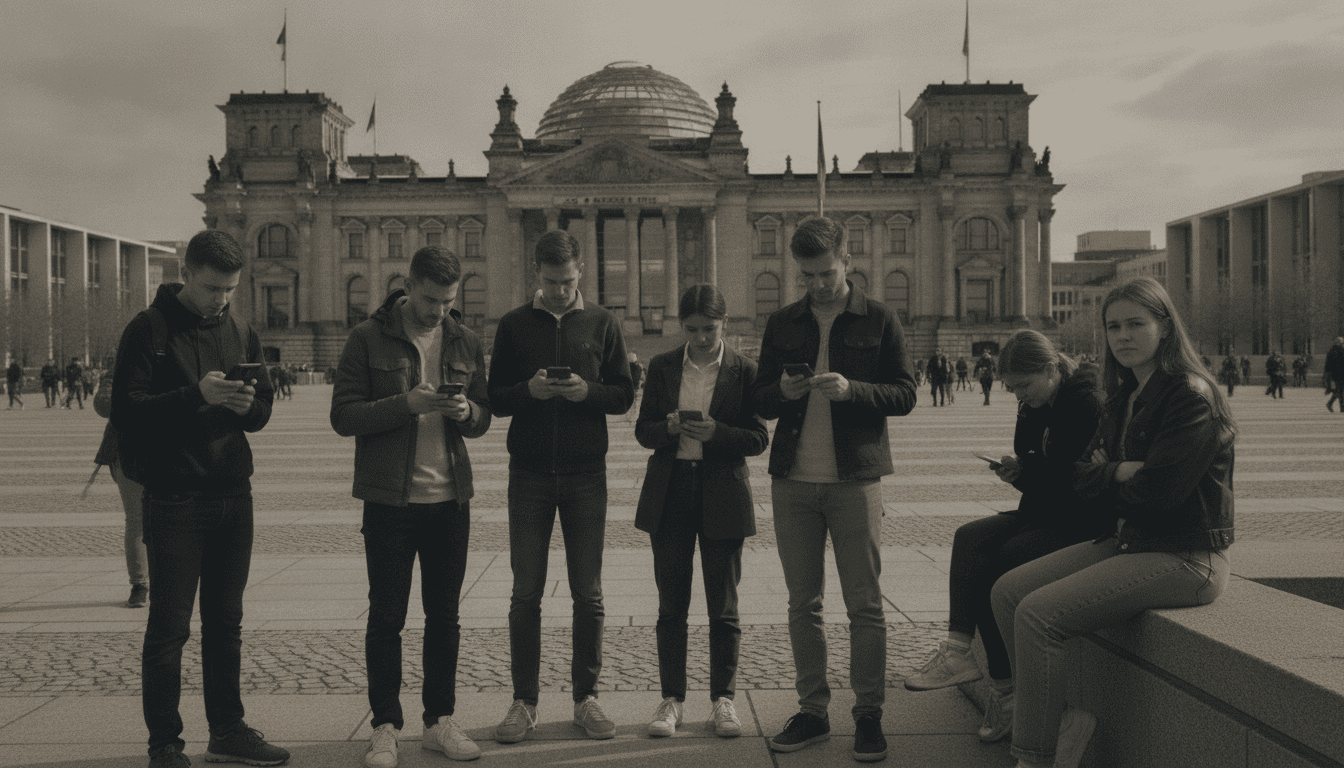
German youth pessimism rises as surveys from Dec 2025–July 2026 reveal growing doubts about future prospects
Studies show German youth pessimism rising: surveys from Dec 2025–July 2026 find increasing doubts about climate, economics and democracy, despite some job optimism.
Young people in Germany are increasingly pessimistic about the country’s future, according to a series of recent surveys that paint a complex picture of concern, conditional optimism and shifting priorities. The trend—highlighted by a Bertelsmann Foundation survey from December 2025, the foundation’s Young Economy Tracker in January 2026, and a youth study published by the German Environment Agency (UBA) on July 7, 2026—shows that while many young adults express caution about long-term prospects, a smaller share still holds guarded optimism about employment opportunities.
Majority of Germans See a Bleak Future, Studies Show
A representative December 2025 survey commissioned by the Bertelsmann Foundation found that 52 percent of Germans believe future generations will fare worse than today’s, with somewhat lower pessimism among 18- to 34-year-olds at 48 percent. Only 13 percent of that younger cohort expect improving conditions for coming generations, compared with 7 percent across all ages. These figures underline a broadly negative outlook that is nevertheless marginally less severe among younger respondents.
The UBA youth study released on July 7, 2026, amplifies the shift: 73 percent of young people now view Germany’s societal future pessimistically, up from 54 percent in 2021. When asked about their personal futures, 30 percent of young respondents reported pessimism—an increase from 19 percent five years earlier—indicating that worries extend beyond abstract national concerns to individual expectations.
Young People More Optimistic on Job Prospects but Doubtful on Wealth
Economic attitudes among youth are mixed, according to the Bertelsmann Young Economy Tracker published in January 2026. A narrow majority of 16- to 25-year-olds (53 percent) said they expect better labor-market opportunities than their parents experienced. At the same time, only 26 percent believe they will achieve greater material wealth than their parents, reflecting a separation between career prospects and expectations of upward financial mobility.
This ambivalence suggests that young people may see improved access to work or more diverse career paths even as they doubt long-term wealth accumulation, a divergence that policymakers and employers will likely watch closely when designing education and labor-market measures.
Political Extremes Linked to Greater Pessimism
The Bertelsmann analysis also found that political preference correlates strongly with future outlook. Voters at the political extremes report higher pessimism than those aligned with centrist parties. More than three-quarters of AfD supporters (76 percent) expect worsening conditions for future generations, and 55 percent of Die Linke voters share that view. By contrast, roughly four in ten supporters of CDU/CSU, SPD and the Greens express similar concerns.
Across party lines, dissatisfaction with democracy is notable: 37 percent of respondents say they are (rather) dissatisfied with Germany’s democratic system, while only 25 percent report satisfaction. Among younger people the dissatisfaction figure is slightly lower, at 31 percent, indicating that political discontent is present but varies by age and partisan affiliation.
Climate Concern Declines but Remains Important for Most Youth
Environmental and climate priorities have shifted in recent years, according to both studies. In the Bertelsmann survey, public spending priorities placed education at the top (90 percent), followed by health and care (87 percent) and transport infrastructure (82 percent); climate policy ranked lower at 62 percent, with defense at 60 percent. The UBA study documents a marked decline in the share of 14- to 22-year-olds who rate climate and environment as “very important,” dropping by about one-third since 2021.
Nevertheless, 73 percent of young respondents still consider environmental protection important, and 69 percent believe the federal government is not doing enough on climate issues. The data suggests that climate remains a core concern for many young people, even as other immediate issues such as security and social justice have risen in salience.
Youth Endorse Merit, Back Equal Starting Conditions
On questions of social justice and fairness, young people express a clear mix of meritocratic and egalitarian views. The Young Economy Tracker found broad support for rewarding effort: 89 percent of 16- to 25-year-olds agreed that it is fair for those who perform well in work to earn more. At the same time, 92 percent endorsed equal starting opportunities for all, and 97 percent supported public measures to assist parenting and care responsibilities.
Views diverge on redistribution: a majority rejects full equality of income and wealth as the defining feature of justice, with 29 percent saying they “not at all” agree and 42 percent saying “rather not” when asked whether equal distribution constitutes justice. Still, substantial majorities favor social protections such as a basic standard of living for the poor and support for families.
Policy Implications for Education, Security and Social Mobility
Taken together, the surveys point to a generation that demands stronger public investment in education, healthcare and infrastructure while seeking reassurance on safety and economic fairness. Rising pessimism—particularly about national prospects—could reshape political engagement, voting behavior and civic trust if left unaddressed. Governments and institutions face pressure to translate young people’s conditional optimism about jobs into tangible pathways to stable income and social mobility.
Addressing these concerns may require targeted policies that combine improved educational opportunities, clearer labor-market transitions, renewed climate action with visible short-term benefits, and measures to strengthen democratic participation among younger cohorts. The next rounds of public policy and political debate will likely be measured against the expectations and anxieties reflected in these recent studies.
The surveys suggest a generational mix of realism and demand for practical solutions, signaling that young Germans are looking for policies that deliver measurable improvements rather than rhetoric alone.
