
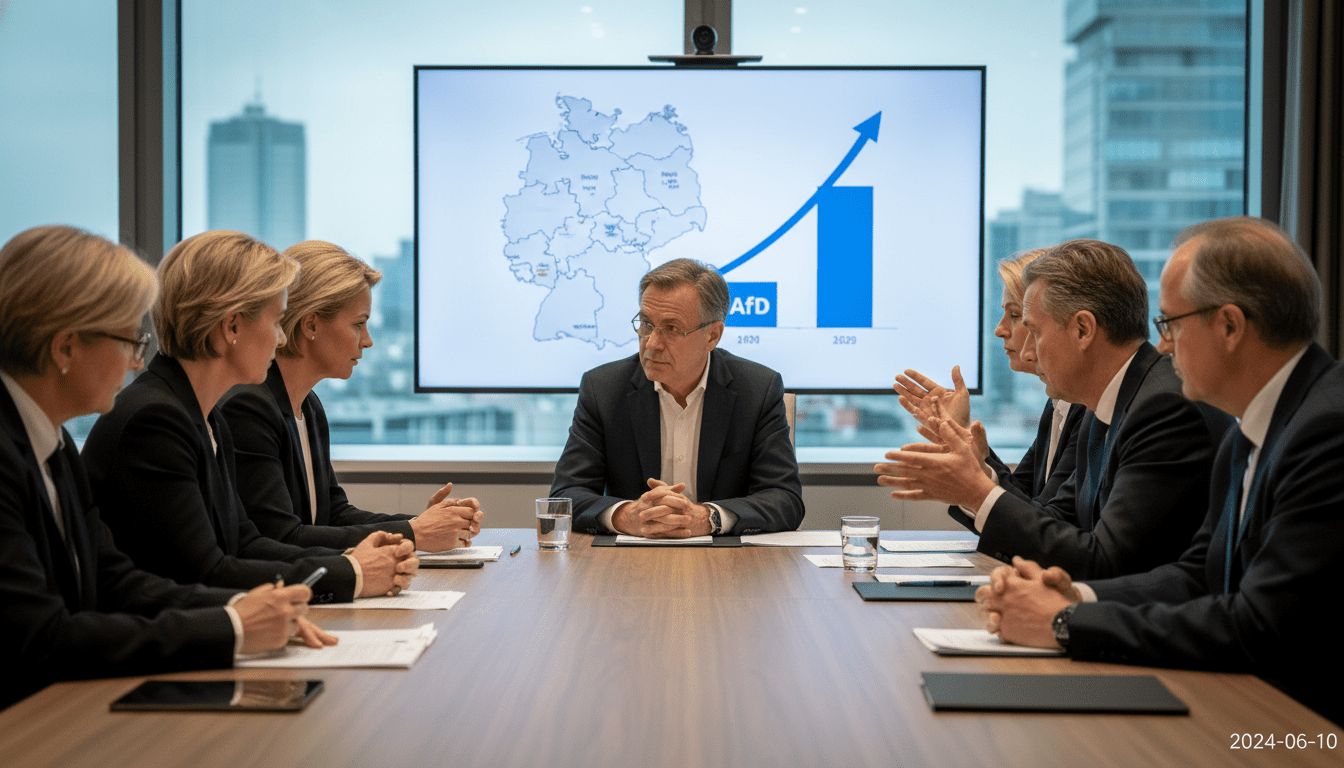
Friedrich Merz Faces Growing Doubt as CDU Weighs Future of Coalition
Friedrich Merz faces mounting uncertainty as CDU concerns over state elections and AfD gains raise prospects of a coalition collapse or a minority government.
Germany’s governing coalition is showing signs of strain as frank conversations among CDU members signal eroding confidence in Chancellor Friedrich Merz and his leadership. Lawmakers and party officials are increasingly willing to discuss the possibility of an early end to the black-red government rather than dismiss such scenarios out of hand. The debate centers on upcoming state elections, internal party dynamics and the difficult arithmetic of parliamentary majorities.
Open Frustration in the CDU Parliamentary Group
Within the CDU/CSU parliamentary group, private remarks about the chancellor’s resolve have become noticeably candid. Some MPs tell colleagues they view Merz as weak on key issues while others note uncertainty over when he might change course again. These statements are not confined to his critics, indicating a broader unease across the faction.
Sources inside the party say the loss of confidence is not the sign of a coup but a symptom of persistent insecurity about government direction. Conversations that once would have stayed behind closed doors are now exchanged in corridors and constituency events, reflecting a party searching for steady leadership.
State Election Calendar Seen as a Critical Test
Party strategists and MPs point to a sequence of state elections this autumn as potentially decisive for the coalition’s fate. The Saxony-Anhalt vote on September 6 and the Berlin election on September 20 are repeatedly cited in CDU discussions as triggers that could reset federal dynamics. Polling and local indicators have heightened fears that a strong AfD showing in Magdeburg could reshape national calculations.
Recent state results have failed to provide the expected momentum for the federal coalition. Gains in Baden-Württemberg and the capture of the Rhineland-Palatinate premiership did not translate into renewed confidence at the national level, leaving many in the CDU skeptical that regional successes will insulate the government from further shocks.
Christian von Stetten Signals Coalition May Not Last
Christian von Stetten, chair of the parliamentary group’s Mittelstand circle, recently told supporters he does not expect the coalition to endure the full legislative term. While von Stetten stressed his personal loyalty to Friedrich Merz, his comments underscored a widening recognition within parts of the CDU that the alliance with the SPD is fragile. He declined to expand further on the record, but his remarks have circulated widely inside party ranks.
Colleagues caution that a string of adverse state outcomes would increase pressure on SPD leadership and could trigger leadership changes in the Social Democrats. Several CDU figures argue that such developments might lead to intensified intra-coalition strain or renewed calls for alternative governing arrangements.
Minderheitsregierung: Public Rejection, Private Considerations
Merz has publicly ruled out a minority government, telling the CDU’s business association in early May that such an option was not one he would pursue. That public stance, however, coexists with private calculations about what a short-lived or untenable coalition could mean for his tenure. Some inside the CDU see a minority government as the only viable path other than cooperation with the AfD or an unlikely alliance with both Greens and Left.
Observers note the political and reputational risks a minority administration would pose, including the likelihood of relying at times on AfD votes to pass measures. That dependence would revive internal tensions and could further fracture the party’s centrist and conservative wings.
Union Warnings About Cooperation with AfD and Member Exodus
Prominent CDU figures have warned that any formal cooperation with the AfD would be existential for the party. Karl-Josef Laumann and other senior regional leaders have said publicly that collaboration with the far-right would amount to the end of the CDU as they know it, and that many members would likely leave. These warnings reflect a deep fear that crossing a red line would trigger a rapid membership exodus and severe reputational damage.
Behind closed doors some within the party imagine dramatic consequences, including high-profile resignations and a wave of departures that could reshape the CDU’s organizational strength. Anecdotal speculation has even included the possibility of former chancellors and senior figures distancing themselves from the party, though such scenarios remain speculative.
Parliamentary Procedures and the President’s Role After a Collapse
If the coalition were to break down, the constitutional path is well-defined but politically fraught: the chancellor would likely have to seek a vote of confidence and, if defeated, the president could be asked to dissolve the Bundestag. Former precedent under Olaf Scholz showed a minority administration can operate briefly before new elections are called, but political actors differ on whether that route would be acceptable today.
Officials point to the role of President Frank-Walter Steinmeier, now on the final stretch of his second and last term, as pivotal in any decision about dissolving parliament. Sources close to the presidential office have suggested Steinmeier may be reluctant to repeat the approach taken after the breakdown of the previous coalition, adding another layer of uncertainty about how a constitutional resolution would unfold.
Ultimately, the coming months are likely to determine whether Friedrich Merz can steady his coalition or whether the CDU’s internal debates will force a choice between painful compromises, a minority government experiment, or early national elections. The party’s future direction—and the survival of the black-red arrangement—now hinge on state ballots, leadership responses and the delicate arithmetic of the Bundestag.
