
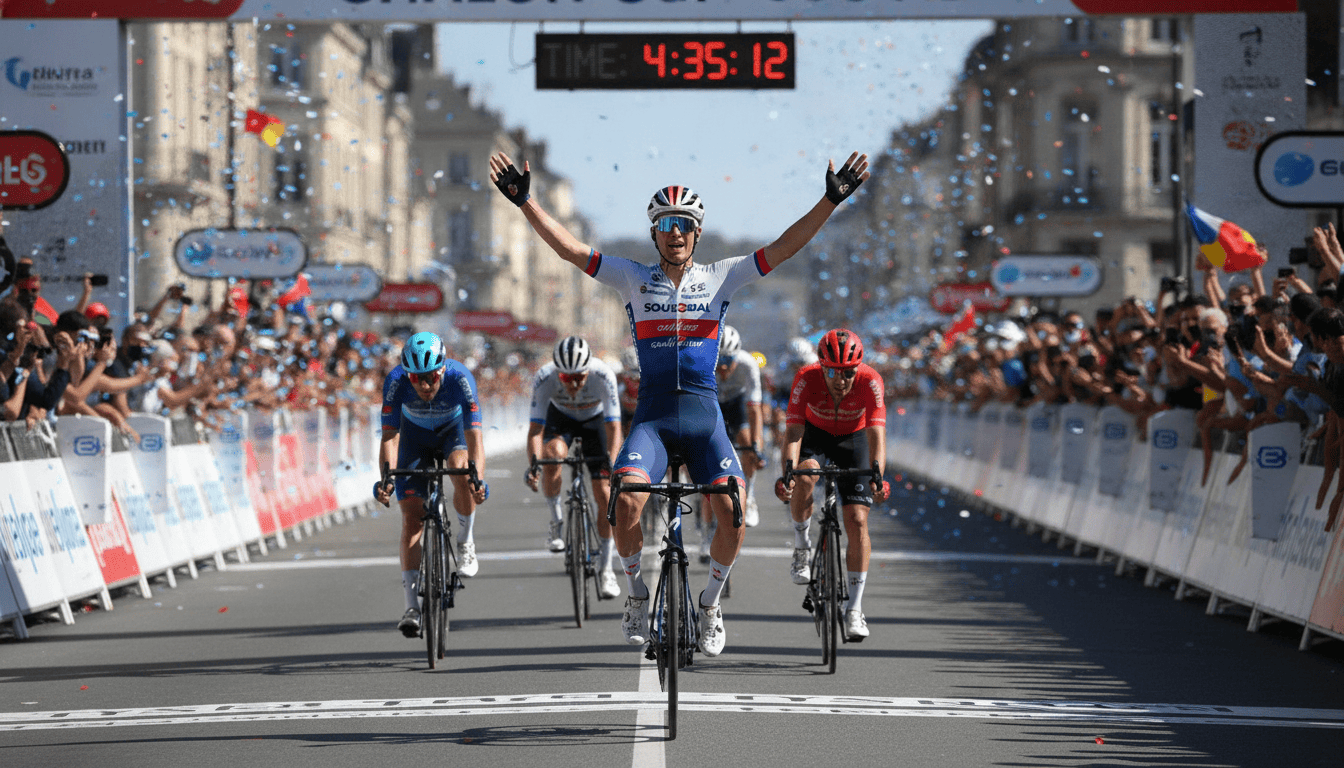
Tim Merlier sprints to third Tour de France stage win as crash mars finish in Chalon-sur-Saone
Tim Merlier takes his third stage at the Tour de France after a decisive bunch sprint in Chalon-sur-Saone, while a late mass crash injures several riders and Tadej Pogacar holds the Yellow Jersey.
Tim Merlier crossed the line first to win the 179.1 km twelfth stage into Chalon-sur-Saone, claiming his third stage victory of this Tour de France with a powerful mass sprint. The Belgian sprinter from Soudal Quick-Step left rivals behind in the final meters, further underlining his dominance in the flat finishes so far. The result reshuffles sprint narratives as the race approaches its final uphill tests.
Merlier Dominates Sprint to Claim Third Stage Win
Tim Merlier accelerated cleanly in the closing straight, outpacing Olav Kooij and Jasper Philipsen to secure the stage victory. The sprint played out from a large peloton after breakaway attempts were neutralized well before the finale. Merlier’s third win this year cements his status as the most prolific fast finisher in the race to date.
The podium featured Olav Kooij of Decathlon-CMA CGM in second and Jasper Philipsen of Alpecin-Premier Tech in third, both demonstrating strong form. Max Kanter, one of the German hopes in the sprint finishes, crossed in seventh place after being shuffled back in the hectic run-in. Teams will now reassess sprint plans as the Tour moves into mixed terrain.
Crash Near Finish Mars Sprint for Several Riders
Just behind Max Kanter a large pile-up unfolded in the closing sprint, sending multiple riders to the tarmac and causing immediate concern among teams and race staff. Reports from the scene indicated several competitors were hurt and required medical attention, forcing team medics into rapid response. The crash changed the composition of the final straight and disrupted some lead-out trains.
Kanter, who avoided the worst of the tumble, described losing many positions during the frenetic approach to the line and noted the difficulty of timing the sprint. Pascal Ackermann, who was close to the incident, reported ongoing shock after the fall, highlighting how quickly danger can appear in a high-speed bunch conclusion. Race organizers and team doctors will monitor injured riders’ conditions in the hours after the stage.
Pogacar Maintains Control of General Classification
Tadej Pogacar emerged from the stage without losing time to his main rivals, preserving the Yellow Jersey and overall lead. The four-time Tour winner from UAE Team Emirates now holds a 3 minute 36 second advantage over Jonas Vingegaard of Visma–Lease a Bike. With time gaps intact, Pogacar remains the rider to beat as the race approaches more selective terrain.
Florian Lipowitz of Red Bull–Bora–Hansgrohe occupies sixth place overall, several minutes down on the leader, showing the GC picture remains relatively stable for now. Teams defending podium positions will look to the upcoming stages to find openings, but for the moment Pogacar’s cushion offers tactical flexibility to UAE Team Emirates.
Implications for German Sprint Contenders and Teams
The outcome leaves German sprinters with limited opportunities, as Merlier’s consistent speed has dominated the bunch finishes that favored fast men. Max Kanter’s seventh place, coupled with the disruptive crash, suggests that the country’s hopes for a stage win in the remaining sprint opportunities have dimmed. Teams with sprint ambitions will need to adapt or seek success in breakaways.
Soudal Quick-Step’s continued success in sprints underscores the value of a reliable lead-out and a rider capable of timing the final burst. Other sprint-focused squads such as Alpecin-Premier Tech and Decathlon-CMA CGM will weigh how to protect their fast men when the course suits high-speed conclusions and when it starts to tilt uphill.
Route Preview: Longest Stage to Belfort Poses New Tests
The race moves on to a 205.8 km thirteenth stage to Belfort, the longest of this year’s Tour de France, featuring a third-category climb and the first-category Ballon d’Alsace. While the stage does not include the highest Alpine or Pyrenean passes, those climbs can still sap energy and offer a launching pad for breakaways. The length of the day will favor opportunists willing to commit early.
Breakaway groups will likely see their best chance of success on a day that combines distance with selective ascents rather than summit finishes. GC teams may choose to ride conservatively to preserve leaders for later, while riders outside the overall picture will chase glory and exposure. Weather and crosswinds could also shape tactics on the longest day.
Team and Rider Reactions After a Turbulent Finish
Soudal Quick-Step celebrated Merlier’s sprint prowess while acknowledging the fragile nature of bunch sprints, where danger can arrive in an instant. Rival teams praised the Belgian’s speed but noted that the closing chaos and the crash highlighted the ever-present risks in high-speed finales. Team directors emphasized rider safety as their immediate priority amid medical evaluations.
Sporting directors and medical staff will continue to assess the physical toll of today’s fall and how it influences team rosters for the coming stages. Meanwhile, sprinters who escaped serious harm must decide whether to contest the next opportunities or conserve energy for terrain that better suits them. The balance between ambition and caution will be central over the next days.
Tim Merlier’s third stage victory adds a significant chapter to this year’s sprint narrative, while the late crash serves as a stark reminder of the dangers inherent in mass sprints at the Tour de France.
