
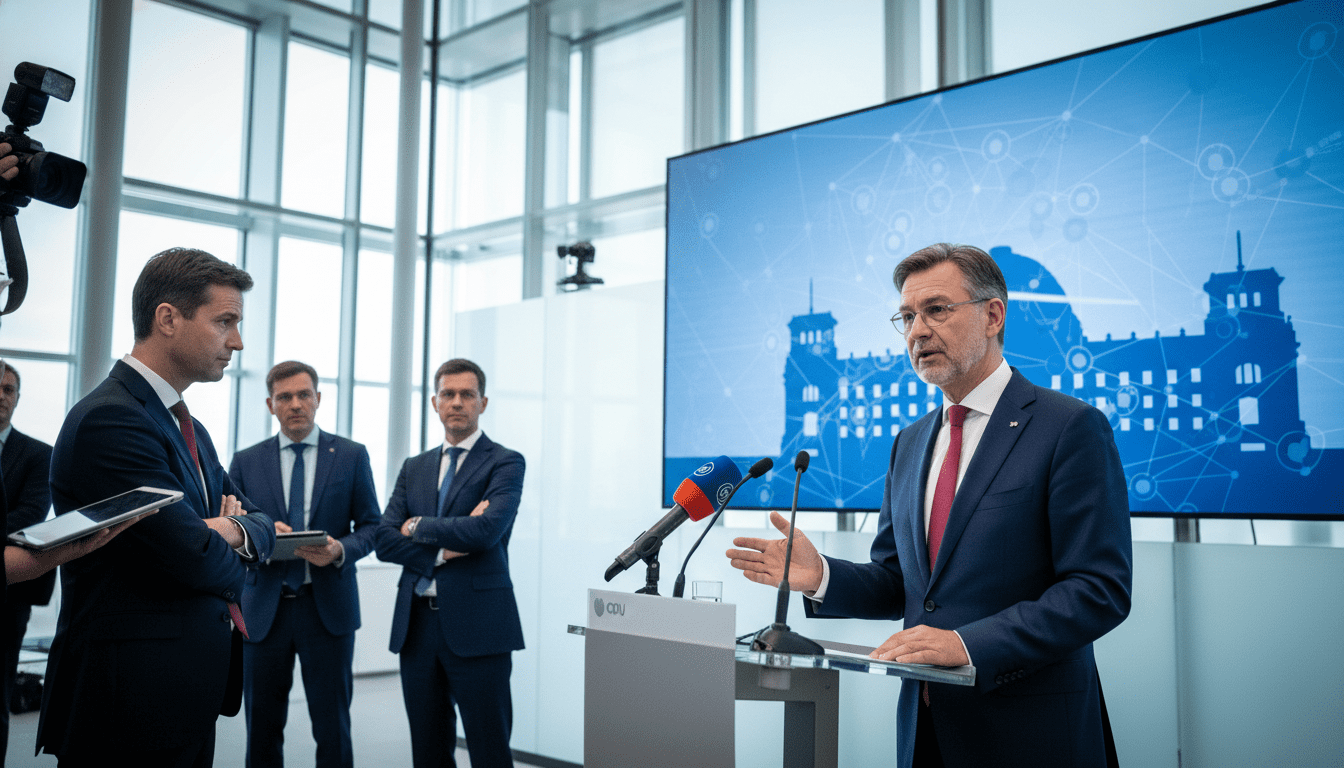
Germany’s bid for data center independence by 2030 confronts supply and cost realities
Germany’s pledge for data center independence by 2030 confronts chip shortages, high energy costs and EU red tape while US and Asian firms scale up rapidly.
Strong political declarations from Berlin and Paris have placed “data center independence” at the center of a new European debate over technology sovereignty. Chancellor Friedrich Merz recently expressed confidence that Germany could be independent of overseas suppliers for data center technology by 2030, a claim echoed in tone by other leaders in the region. Experts say the ambition highlights a tension between political will and structural limits in supply chains, energy markets and regulatory frameworks.
Merz’s 2030 data center pledge
Merz framed his statement as a strategic goal to reduce reliance on non-European suppliers for critical computing infrastructure. The pledge joins similar pronouncements from other European capitals that want more control over the hardware and software that underpin artificial intelligence and cloud services. Observers caution that declaring a target year is one thing; mobilizing the industrial capacity and capital to meet it within seven years is another.
Supply chain realities: chips, servers and software
The most immediate constraint is the global semiconductor and server market, where manufacturing and specialized design remain concentrated in Asia and the United States. Advanced processors and accelerator chips essential to high-performance data centers are produced largely in Taiwan, South Korea and by US-based firms, creating a dependency that is not easily severed. At the same time, sophisticated data center management software and systems integration come predominantly from American companies, meaning hardware independence alone would not deliver complete autonomy.
Energy costs and regulatory hurdles in Germany
Beyond components, Germany faces domestic headwinds that make rapid expansion of large-scale data centers difficult. Industrial electricity prices in Germany are among the highest in Europe, adding a persistent cost penalty for energy-intensive computing facilities. Planning and permitting processes in many German states and across EU jurisdictions can slow or block projects, creating further friction for operators that need speed and scale to remain competitive.
Global competition and capital flows
While European policymakers debate independence, global technology firms are accelerating investments in new, highly efficient data centers. Major US and Asian players have significant capital reserves and access to deep financial markets, allowing them to build next-generation facilities at pace. Those investments not only increase compute capacity but also set technical and operational standards that shape market expectations and make catching up more costly for late entrants.
Industrial policy options and political will in Brussels and Berlin
Achieving meaningful data center independence would require a coordinated industrial strategy that addresses chip fabrication, server manufacturing, software ecosystems and energy policy simultaneously. That implies large public investments, incentives for private-sector partnerships, streamlined permitting regimes and a focus on domestic or intra-European supply chains. Whether Brussels and Berlin are prepared to prioritize such measures and accept the fiscal and political trade-offs remains uncertain.
Risks of strategic overreach and misaligned expectations
Policymakers risk creating a gap between rhetoric and achievable outcomes if declarations of independence are not matched by realistic timelines and resource commitments. Overpromising on dates can encourage a “reality distortion” dynamic in which political statements outpace technical and economic feasibility. For industry partners and investors, clarity about priorities and realistic milestones will be essential to align planning and funding decisions.
Europe’s path to greater autonomy in data center technology is practicable in stages but will be costly and politically demanding. Incremental steps—targeted chip and server investments, regulatory reform to speed permitting, and coordinated energy policy to control operating costs—would reduce exposure over time without promising instant self-sufficiency. If the 2030 horizon is intended as a spur to action rather than a firm deadline, policymakers must back their claims with concrete programs and funding to avoid eroding credibility.
Ultimately, the debate over data center independence is as much about strategic priorities as it is about technical supply chains. Closing the gap between political ambition and market realities will require sustained effort from governments, industry and capital markets, and a willingness to confront the trade-offs inherent in reshaping a globally interdependent technology ecosystem.
