
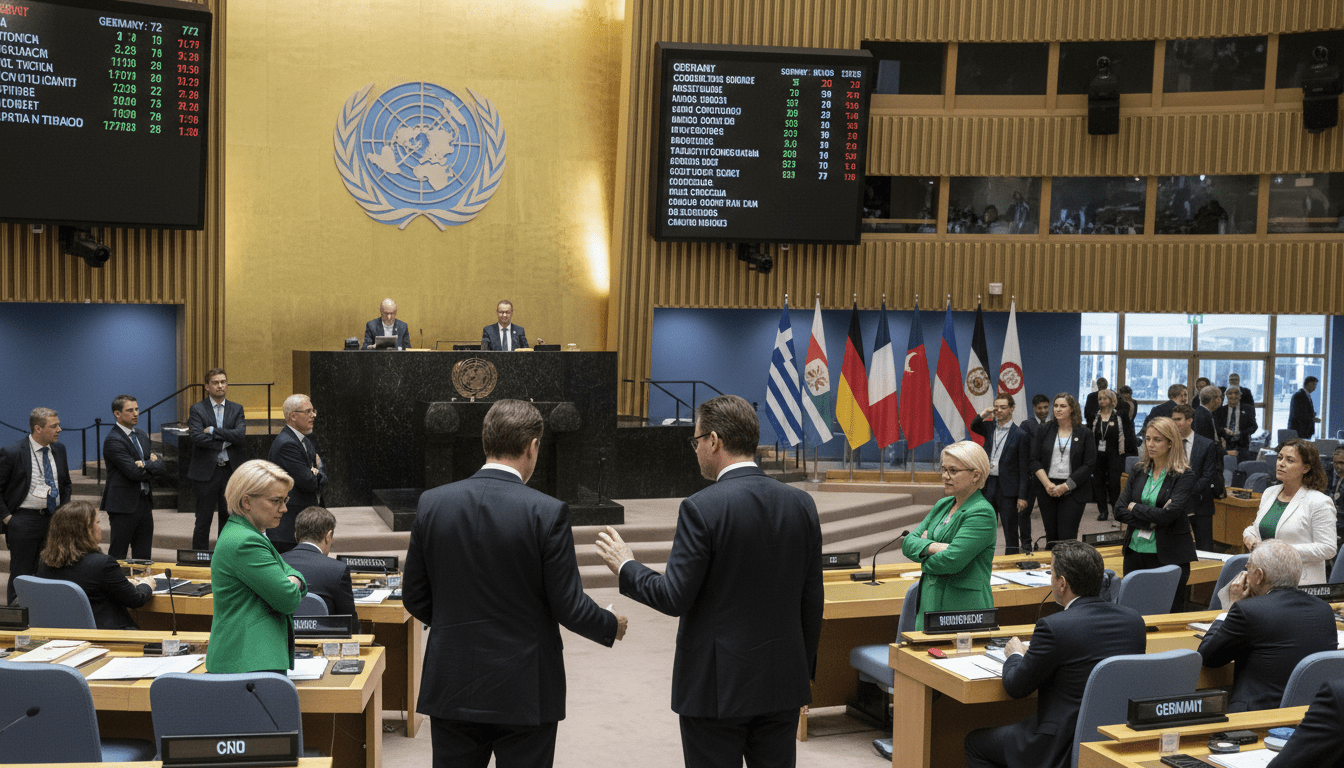
Germany’s Failed UN Security Council Bid Sparks Political Backlash
Germany’s failed UN Security Council bid for 2027–2028 drew criticism of the federal government and renewed debate over the country’s foreign policy direction.
Germany’s failed UN Security Council bid ended in a clear defeat at the UN General Assembly, where the country fell short of the two‑thirds threshold needed for a non‑permanent seat. With Austria and Portugal taking the two available Western European seats, Berlin did not secure the 127 votes required under the informal regional grouping rules. The result marks the first time Germany has lost such a bid after six previous successful memberships, most recently in 2019–2020.
Vote Outcome and Numbers
The vote was held among UN member states to allocate two non‑permanent seats from the Western European and Others Group for 2027 and 2028. Germany competed against Austria and Portugal; when three candidates contest two slots, a vote becomes necessary and Germany failed to amass the requisite two‑thirds majority. Observers noted the margin was decisive rather than marginal, signaling broader diplomatic shortfalls rather than the consequence of a tight ballot.
This defeat breaks a longstanding pattern of German presence on the Security Council and will deny Berlin a formal platform in the Council during the 2027–2028 term. UN diplomats said the distribution of votes reflected both regional dynamics and the effectiveness of the rival campaigns, which appeared to mobilize wider support across the General Assembly.
Greens and Left Criticize Federal Government
Opposition lawmakers from the Greens placed responsibility squarely on the federal government, arguing that the campaign lacked modern ideas and sustained diplomatic outreach. The Greens’ defence spokesperson said Chancellor Friedrich Merz and Foreign Minister Johann Wadephul had not promoted the candidacy energetically enough and pointed to policy cuts in development aid and a perceived lack of leadership on climate issues.
The Left party echoed these concerns and went further, framing the loss as evidence of double standards in Germany’s foreign policy. Party leaders argued that Berlin’s muted responses to perceived breaches of international law in several recent conflicts had eroded trust and damaged Germany’s standing among key UN partners.
Wadephul Rejects Personal Consequences
Foreign Minister Johann Wadephul described the outcome as a “bitter defeat” but rejected calls for personal accountability, saying he had nothing to reproach himself for. He attributed part of the failure to the timing of Germany’s application, which he said came after Austria and Portugal had already publicized their bids and had more momentum in the run‑up to the vote.
Wadephul also suggested that geopolitical factors, including concerted efforts by other states and possible Russian influence, had worked against Germany. He further asserted that Berlin’s strong support for Ukraine and a distinct stance on the Middle East, including close ties to Israel, may have cost votes in some quarters.
Merz Pledges Continued Multilateral Engagement
Chancellor Merz responded to the result by reaffirming Germany’s commitment to the United Nations and to multilateral diplomacy, stating that the outcome would not diminish Berlin’s engagement. He framed Germany as a “reliable pillar” of the rules‑based international order and emphasized ongoing cooperation with both Portugal and Austria in the UN system.
In his remarks, Merz sought to temper domestic criticism by highlighting shared European responsibilities at the UN and by calling for continued coordination. The chancellor’s comments were intended to reassure allies and underline that failure to win a seat would not translate into retreat from multilateral commitments.
Parliamentary Reactions and Calls for Policy Change
Voices across the Bundestag, including some within the governing coalition, urged reflection and concrete change. The CDU’s foreign policy spokesperson recommended earlier and closer coordination among European candidates to avoid splitting support in future ballots. Lawmakers warned that competing bids within the same regional grouping could diminish the bloc’s collective influence.
SPD figures demanded a firmer and more consistent stance on violations of international law, arguing that clearer criticism of abuses should not depend on political alignment. Party deputies said the result contained a message: Germany must be more consistent and outspoken when international norms are breached, regardless of the actors involved.
Diplomatic Consequences and Next Steps
Diplomats and analysts say Germany now faces a period of diplomatic repair if it hopes to restore momentum for future UN ambitions. That could include ramping up bilateral outreach, increasing visible leadership on climate and development issues, and reversing recent aid cuts that critics say have undermined Germany’s influence. European partners have also urged a more strategic approach to candidate coordination to prevent similar outcomes.
Some foreign policy experts note that losing the vote does not erase Germany’s networks or its capacity to influence multilateral debates, but it does remove a high‑visibility forum at a moment of intensifying global tensions. How quickly Berlin translates criticism into a coherent policy response will shape its international reputation ahead of any future Security Council campaigns.
The vote’s immediate political fallout is likely to focus domestic debate on the government’s priorities in international affairs, funding for development and climate diplomacy, and the timing and tactics of future candidacies for multilateral bodies.
