
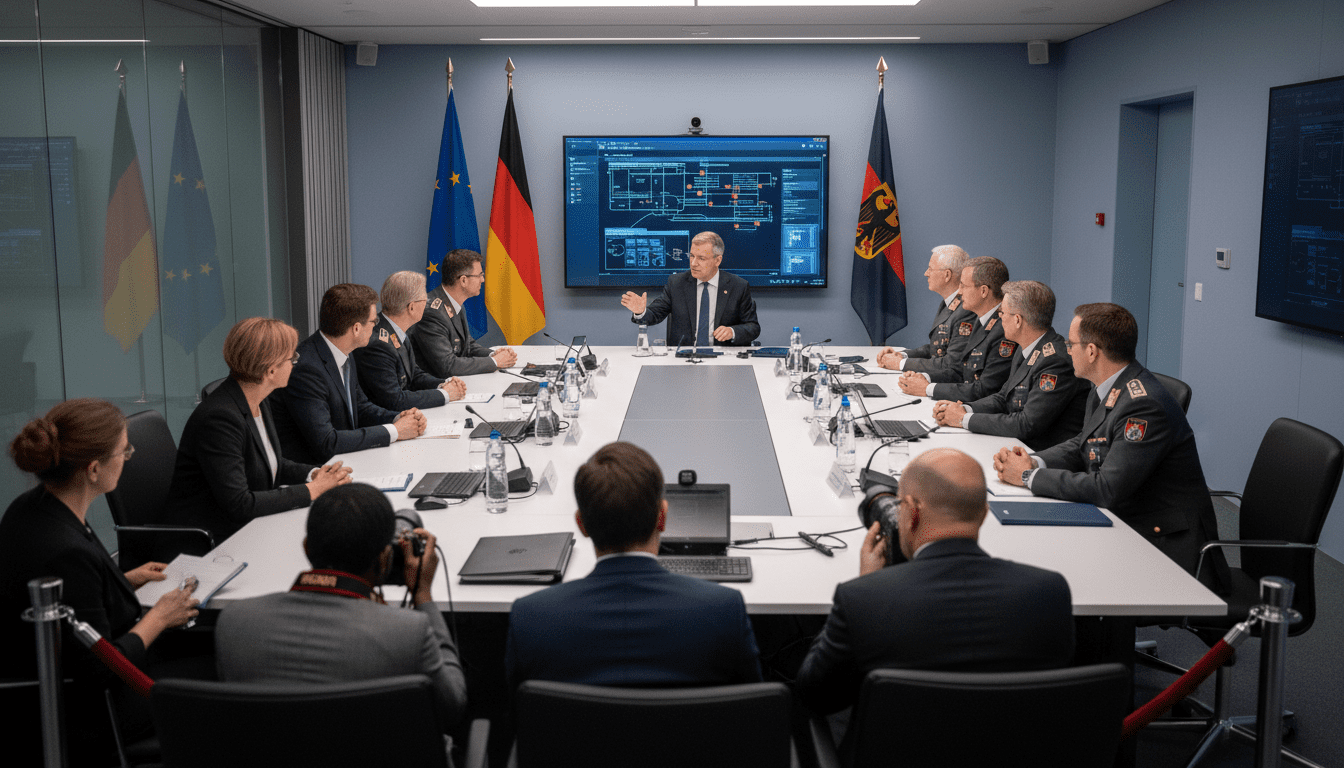
Bundeswehr ramps up Cyber and Information Space (CIR) to prioritize electronic warfare, AI and space
Bundeswehr expands Cyber and Information Space, prioritizing electronic warfare, AI and space surveillance while keeping sensitive data under national control.
Germany’s armed forces are intensifying the build-up of the Bundeswehr Cyber and Information Space (CIR), a cross-cutting service branch focused on electronic warfare, cyber defense, artificial intelligence and space capabilities. The CIR, now an independent element of the military structure, is being developed as a force multiplier that operates across ships, air platforms and ground units while keeping critical data under national control. Military leaders say the drive reflects a strategic shift: data, networks and the electromagnetic spectrum are now central to deterrence and defence planning.
CIR operates across traditional service lines
The Cyber and Information Space does not resemble conventional branches that possess distinct uniforms or platforms, but its footprint is present wherever digital systems are used. A sailor maintaining a satellite link on a frigate remains under the ship’s command, yet that task also follows technical standards and procedures set by CIR to ensure interoperability and resilience. Defence officials emphasize that CIR’s role is to set common rules, provide specialised tools and coordinate operations that span the army, navy and air force.
Inspector Thomas Daum frames the mission
Vice Admiral Thomas Daum, the inspector of the new branch, describes CIR as the military’s “nervous system” and stresses its integrative function across domains. Daum’s career spans operational sea service and academic training in computer science, a background he cites as shaping his insistence that information technology receive sustained institutional priority. He says the aim is to make CIR’s capabilities reliable and widely available rather than concentrated in tiny, ad hoc purchases tied to individual crises.
Cloud, AI and space investment underlined
Officials report large-scale investment plans that place cloud infrastructure, artificial intelligence and space-based sensing at the centre of future capabilities. A recent national space strategy earmarks substantial funding for satellite communications, space surveillance and cyber protections, and the Bundeswehr is building an in-house cloud to host analytics and machine-assisted decision tools. While international contractors lead commercial markets for data fusion and battlefield analytics, military leaders insist sensitive systems and datasets must remain subject to national control and security rules.
Electronic warfare elevated as a core task
Electronic warfare, known in German military parlance as Eloka, is a principal mission area of CIR because control of the electromagnetic spectrum affects communications, navigation and reconnaissance on both sides of a conflict. Tasks range from intercepting adversary communications and jamming radars to inhibiting drone command links. Defence officials argue that mastery of that spectrum is as decisive as traditional firepower, since data can be exploited as both a weapon and a vulnerability.
Shortfalls, procurement and a 2029 readiness target
The Bundeswehr acknowledges gaps in current operational capabilities that stem from years of crisis-driven, piecemeal procurement. Several systems in use today reportedly derive from older generations of hardware, prompting a push for rapid, scalable purchases of market-ready solutions to achieve an “operational minimum.” Senior military planners have set an objective to reach a baseline of warfighting readiness in the electronic and cyber domains by 2029, driven by assessments of evolving threats in Europe.
Civilian agencies retain first responsibility for many cyber incidents
Under current legal and institutional arrangements, civilian authorities remain the primary responders to many cyber incidents below the threshold of armed conflict, with agencies such as the federal police, the domestic intelligence service and the national cybersecurity agency charged with defensive and attribution tasks. Government officials have signalled a willingness to adopt more assertive measures against foreign attackers, including disruption of hostile infrastructure, but military countermeasures generally require a formal determination of defence status. Recent large-scale phishing operations that affected political communications underline the blurred boundary between criminal, hybrid and military threats.
International cooperation and learning are also central to CIR’s development, with senior officers engaging counterparts abroad to share lessons and improve interoperability. Defence planners warn that incremental, multi-year modernization timelines are no longer sufficient; the pace of technological change and the character of contemporary conflict have made rapid adaptation a strategic necessity.
The Bundeswehr’s Cyber and Information Space is being built as a force that both enables and protects operations across domains, balancing urgent procurement with concerns about data sovereignty and legal constraints on offensive action. Military leaders say scaling up personnel, equipment and doctrine for electronic warfare, AI-enabled analysis and space-based sensing is essential to deter and respond to the range of hybrid and conventional threats now facing European security.
