
Logistics firms build private charging hubs as electric trucks prove profitable
Logistics firms are investing in electric trucks and private charging hubs, driven by cost savings and high fuel prices despite shifting political support.
The owner of Spedition Rüdinger in Krautheim opened a “mega” charging hub in September 2025 as part of a wider push by transport companies to put electric trucks into regular service. Operators say the decision to adopt electric trucks is driven by operating economics and rising diesel costs rather than environmental ideology, and several firms are now installing their own depot chargers and fast points to support the transition.
Rüdinger unveils a depot-scale charging hub
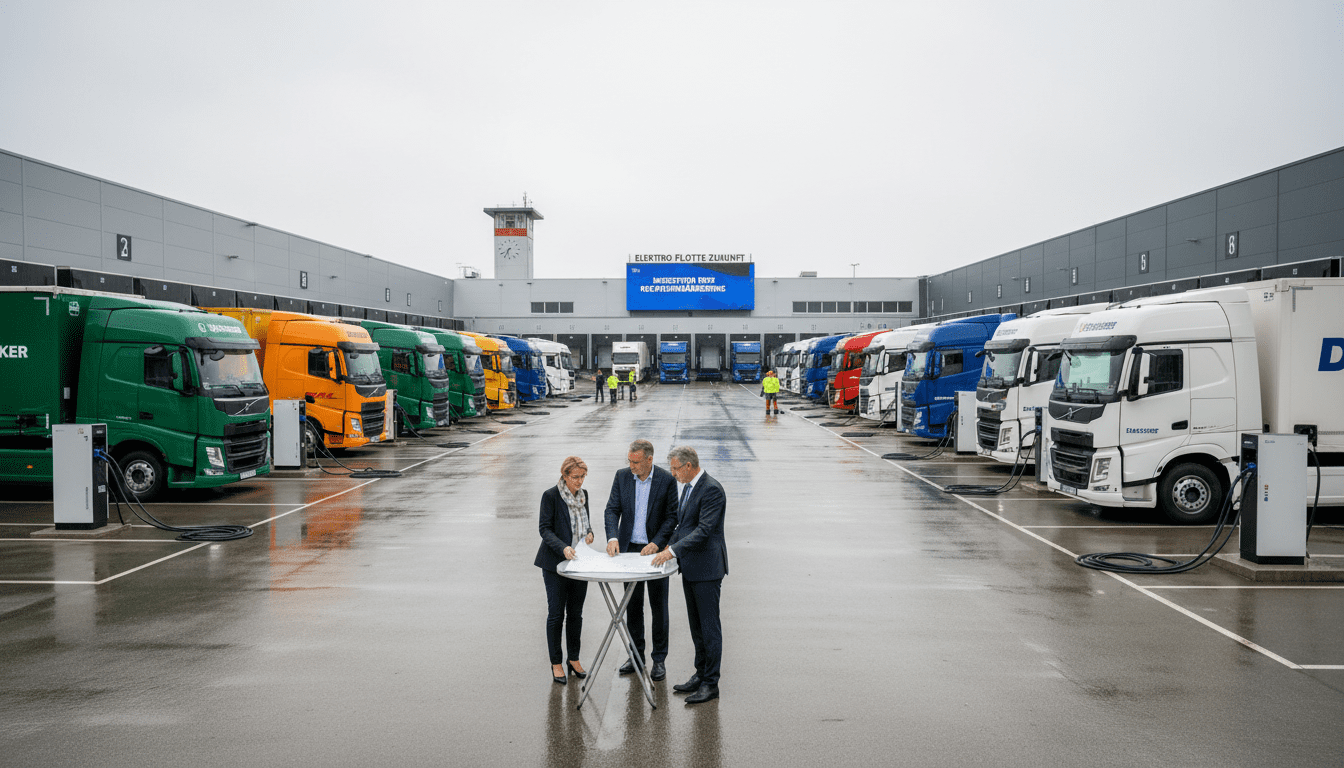
A vivid orange steel gantry spans the Rüdinger yard, its booms resembling oversized petrol-station vacuums that feed electricity to vehicles beneath. The installation, which Roland Rüdinger calls a “Mega-Ladepark,” can serve seven trucks simultaneously at the gantry while five additional fast chargers are mounted at ground level.
Rüdinger opened the facility in September 2025 and has already converted a slice of his fleet: 36 of the company’s 220 trucks run on electricity today. The owner, who describes himself as motivated by revenue rather than green credentials, framed the investment as pragmatic fleet management aimed at reducing fuel spend and downtime.
Cost calculus favors electrification for long-haul operators
High diesel prices and predictable electricity tariffs have shortened payback periods for many heavy-duty electrification projects, according to fleet managers. Companies that model total cost of ownership increasingly find electric trucks deliver lower operating costs over vehicle lifecycles even when purchase prices and depot upgrades are included.
The shift is not purely financial engineering: operators report operational gains from quieter vehicles, lower maintenance requirements and reduced exposure to volatile diesel markets. These advantages, logistics managers say, make electric trucks an attractive asset class for forward-looking fleets.
Major logistics companies invest in private charging networks
Some larger groups are responding by building their own charging ecosystems rather than relying solely on public infrastructure. Mosolf and other logistics operators have begun installing depot chargers and planning private charging corridors to secure access and minimize queuing risks for scheduled departures.
Owning charging infrastructure also allows firms to manage energy procurement and avoid dependence on third parties. In addition to grid-connected charging, several companies are exploring hybrid approaches — pairing battery charging with renewable generation, storage systems or fast-fuel alternatives to shore up operational resilience.
Political uncertainty has not halted commercial uptake
Industry executives note that recent policy shifts — including the suspension or rethinking of certain combustion-engine phase-outs and changes to subsidy programs — have introduced uncertainty for long-term planning. Despite those signals, investment decisions at many depots continue because operators prioritize immediate cost savings and supply-chain reliability.
Several logistics leaders are candid that political support would accelerate adoption, but they no longer see it as the sole driver. Capital allocations increasingly hinge on demonstrable returns at depot and route level, not on regulatory timelines.
Technical and operational challenges persist during rollout
Electrifying heavy-duty fleets requires significant depot adaptation, from high-capacity grid connections to upgraded parking and energy management systems. Charging a truck fleet at scale also demands careful scheduling to avoid peak demand charges and ensure vehicles are ready for afternoon or early-morning departures.
Range limitations and charging times remain constraints on some long-haul routes, pushing companies to use a mixed-fleet approach while battery technology and charging speeds improve. Manufacturers and fleet operators are running pilots to refine route planning, charging windows and driver workflows before committing to full replacements.
Alternative fuels and mixed strategies keep options open
Alongside battery-electric trucks, logistics companies are evaluating alternative fuels such as HVO, synthetic diesel, and hydrogen for specific use cases. These options are being considered for routes where charging infrastructure is impractical or where rapid refuelling is essential for tight schedules.
Many operators expect a heterogeneous future: electric trucks for structured, return-to-base routes; biofuels or e-fuels for long-distance shuttles; and hydrogen for specific heavy-duty segments. That pragmatic mix allows firms to lower carbon intensity while maintaining service levels.
The commercial momentum behind electric trucks is visible at depot level and in boardroom budgets alike, driven by measurable cost benefits and growing operator confidence. As battery technology, grid connections and private charging networks expand, fleet managers expect electrification to become an increasingly standard element of logistics planning even amid political shifts.
